Sometime in the last three weeks, without a single formal proceeding against him, the Chief Justice of India stopped being able to graduate students.
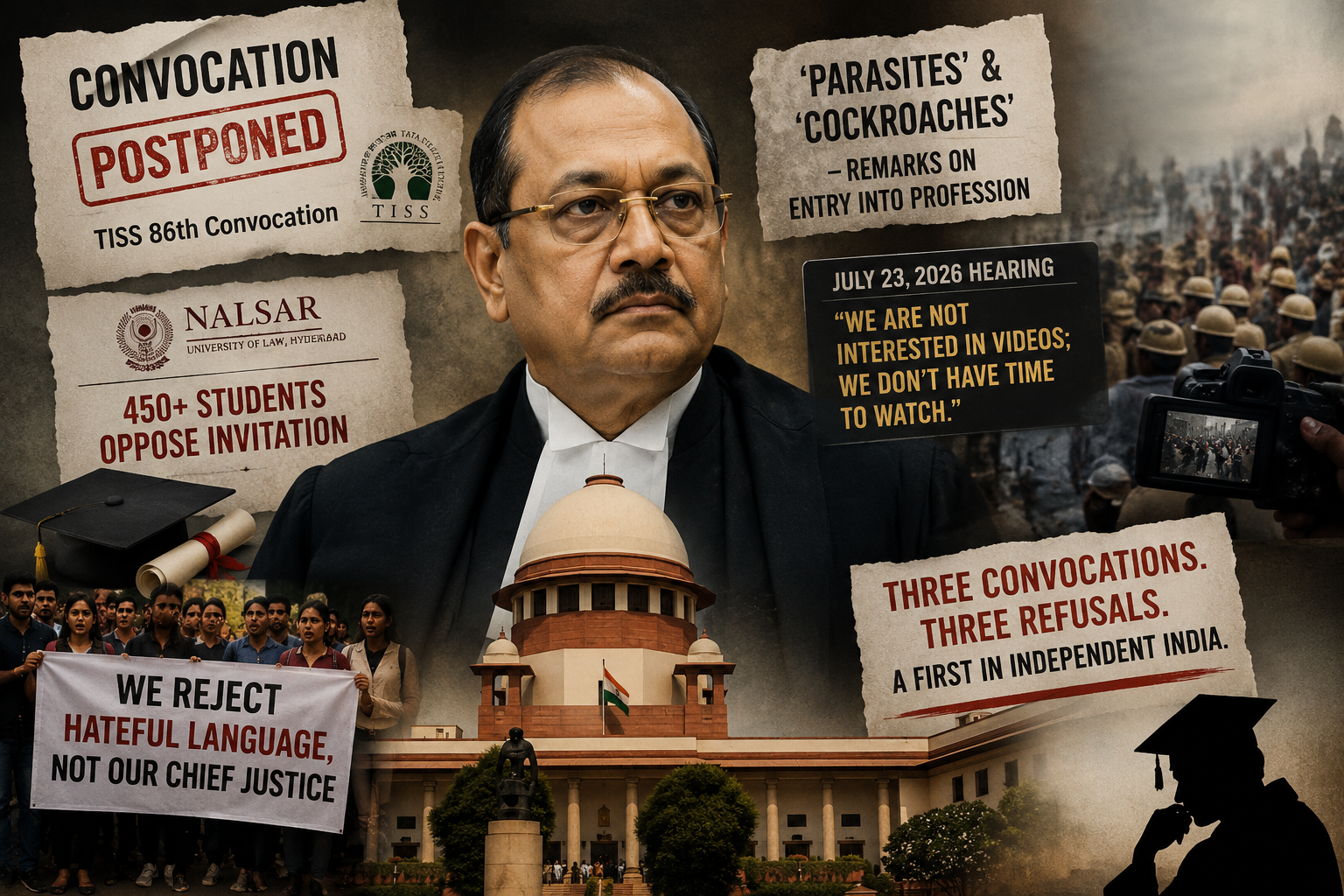
The Tata Institute of Social Sciences postponed its 86th convocation less than two days before it was to be held, citing “unforeseen circumstances” while its own staff privately acknowledged fears of protest around the Chief Justice’s presence. At the National Academy of Legal Studies and Research in Hyderabad, more than 450 members of the outgoing 2026 batch — future lawyers, the profession’s own next generation — wrote to their Vice-Chancellor asking the university not to invite Justice Surya Kant as chief guest at all. Their letter did not object to the office of the Chief Justice. It objected to the man occupying it: to his having called people “parasites” and “cockroaches” while discussing entry into the professions, and to a hearing on July 23, 2026, in which he is reported to have declined to view video evidence of alleged police violence against protestors at Jantar Mantar with the words, “we are not interested in videos; we don’t have time to watch.” Three convocations in three weeks — contested, declined, or abruptly deferred. In the history of independent India, no sitting Chief Justice has faced this before.
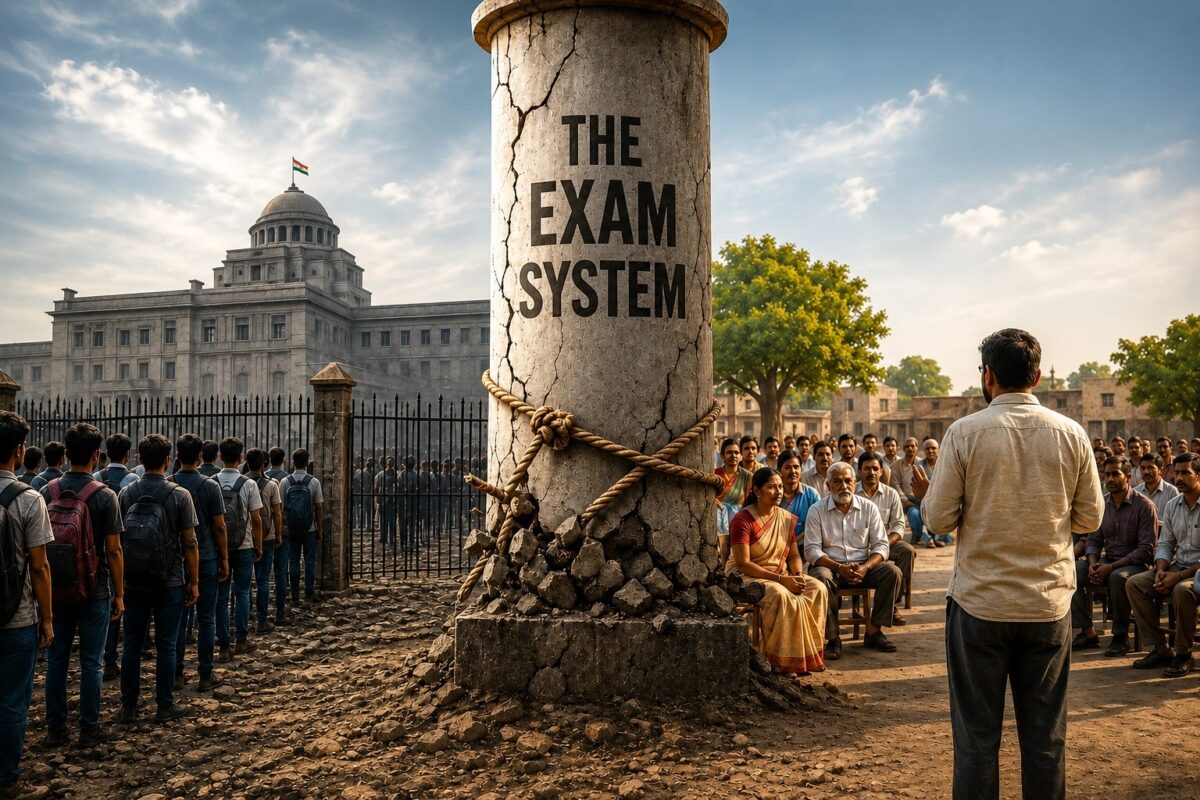
It would be a mistake to read this as a single scandal. It is the visible edge of something structural: the last institution built to survive the failure of every other institution has itself begun to fail, and the first people to say so in public are the ones being trained to succeed it.
Why the judiciary, and why this is different
Every other organ of Indian democracy was built to be contestable. Parliament and the executive are won and lost at the ballot box; statutory bodies — the Election Commission, the agencies that police campaign finance — exist by ordinary legislation and can be reshaped by whichever majority currently holds power, as the last decade’s history of electoral bonds, FCRA amendments, and enforcement-agency pressure on opposition-adjacent civil society has shown in granular detail. The judiciary was designed differently. Kesavananda Bharati’s basic structure doctrine exists precisely because the Constituent Assembly, and later the Court itself, refused to trust even a sovereign Parliament to police its own limits — the judiciary was installed as the one organ explicitly insulated from majoritarian capture, empowered to strike down even a constitutional amendment. It is not, in Dicey’s original sense, simply the enforcer of “no punishment except for breach of law established before ordinary courts.” In the Indian constitutional order it is something more specific: the backstop trustee, the guardian nobody elected and nobody can vote out, whose entire legitimacy rests on being the one actor in the system that does not need electoral accountability because it was never supposed to have private interests to be captured in the first place.
When every other institution erodes “mainly by their weakness,” that weakness is often a Design Feature working exactly as designed — statutory bodies were always going to bend toward whoever controls the legislature that created them. The judiciary’s weakness, if it is happening, is a Design Failure: the one lock the constitution installed specifically so it would not need to be re-won every election cycle has started to give.
The grammar of consent, corrected
There is a temptation, watching this unfold, to reach for a grand theory of ruptured collective identity — to say that when a “people” fractures into distinctions, the original consent to be governed together simply lapses. That temptation should be resisted, and not only because it happens to be the logical form separatist movements have always used. It is also simply the wrong diagnosis. A society is not a single undifferentiated will that shatters into faction; plurality is the baseline condition of any polity large enough to be free, not a fall from a prior unity that never existed. Locke’s actual account of political obligation assumed exactly this — that individuals consent not to a promise of homogeneous interest but to be governed by a trustee bound to hold power impartially between competing, permanently diverse interests. What dissolves obligation, on this account, is not diversity itself but breach of trust: the moment the trustee stops holding the scales evenly and becomes an interested party favoring one faction against another.
That is the sharper and more defensible way to describe what a dismissed video and a “we don’t have time” amounts to. It is not evidence that Indian society has fractured past the point of governability. It is evidence that the fiduciary the constitution appointed to arbitrate between citizen and state, precisely in the moments when that arbitration is hardest, declined to arbitrate at all — and did so in a way that inverts equality before law rather than honoring it. Equality before law is not only qualitative — the same rule regardless of rank — but quantitative: the same rule regardless of how many claimants bring it. A single petitioner alleging one act of police violence would, in the ordinary run of things, expect the video to be watched. A crowd alleging the same violence, multiplied, should not see its claim become easier to wave away simply because it arrived at scale; if anything numbers should make the injury harder to dismiss, since it is the same injury repeated rather than a different, lesser category of harm. Indian constitutional doctrine already has the machinery to test this — the proportionality standard elaborated in Puttaswamy requires a legitimate aim, a rational nexus, necessity, and a final balancing exercise before any departure from equal treatment can be justified by an appeal to public order. What the July 23 hearing did not do, on the reporting available, is run that test. It substituted logistical impatience for it.
None of this requires a theory of an “original public will” that fragmentation then betrayed. What it requires, and what Buchanan and Tullock’s calculus of consent supplies with more precision than any metaphysics of collective identity, is the observation that citizens accept majority rule — accept, in effect, the risk of losing any particular vote — because the majority that wins today is expected to be a floating one: not permanent, subject to future defection and re-formation, so that today’s loser has a rational expectation of being tomorrow’s winner. The entire actuarial logic of democratic consent rests on that alternation continuing to function. What converts a floating majority into a fixed one — starved opposition financing, enforcement-agency pressure on rival coalitions, the funding chokehold on the civil-society ecosystem that would otherwise organize dissent — is not a metaphysical rupture of collective will. It is an engineering problem, and it has an engineer. The judiciary’s proper constitutional role in this frame is narrower than arbitrating some pre-political common good, and more defensible: it exists to guard the specific conditions that keep a majority floating — free assembly, a free press, the right to protest — because protest is the most direct mechanism by which a majority is ever actually dislodged. A court that declines to examine video evidence of police violence against protesters is not merely failing one case. It is declining to protect the one channel through which the floating-majority mechanism renews itself.
Not the last straw, but the second lock to fail
It is tempting to read Justice Surya Kant’s convocation crisis as the final domino in a long chain of institutional collapse — parties, media, statutory bodies, and now, at last, the courts. That framing understates what has actually happened, because it implies a first fall. India’s judiciary has been here before, and the comparison is instructive precisely because of how differently the capture was executed.
In 1973, Indira Gandhi’s government superseded three senior judges — Shelat, Grover, and Hegde, each of whom had ruled against the government’s position in Kesavananda — to install A.N. Ray as Chief Justice. Two years later, after the Allahabad High Court found her guilty of electoral malpractice (over charges like height of her podium) and disqualified her from office, and after the Supreme Court’s vacation judge granted only a conditional, not absolute, stay, she did not attempt to corrupt the judges hearing her case. She appealed through the ordinary process and accepted its interim terms; only once the verdict stood did she reach outside the judicial process entirely, declaring Emergency within thirteen days and pushing a constitutional amendment to retroactively wall off the Prime Minister’s election from judicial review. That sequence is capture after the fact and in public: visible, dated, immediately legible as an assault, and for exactly that reason it generated its own resistance — Justice H.R. Khanna’s lone dissent in ADM Jabalpur, his resignation after being passed over for the chief justiceship, and eventually a Bar and a public that organized around the Emergency as a defined and datable aberration to be corrected.
What the Misra-Gogoi-Kant sequence describes is a different mode of capture, and a harder one to fight because it offers no equivalent rallying point. Dipak Misra’s exposure was not a proven personal bribe; it was that as Chief Justice he assigned the medical-college bribery scandal — a case in which a CBI FIR alleged a conspiracy to bribe “apex court judges” — to a bench of his own choosing, and refused to recuse even after being told he was an interested party, protecting the institution’s own exposure rather than the litigants’ rights. Surya Kant’s record is a different category still: a documented complaint trail, still formally unresolved, alleging undervalued property dealings and bribes for bail, that sat with the collegium for over six years while he continued sitting as a judge — and was still unresolved when he was elevated to a High Court chief justiceship, and again when he reached the Supreme Court. The collegium possessed this information at every stage. It did not investigate. It promoted anyway, three times.
This is capture by discretion rather than capture by decree, and it is more dangerous for exactly the reason it is quieter. The Emergency gave the country an Article 352 to organize against and eventually repeal. A government that instead waits patiently for a compromised judge to rise through an internal process that declines, on its own initiative, to examine the file it holds never has to seize anything visibly. There is no proclamation to protest. There is only a graduating class, on their own initiative, noticing what the institution meant to protect them chose not to open.
The men who would not be dwarfed, and what happened to them
An office can outgrow the men who occupy it. A perfectly decent individual can still be dwarfed by an institution whose informal survival rules — do not investigate your own, do not recuse from cases touching your patrons, accept the post-retirement sinecure as the ordinary reward for compliance — were set long before he arrived and will outlast his departure. This is why the crisis cannot be read as limited to the current bench, or resolved by waiting for either a morally exceptional judge or a benevolent executive to appear. The institution has already run both experiments, and both results are on the record.
The one moment the judiciary attempted collective self-defense confirms both lessons at once. On January 12, 2018, the four senior-most judges of the Supreme Court — Chelameswar, Gogoi, Lokur, and Kurian Joseph — broke with all precedent and held a press conference against their own sitting Chief Justice, Dipak Misra, warning that unless the institution was preserved, “democracy will not survive.” It was the correct diagnosis, delivered six years early, by people with everything to lose. It also changed almost nothing durable. Chelameswar explicitly rejected impeachment in favor of internal reform — a consultation process on case allocation, to check the Chief Justice’s unilateral “master of the roster” power, which is itself the precise mechanism that makes internal dissent so costly, since the CJI alone decides which judge hears which case and can quietly punish any colleague who steps out of line. A year later the only change that had stuck was that the roster became public; it is still drawn up unilaterally. And within two years, Ranjan Gogoi — one of the four judges who had staged the revolt in the name of institutional integrity — was himself the subject of a sexual harassment complaint, cleared through an in-house process he effectively presided over, and took a Rajya Sabha seat from the government within six months of retirement, a nomination the legal profession openly called quid pro quo for a pattern of deference that included the Ayodhya verdict and a slow-walked set of Kashmir habeas petitions. Whether that capture arrived through vulnerability or through ordinary reward-seeking is, in the end, a secondary question. What matters is that the very man who led the institution’s one attempt at collective self-correction became, within a single tenure, a data point for the failure of exactly that correction. Individual courage was tested here, publicly, at the highest possible level, and it did not hold past one tenure without something external to sustain it.
What redemption actually requires
The reason individual virtue keeps failing to fix this is not a moral failing in any particular judge. It is a structural feature of any organization staffed by self-interested actors — which is to say, any organization at all. If men can be expected, as economic agents, to maximize their own interest, there is no reason to expect the men who staff an institution to maximize the institution’s interest over their own by default. The traditional economic answer to this — monitoring, bonding, contractual constraint — runs into the same wall constitutional drafting always runs into: no contract can be written in 1950 that specifies, in advance, what a bench should do about a viral video of police violence against student protestors in 2026. What fills that gap, in the modern economic theory of organizations, is culture: not sentiment, but an equilibrium-selection device. An institution demonstrates, through how it resolves the cases nobody wrote a rule for in advance, what it will do next time — and members and the public alike infer future behavior from that track record rather than from any contract. Culture is what a court has instead of a rule for every case. Philip Selznick’s distinction sharpens this further: a mere organization is a replaceable technical instrument; an institution is one “infused with value” beyond its technical function, one whose loss the public would actually feel. The Supreme Court’s claim to being sanctum sanctorum rests entirely on the second kind of standing. The moment it becomes indistinguishable from a competent dispute-processing bureaucracy that happens to wear robes, it has lost the thing that made deference to it rational to begin with.
This is also why a declaration of renewed values will not do the work the moment requires. Cheap talk does not move belief. What moves belief, in the reputation literature that gives Kreps’s account its teeth, is a costly, irreversible, public act — something an institution merely posturing at reform would not bear the cost of doing. Reopening the collegium’s own unexamined files. Publishing the Memorandum of Procedure it has resisted disclosing for years. Actually engaging with the Jantar Mantar evidence it previously declined to watch. Each of these is expensive precisely because it exposes the institution to scrutiny it has spent a decade avoiding — and that expense is what makes it credible where a speech would not be.
The pivot, and what it is not
It is tempting to end here with an appeal to Justice Surya Kant personally — to say the fate of the institution now rests on his individual redemption. That framing should be resisted, for the same reason the earlier appeal to moral exceptionalism had to be resisted: no single man’s virtue completes a process that Kreps’s own framework says can only be built through a track record, repeated over time, reinforced by structures that survive any one tenure. What is true, and narrower, is that he is positioned to supply the founding signal such a track record would need to begin — and that his own history makes him, perversely, the most credible possible messenger for it. A judge with a clean record who reopens his file proves little. A judge who has carried an unresolved allegation since 2012, who was elevated three times without the collegium examining it, and who chooses now to answer it rather than continue outrunning it, would be bearing a cost no untainted colleague could match — and it is exactly that cost that would make the signal mean something.
He does not have to do this alone, and the record of the last decade suggests he cannot be relied upon to do it alone even if he wished to. What is different this time, and what makes the framing of “pivot” rather than “verdict” appropriate, is that a constituency now exists that did not exist for Khanna in 1976 or for the four dissenting judges in 2018: 450 law students and an entire postponed convocation, publicly and durably on record as withholding legitimacy from compromised judicial authority. Khanna’s dissent was absorbed quietly and took decades to become the celebrated one rather than the career-ending one, because no organized public was watching closely enough, for long enough, to make the cost of ignoring it durable. The 2018 press conference decayed within a single CJI’s tenure for the same reason — the shock landed and then had nothing external to sustain it. The students refusing their own degree ceremony are not asking Suryakant to be virtuous. They are supplying, from outside the institution and at far lower personal risk than any sitting judge could bear, the exact condition that was missing both times before: a public that will notice, and reward, the difference between a costly signal and a speech.
Whether the judiciary pulls itself up from this depends on whether that noticing outlasts the news cycle the way it did not in 2018 — and on whether Suryakant, and the collegium behind him, understand that the ignominy he is now synonymous with is not a personal verdict on one man’s career, but the first moment in India’s constitutional history that the institution’s own future custodians have said, in public and on the record, that they can see the file the institution meant to keep closed. The court cannot outrun that. It can only decide whether to open the file itself, or wait for someone else to.