In 2022, at Harvard, Rahul Gandhi delivered a precise diagnosis of the ruling dispensation. He observed that if the Prime Minister were to sit down with God, he would begin explaining how to run the world.
This, Gandhi said, was the purest expression of mediocrity: a mind of limited reach that nonetheless claims total mastery, ready to lecture even the divine. The remark captured an early stage of a deeper pathology.
Mediocrity at the apex of power is never stable. It is insecure. Sensing its own insufficiency, it grows paranoid. It begins to weave conspiracy theories to explain every resistance, treats disagreement as existential threat, and responds with calculated cruelty to protect its position.
The system under such leadership becomes anxious, punitive, and conspiratorial.
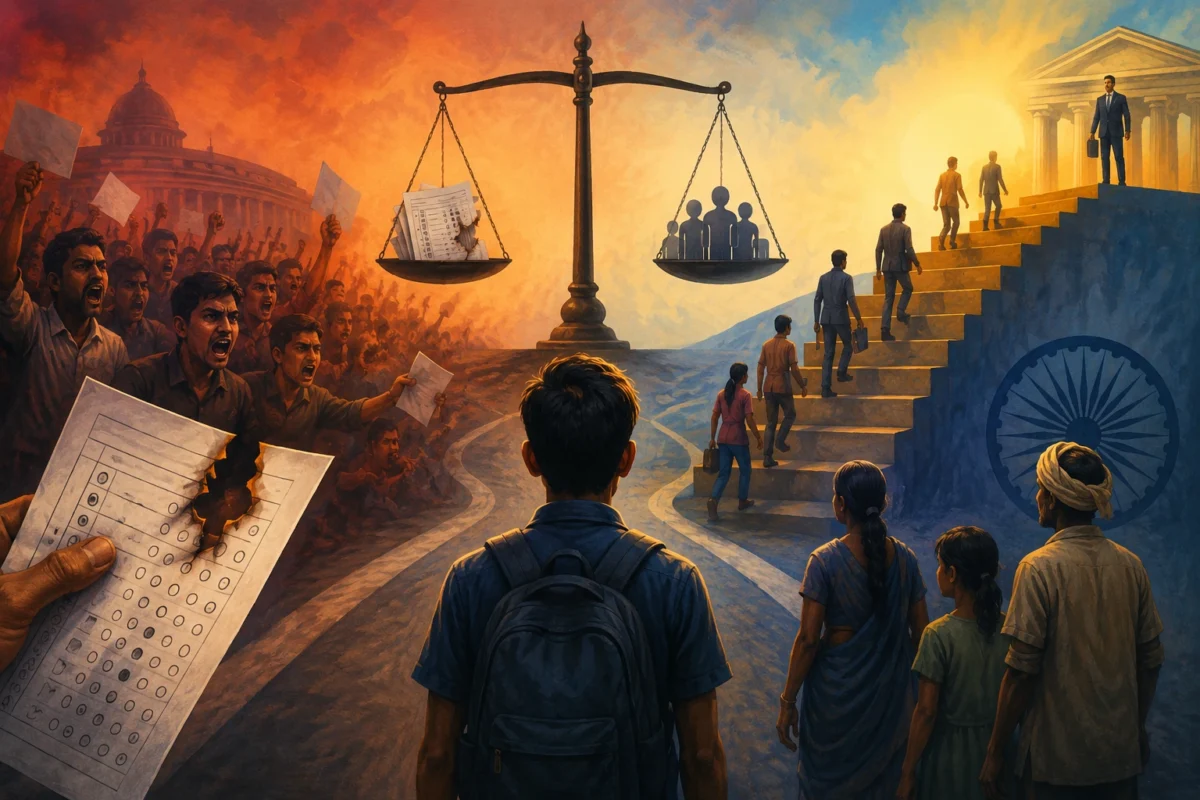
Four years later, in the Lok Sabha on 29 July 2026, that diagnosis reached its logical culmination. During the debate on the anti-paper-leak bill, Rahul Gandhi recounted a conversation with an eighteen-year-old student who had been part of the nationwide protests. She divided people into three categories.
The first is the student: open-minded, open-hearted, conscious of the limits of her knowledge, and therefore willing to learn.
The second is the idiot: absolutely convinced that he knows everything, certain that knowledge emerges solely from within himself, and unwilling to listen to anyone.
The third is the andhbhakt: the person who is absolutely convinced that this idiot is God. The progression is exact and deliberate.
What began as discussable mediocrity has hardened into closed idiocy. The idiot no longer requires information from others.
He deems the rest of society incapable of understanding him. Communication becomes one-way or unnecessary.
The earlier paranoia gradually coats itself in an impervious blanket of arrogance.By the time this stage arrives, ordinary citizens have already learnt to keep their distance from the centre of power.
There is no point in attempting to endear oneself to a leadership that neither hears nor values external counsel.
The real danger, however, does not reside solely in the figure at the top. It resides in the religioid authority exercised by the andhbhakt cohort.
These followers do not merely offer political support. They function as a priesthood. They enforce a rigid code of conduct, police the boundaries of permissible speech, and extract social and political rent for their priestly services.
Their unshakeable belief that the leader is God supplies the moral and psychological impunity that allows the system to act brazenly against those labelled dissenters or infidels.
From this ontological construct the leader derives both religious authority and the freedom to move without the ordinary constraints of democratic accountability.
That construct has now been destroyed. The youth protests that erupted over successive examination paper leaks—especially the NEET irregularities—produced more than demands for administrative accountability.
They produced a sustained wave of raw, casual, and widely circulated expletives directed at the Prime Minister. Many of these abuses specifically targeted his late mother.
In doing so, the protesters performed a decisive ontological act.
By invoking the most intimate biological fact—that the leader was born of a womb and that the same lineage could be subjected to the coarsest street language—they affirmed his mortal, biological status.
The carefully cultivated image of non-biological exceptionalism, of renunciation and transcendence, collapsed under the weight of ordinary human invective.
This was not the work of fringe elements. It was the voice of a large, predominantly apolitical body of students, many of whom had no prior party loyalty.
When a figure elevated to divine status can be casually and repeatedly abused in the language of the street by young people who claim no political ownership, the god is destroyed.
The andhbhakt is plunged into ontological crisis. The deity from whom he drew authority and for whom he collected rent has been publicly profaned.
The priesthood loses its object of worship and therefore its justification. The code of enforced reverence becomes unenforceable.
Set against this rupture, the resignation of Education Minister Dharmendra Pradhan on 25 July 2026 is historically insignificant.
Ministerial sacrifices under protest pressure are routine transactions of politics. A new face is installed, the bureaucratic machinery continues, and the episode fades into the footnotes of parliamentary records.
The expletives, by contrast, leave permanent marks on the Indian polity. They have desacralised the highest office in a manner that no cabinet reshuffle can reverse.
They have demonstrated that the aura of godliness was always contingent, sustained only by collective suspension of disbelief and by the active enforcement of the priestly class.
The result is liberation. Once the religioid authority is terminated, the leader can no longer act with the same unshakeable conviction against those who disagree.
The moral and psychological shield that permitted impunity is gone. Power remains, but it is now ordinary political power, stripped of transcendental pretension. Society is freed from the obligation to treat one mortal as beyond criticism, beyond ordinary human frailty, beyond the reach of the most basic and vulgar forms of speech.
That freedom, independent of which party occupies office, constitutes a genuine expansion of the democratic space.The students who hurled those words did more than express frustration over leaked examination papers. They performed an act of collective iconoclasm.
In reducing the god to a biological man born of a mother, they terminated the priesthood that had long policed Indian public life.
History will record the ministerial resignation as a minor administrative adjustment. It will record the expletives as the moment the sacralised order finally cracked.
From the mediocrity diagnosed at Harvard to the idiocy exposed in the Lok Sabha, the arc is complete. The god is gone.