A Rebuttal to Pratap Bhanu Mehta (Indian Academician and Former Vice chancellor Ashoka University)
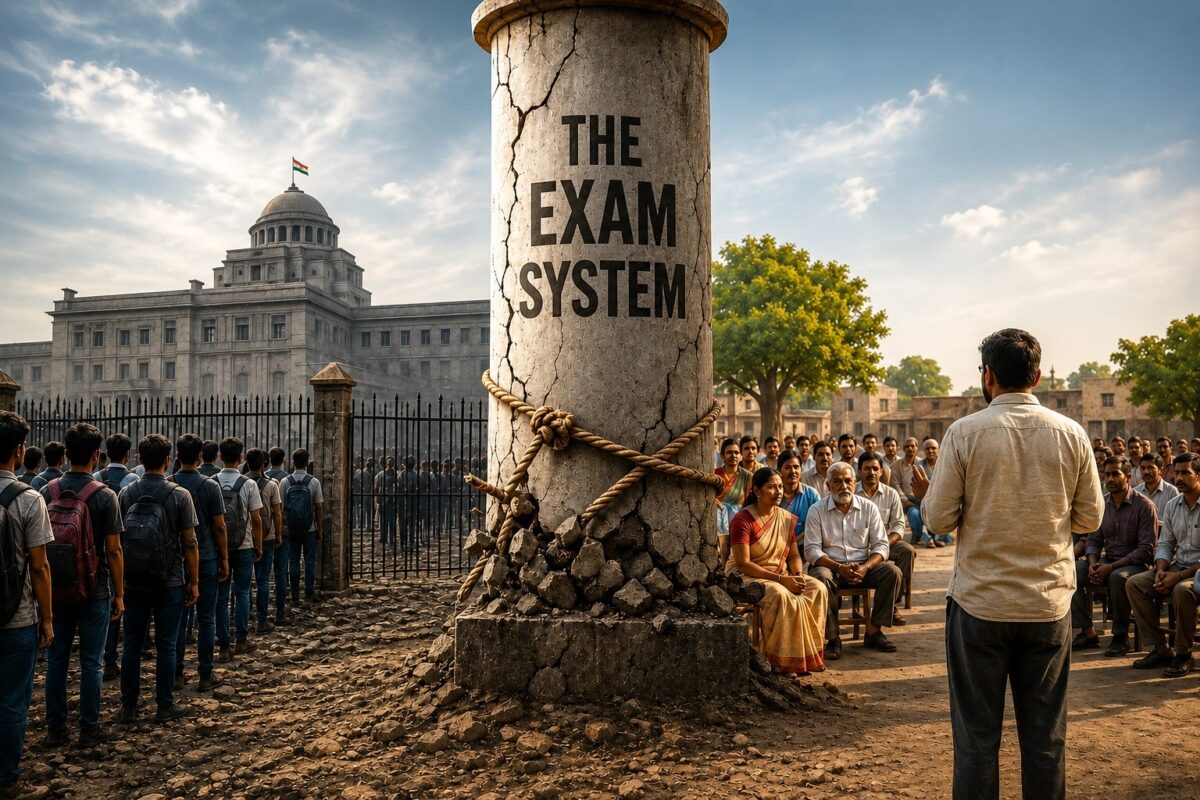
Pratap Bhanu Mehta’s recent warning that a collapse of trust in the UPSC exam would be “more than a revolution” and could “make the Indian state collapse” has been widely shared and rightly debated. His argument is elegant: the exam system is the last remaining pillar of procedural fairness in a state that offers little else. If that pillar crumbles, so does the state’s legitimacy.
But elegance is not truth. And Mehta’s argument, for all its sophistication, is built on a foundation that his own earlier work exposed as hollow.
The Burden of Contradiction
In 2019, Mehta wrote eloquently about “The Burden of Meritocracy.” He argued that the exam system does not produce public servants—it produces entitled bureaucrats who see their positions as rewards earned, not responsibilities owed. He noted that meritocracy cannot be shamed, because its procedural fairness immunizes it against deeper critique. He understood that the system severs individuals from their communities and socializes them into loyalty to the state, not to the people.
Now, in 2024, he asks us to defend this very system as the bedrock of state legitimacy.
The two arguments are not contradictory—they are tragic. But tragedy does not make them right. What Mehta is asking us to do is sanctify the very machinery that produces the rot he diagnosed. He is asking us to protect the alibi, not to confront the crime.
Fairness Is Not Justice
The exam system offers one thing, and one thing only: procedural fairness. The same paper, the same time, the same marking scheme. On paper, every applicant is equal.
But fairness is not justice.
Fairness                             Justice
Equal rules for all              Equal outcomes for all
Same starting line             Recognition of unequal starting points
Procedural legitimacy       Substantive dignity
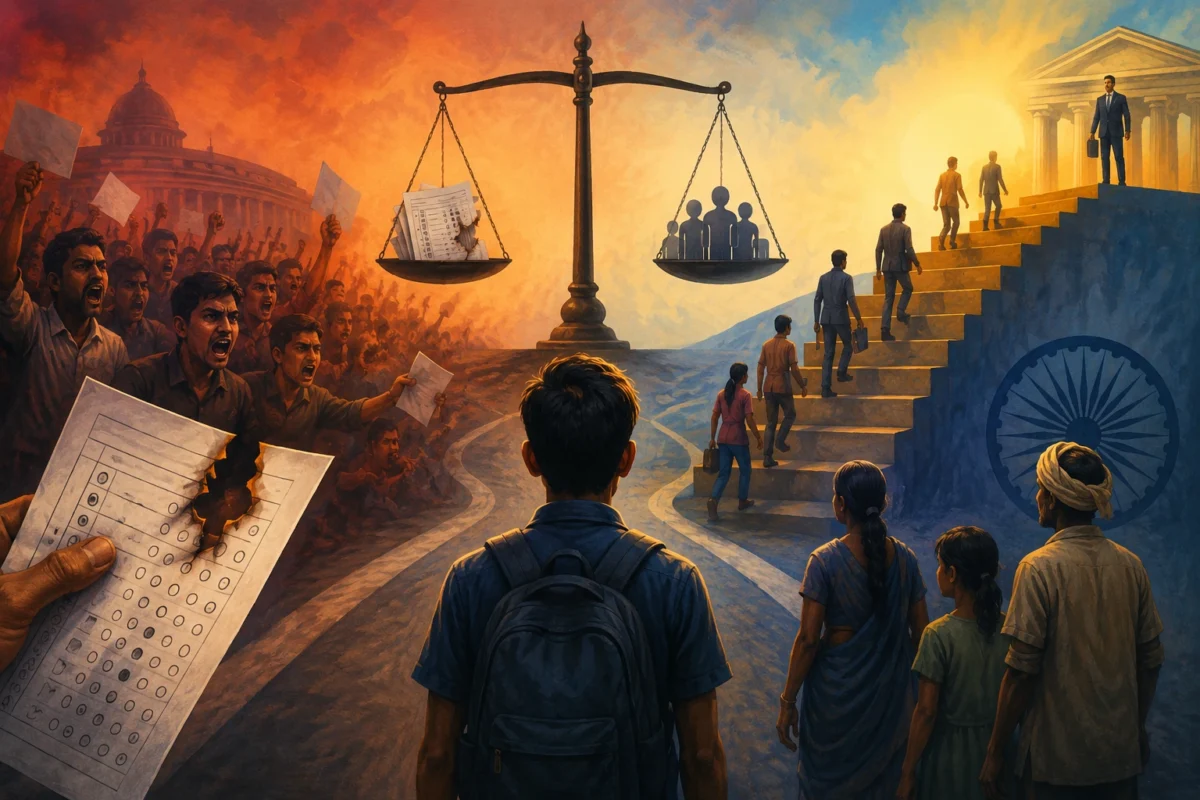
The UPSC exam is fair. But it is not just. It selects a few thousand individuals from a population of 1.4 billion, and in doing so, it does not uplift the masses—it legitimizes their exclusion. Those who fail are told they were not good enough. Those who succeed are told they earned their place. The system thus converts structural inequality into individual failure, and individual success into moral entitlement.
This is not justice. This is blaming the excluded for their exclusion.
Unfavorable Inclusion
Amartya Sen taught us to distinguish between exclusion and unfavorable inclusion. The exam system is a textbook case of the latter.
You are “included” in the competition—but only as a supplicant. You are welcome to compete, but only on the state’s terms. You are allowed to win, but only if you accept that winning means serving the state, not your community. You are given a place, but that place severs you from your roots, your people, and your accountability.
This is not liberation. This is co-optation dressed as opportunity.
Reservations, Mehta’s own earlier critique notwithstanding, have followed the same logic. For eight decades, they have offered inclusion—but on terms that sever the selected from their communities. The Dalit or Adivasi who clears the UPSC becomes a servant of the state, not a representative of their people. Their success is used as proof that the system works, even as their communities remain excluded, impoverished, and voiceless.
The exam system does not produce representatives. It produces alibis.
The State Has Nothing to Offer
This brings us to the heart of the matter. Mehta argues that the exam system is the last pillar of legitimacy because the state has nothing else to offer. But this is not an argument for protecting the exam system it is an indictment of the state itself.
Why does the state have nothing else to offer?
Because it has emptied itself of substance. It offers no welfare, no dignity, no justice, no security, no hope. What remains is a single, overloaded mechanism: the exam. The state tells the people: “We cannot give you healthcare, education, employment, or respect. But we can give you a fair chance to escape.”
This is not legitimacy. This is extortion by scarcity.
The exam system is not the state’s strength. It is the state’s confession of its own bankruptcy.
The Grammar of Elections
Mehta’s argument applies equally to elections. The first-past-the-post system operates on the same logic as the exam: a procedural mechanism that confers legitimacy without delivering accountability.
Elected representatives are selected by the party, endorsed by the state, and accountable to neither. Their loyalty is to the party that gave them the ticket, not to the constituency that voted for them. Like the bureaucrat, the politician is a servant of the state, not a servant of the people.
The people are not represented. They are managed.
A Confessional Alternative
If the exam system is the alibi, what is the alternative?
Mehta’s 2019 argument points the way, even if his 2024 argument abandons it. A confessional system of recruitment—one where communities nominate, scrutinize, and hold accountable those who would serve them—would shift the locus of legitimacy from the state to the people.
Current System                   Confessional Alternative
Anonymous exam                Public nomination
State selects                         Community authorizes
Loyalty to the state              Accountability to the community
Entitlement earned              Responsibility conferred
Individual achievement        Collective trust
This is not a return to patronage or parochialism. It is a recognition that legitimacy flows from the people, not from the state. It is a rejection of the Hegelian bureaucracy that pretends to be universal while being alienating, rational while being inhuman, and impartial while being indifferent.
The Real Crisis
Mehta warns that a collapse of trust in the exam system could destabilize the state. But the real crisis is not the collapse of trust—it is the trust we have placed in a system that does not deserve it.
The exam system has been the state’s alibi for decades. It has allowed the state to avoid welfare, justice, and accountability. It has turned citizens into supplicants, communities into afterthoughts, and public office into private entitlement.
If that alibi collapses, the state will indeed be in crisis—but that crisis is not a tragedy. It is a reckoning.
And reckoning, however painful, is the only path to renewal.
Conclusion
Pratap Bhanu Mehta is one of India’s most incisive public intellectuals. But on this question, he has let his anxiety overwhelm his insight. He is right that the exam system is overloaded. He is wrong that we should protect it.
The exam system does not hold the state together. It holds the state back.
What India needs is not a better exam. It needs a better state—one that serves, that is accountable, that draws its legitimacy from the people it exists to protect. That state will not be built by defending the alibi. It will be built by confronting the rot, dismantling the machinery of entitlement, and rebuilding from the ground up—with communities as the authors of their own destiny.
The exam system is not the last pillar of Indian democracy. It is the last excuse for its failure.