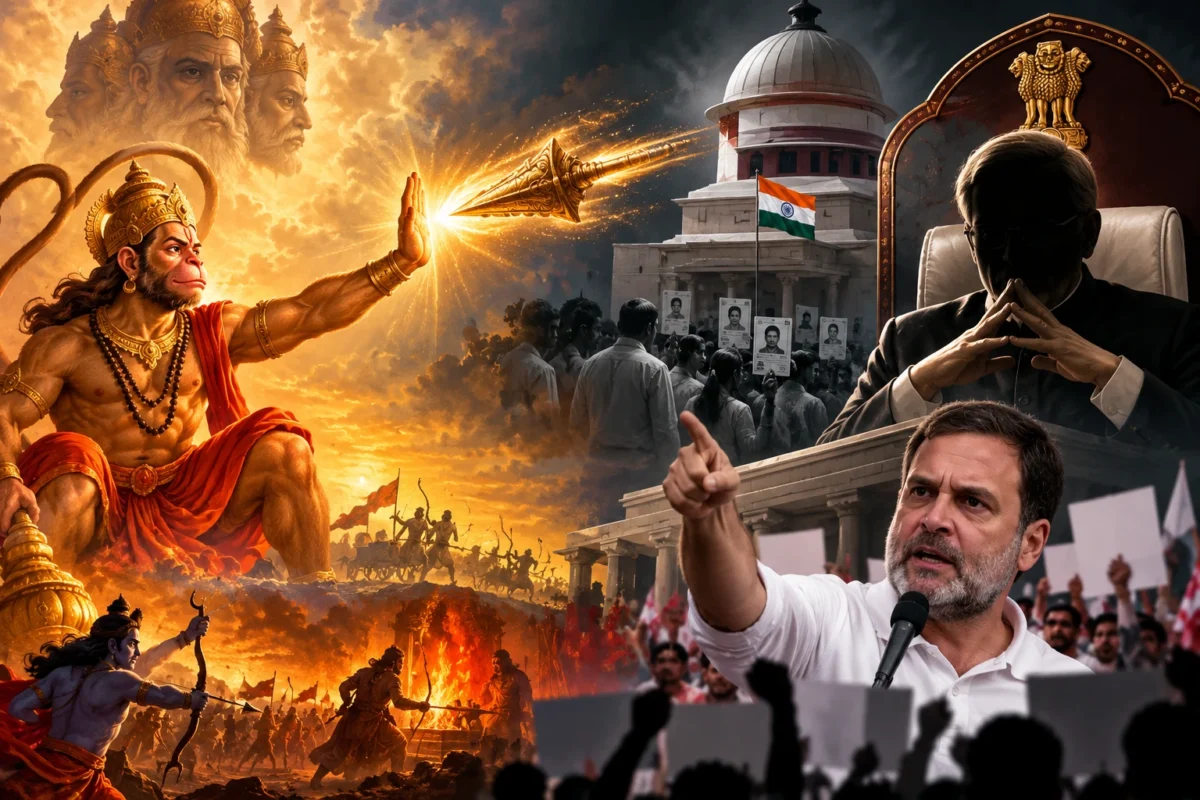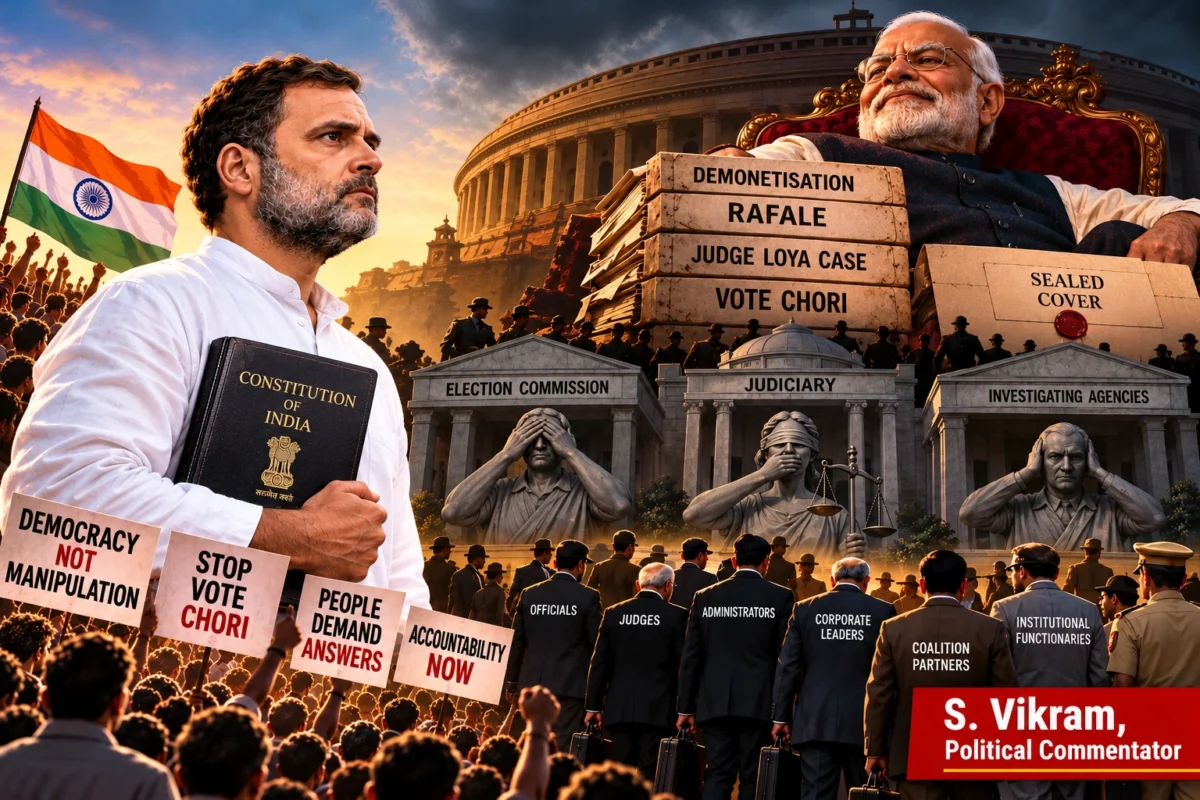
On Rahul Gandhi, the inheritance of Gandhi, and the moral perseverance required to confront a regime that has learned to digest shame.
There is a peculiar political problem before us. The charges accumulate, the explanations do not arrive, institutions retreat into silence, and the regime goes on as though nothing has happened. It has acquired an extraordinary digestive capacity. Demonetisation, Rafale, the Judge Loya case, and now the allegations surrounding vote chori: each controversy has had its moment in the public imagination, each has generated questions that demanded answers, and yet the larger political structure has survived with its confidence intact. In several instances, judicial proceedings have failed to produce the public accounting that critics sought. Sealed covers have become a metaphor for a politics in which the demand for transparency can be answered without the substance of transparency.
The lesson is not that nothing sticks. It is that the accumulation of allegations, by itself, is no longer sufficient to produce accountability. A regime that does not fear shame cannot be defeated by the mere demonstration that it ought to feel ashamed.
This is the problem that Rahul Gandhi must now confront, not merely as the Leader of the Opposition but as the person who has increasingly come to occupy the public space of resistance. He has spoken of perseverance. He has spoken of the Constitution, of institutional capture, of electoral manipulation. He has helped bring the question of vote chori into the national political conversation. But there comes a point when the articulation of a charge must become the organisation of a confrontation.
He must recognise that he is already at the helm of a movement, whether or not he has formally declared himself its leader. The question is no longer whether he has the permission, the mandate, or the institutional endorsement to lead. It is whether he is prepared to accept what leadership demands.
I. The regime that does not blush
Our earlier parable of the second bullet offers a way of understanding the extraordinary impunity of political power.
The first bullet is the original crime. The second is the act by which a person makes himself permanently complicit in it. The first may be committed under pressure, for gain, or out of ideological conviction. The second is different. It is the deliberate destruction of the possibility of returning to an unencumbered moral life.
A person who has fired the second bullet cannot afford to acknowledge what has happened. Admission would expose not merely an offence but the identity he has constructed around it. He must deny, deflect, ridicule, or remain silent. What appears to be shamelessness may have become a condition of political survival.
This is why it is futile to imagine that one more revelation, however serious, will necessarily bring the regime to its senses. The charge may be true, the evidence may be compelling, the public indignation may be widespread. Yet the person who has made his moral existence dependent upon denying the charge has no incentive to concede anything.
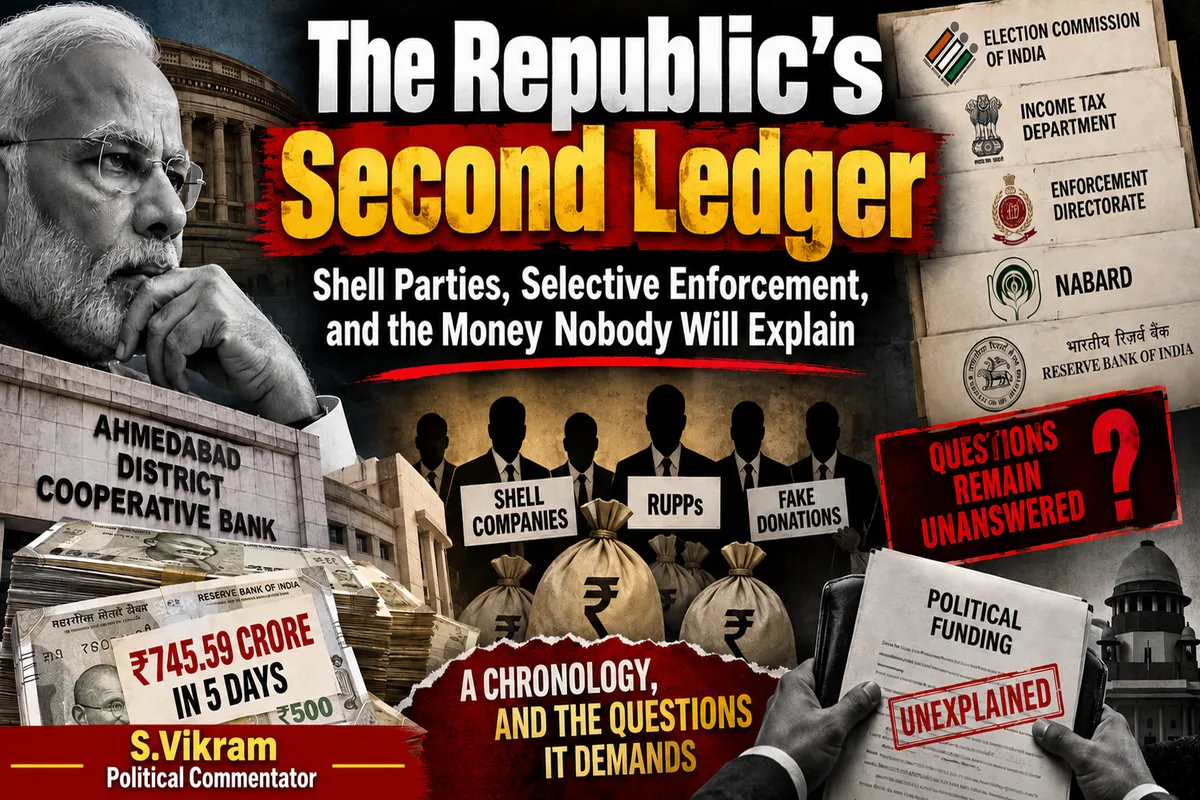
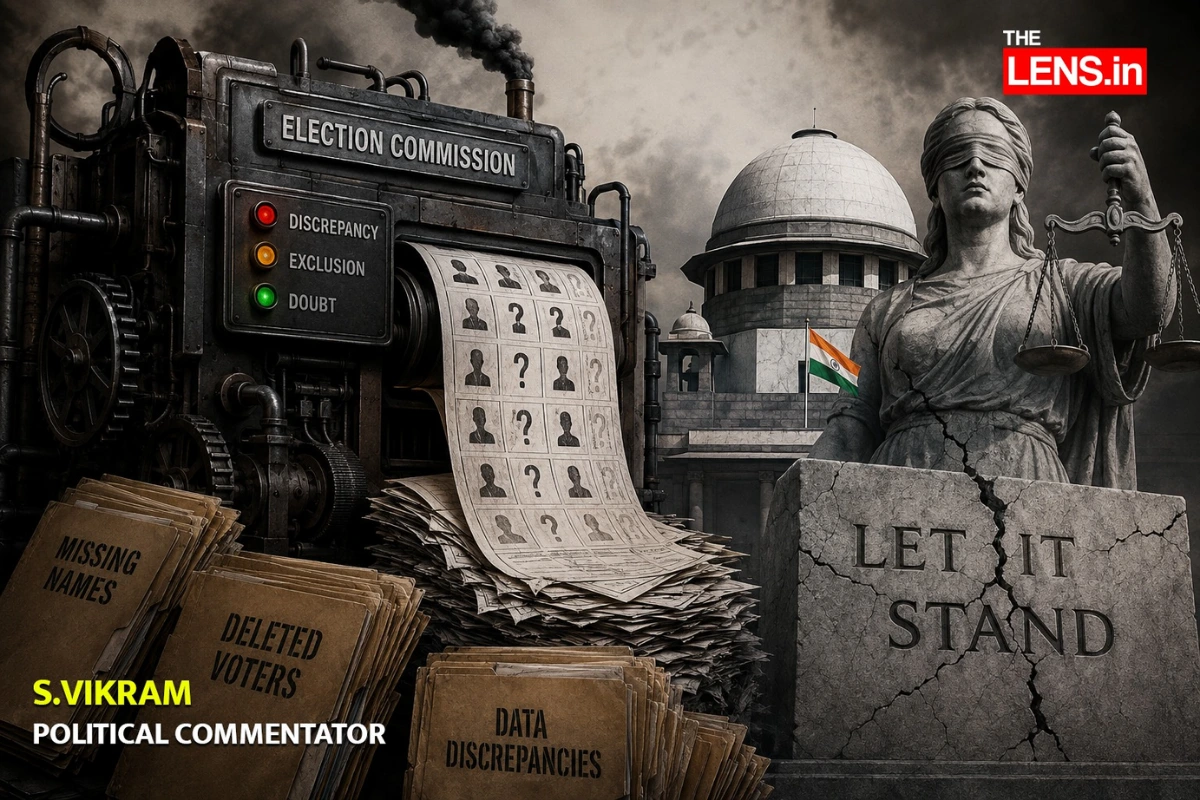
The difficulty becomes greater when institutions are implicated. An Election Commission that fails to answer legitimate questions about electoral integrity risks damaging the very trust upon which its authority rests. A judiciary that declines to provide timely and intelligible scrutiny of serious constitutional allegations risks being seen as preserving procedure while evading responsibility. Investigating agencies that appear selective in their attention risk losing the credibility that gives their actions legitimacy.
These are judgments that must be tested against records, evidence, and the conduct of each institution. An allegation is not a finding of guilt. But neither is institutional silence a satisfactory substitute for an answer.
The central question, therefore, is not how to make the regime blush. It is how to make the people who sustain it confront the cost of sustaining it.
II. The devas who have not fired
Every political order has its inner circle: those whose survival has become inseparable from the survival of the power they serve. They may have fired the second bullet. Their interests, reputations, and futures are so deeply invested in the arrangement that an admission of wrongdoing would threaten the foundations of their own lives.
But no regime consists only of such people.
Around the inner circle stands a much larger company: officials, judges, administrators, corporate leaders, coalition partners, professional intermediaries, and institutional functionaries. They may not have designed the arrangement. They may not have committed the original wrong. They may even privately disapprove of what they witness.
They continue, nevertheless.
They sign the papers, process the decisions, defend the procedures, lend the institution their standing, and reassure themselves that their individual participation is too small to make them responsible for the whole. They preserve their professional respectability while enjoying the advantages of proximity to power.
These are the devas of the procession.
Their defining characteristic is not necessarily malice. It is moral optionality: the ability to participate in an arrangement while reserving the right to claim innocence when the arrangement collapses.
The strategy of opposition must therefore distinguish between those who have made themselves inseparable from the wrongdoing and those who still retain the freedom to refuse complicity.
The distinction is essential. If everyone is treated as equally guilty, there is no incentive to change sides. If every late dissenter is denounced as a hypocrite, the door to dissent is closed. And if the only demand made upon institutions is that they express their disapproval, the opposition will receive statements of concern where it needs acts of responsibility.
The task is to make the difference between the two groups visible.
The bureaucrat who insists that he is merely implementing policy must be asked whether the policy is lawful. The corporate leader who invokes neutrality must be asked whether neutrality is compatible with the use of public power to secure private advantage. The judge who invokes institutional restraint must be asked whether restraint is being applied consistently, and whether delay itself has consequences for constitutional rights. The coalition partner who claims independence must be asked what, precisely, his independence permits him to refuse.
These questions must be addressed to individuals in their official capacities, on the basis of documented conduct, and through lawful public scrutiny. The purpose is not to humiliate families or punish private associations. It is to remove the protective screen behind which public responsibility disappears.
The Valmiki test is relevant here. In the ancient story, the robber discovers that those who share the benefits of his crimes will not necessarily share the moral burden. The story exposes the fiction of ethical outsourcing: that one can enjoy the fruits of an arrangement while assigning responsibility for its consequences to somebody else.
The test must be applied to public life. Who made the decision? Who implemented it? Who raised an objection? Who suppressed the objection? Who benefited? Who had the authority to intervene, and what did that person do with it?
The answers will not always establish guilt. But they will make evasion more difficult.
III. The inheritance of Gandhi
This is where Rahul Gandhi must decide what his invocation of Gandhi means.
The inheritance cannot be merely commemorative. Gandhi’s relevance does not lie in the fact that he led a national movement, nor in the moral prestige subsequently attached to his name. It lies in the method by which he transformed political confrontation.
He did not wait for the authorities to grant civil disobedience a place within the authorised repertoire of protest. He made an unjust exercise of authority the object of a public confrontation. He led people towards the point at which the state’s coercive power would become visible, and he insisted that the protesters’ refusal to retaliate was part of the confrontation itself.
Nonviolence was not the absence of conflict. It was a method of conducting conflict while refusing to reproduce the violence of the opponent.
The distinction matters because nonviolence has too often been reduced to a political temperament: peaceful speeches, designated gatherings, slogans, memoranda, and an eventual dispersal that leaves the machinery of power undisturbed. Such activities have their place. But they do not exhaust the possibilities of civil resistance.
A barricade is not merely a physical obstacle. It is a declaration about where the citizen may stand and where authority refuses to be questioned. A protest can become politically harmless when it accepts, without challenge, every boundary that the authority under protest has prescribed.
Yet breaking that boundary need not mean attacking the people who enforce it. Nor does Gandhi’s example license the romanticisation of confrontation, the pursuit of injury, or the assumption that a violent response from the state will automatically confer moral authority upon the protester.
The Gandhian challenge was harder than either submission or retaliation. It demanded that the protester approach the point of coercion, remain there despite the consequences, refuse to strike back, and retain sufficient discipline to withdraw when the collective purpose required it.
The courage lay in the willingness to bear consequences without allowing those consequences to dictate the protester’s moral conduct.
That is the tradition Rahul Gandhi must claim—not as a descendant entitled to inherit its prestige, but as a political leader willing to submit himself to its discipline.
IV. From the barricade to the threshold
If the opposition believes that the integrity of elections is under threat, it must identify the institutions responsible for answering that charge. It must frame its demands precisely, publish its evidence, pursue the available legal remedies, and establish a public record of what has been asked and what has been refused.
But it must also consider whether the conventional geography of protest has become a means of containing dissent.
A gathering at a designated site can be large, eloquent, and entirely predictable. The authorities know where it will assemble, where it will end, and how much inconvenience they need to tolerate before the protesters disperse. The protest becomes an event that the state administers rather than a demand that it must answer.
A different kind of civil resistance would make the responsible authorities the immediate audience of the protest. It would seek lawful, publicly visible proximity to the institutions whose conduct is in question. Its purpose would not be to storm a building, threaten an official, or obstruct emergency services. It would be to insist that the people exercising public authority cannot indefinitely place themselves beyond the sight and scrutiny of the people in whose name they act.
Such a movement would require preparation, discipline, and a clearly stated objective.
Rahul Gandhi would have to lead it personally. He could not merely address the crowd before it began, appear for the photographs, and leave the consequences to younger protesters. He would have to remain present when the confrontation became difficult, when the authorities refused to engage, when the crowd became exhausted, and when the temptation to retaliate grew strongest.
He would have to make the demands unmistakable. What information must be disclosed? What questions must the Election Commission answer? What independent scrutiny is being sought? What judicial remedy has been requested? What response has been received? What will count as progress, and what will happen if the demand is refused?
A movement that cannot answer these questions risks substituting the intensity of its anger for the precision of its purpose.
And the leader must take responsibility for the end of the confrontation as seriously as for its beginning. He must be prepared to call for withdrawal when the objective has been achieved, when the immediate action can no longer advance it, or when the risk to participants becomes disproportionate. A disciplined retreat is not a surrender. It can be the demonstration that the movement is governed by a political purpose rather than by the emotional momentum of a crowd.
The point is not to prove that the protesters can inflict damage. It is to demonstrate that they can approach power without permission, bear its refusal without retaliation, and leave without surrendering the legitimacy of their demand.
V. The second bullet in reverse
The regime’s apparent immunity from shame poses a further problem. If those at the centre have destroyed their capacity to acknowledge wrongdoing, why should public exposure matter?
Because the regime is not the whole of society, and the inner circle is not the whole of the state.
There are judges whose professional identity depends upon the credibility of the judiciary beyond the tenure of any particular government. There are civil servants whose careers will continue after the political circumstances in which they serve have changed. There are investigators who must decide whether professional duty means following evidence wherever it leads. There are corporate leaders whose standing depends upon the difference between commercial success and political patronage. There are coalition partners who must explain their decisions to constituencies that have interests of their own.
Not all of them will respond to moral argument. Some will respond to legal obligation, some to professional responsibility, some to public scrutiny, and some to the prospect that their present conduct will become part of their permanent record.
The opposition cannot assume that exposure will produce defection. It must create the conditions in which independent conduct becomes possible and continued complicity becomes harder to justify.
This is the reverse of the second bullet.
The first bullet makes wrongdoing possible. The second makes the perpetrator’s identity dependent upon it. But those who have not fired the second bullet retain a choice. They can refuse an unlawful instruction, disclose a documented irregularity through appropriate channels, insist upon a reasoned institutional decision, decline to lend their standing to an unsupported claim, or exercise an independent constitutional responsibility.
The purpose of sustained public scrutiny is to keep that choice alive.
This is also why opposition strategy cannot rest upon denunciation alone. If a bureaucrat refuses an unlawful order, the opposition must defend the principle of lawful administration rather than demand partisan allegiance. If an election official raises a genuine objection, that objection must be judged by its evidence, not by the official’s political usefulness. If a judge delivers an unwelcome ruling, the opposition must distinguish disagreement with the decision from an attack on the judge’s legitimacy.
Otherwise, the movement will merely replace one demand for obedience with another.
Moral perseverance means refusing to abandon the distinction between accountability and revenge, even when the temptation to do so is strongest.
VI. The allies, the agencies, and the cost of neutrality
The same logic extends beyond the permanent institutions of the state.
Coalition partners such as the JD(U) and the TDP possess political agency. Their participation in government is not a purely administrative fact. It is a continuing political choice, made in exchange for a set of commitments, benefits, and expectations. They must be asked to explain what conditions they consider essential to the legitimacy of the government they support.
The demand should not be that they join the opposition. It should be that they demonstrate the independence they claim: that they insist upon transparent answers to serious electoral allegations, defend the constitutional autonomy of institutions, and refuse to treat the integrity of the electoral process as a negotiable matter of coalition management.
The same principle applies to the bureaucracy and investigative agencies. Their neutrality cannot mean indifference between lawful and unlawful conduct. It must mean independence from partisan direction, consistency in the application of law, and a willingness to act on evidence regardless of whose interests are affected.
Corporate India cannot be exempted from scrutiny merely because its influence is exercised through donations, contracts, access, or private conversations rather than public office. But scrutiny must remain grounded in verifiable facts. Commercial success is not proof of political favour, just as political proximity is not proof of corruption. Where evidence of improper influence exists, it must be made public and investigated through credible procedures.
The strategy is one of sustained political pressure, but pressure with a purpose: to make it increasingly difficult for each participant to hide behind the claim that somebody else is responsible.
This is the titration that opposition politics must attempt. Not every ally will leave. Not every official will dissent. Not every institution will recover its independence at once. The objective is to identify the points at which the system still contains people capable of making a different choice, and to make that choice visible, consequential, and defensible.
A procession made up entirely of people whose interests depend upon the central figure is no longer a government sustained by independent judgment. It is a structure of mutual dependence. But such structures begin to change when the people at their edges discover that their participation is neither invisible nor inevitable.
VII. Perseverance as moral belligerence
Rahul Gandhi has spoken of perseverance. The word must now be given a harder meaning.
Perseverance is not simply the ability to repeat an accusation after it has been dismissed. It is not the endurance required to make another speech, conduct another press conference, or survive another cycle of political ridicule.
It is the willingness to remain in a state of moral belligerence with power: to refuse the normalisation of what should not be normal, to insist upon answers when silence has become the expected response, and to continue the confrontation without allowing it to corrupt the purpose for which it began.
Moral belligerence is not personal hostility. It does not require the assumption that every opponent is irredeemable or that every official is secretly complicit. It requires that no public authority be permitted to convert the passage of time into a substitute for accountability.
The leader must be prepared to pay the price of this persistence. He must accept arrest where the law is lawfully applied, judicial scrutiny where his actions are challenged, criticism where his strategy fails, and the possibility that even a carefully organised movement will not produce immediate results. He must not promise that a confrontation will succeed merely because it is morally justified.
Above all, he must be prepared to bear the consequences of his own method. A leader who asks the young to stand before power while keeping himself safely at a distance has not inherited Gandhi’s discipline. A leader who invites confrontation but cannot restrain retaliation has confused courage with escalation. A leader who calls for perseverance but abandons the movement when its costs become real has converted a moral claim into a political performance.
The responsibility is to lead from the front and to remain accountable to those who follow.
VIII. The measure of the movement
The youth who enter public life now do not need another sermon about the virtues of democracy. They need to see what democratic courage looks like when institutions disappoint, when evidence is contested, when authorities refuse to answer, and when the immediate temptation is either resignation or rage.
They need to see that nonviolence is neither a request for permission nor an agreement to remain harmless. It is a disciplined refusal to let the conduct of the state determine the moral character of the opposition.
They need to see a leader who will approach the institution he criticises, state his demands in terms that cannot be mistaken, remain present when the answer is refusal, protect the discipline of the movement, and withdraw without pretending that withdrawal has resolved the underlying dispute.
They also need to see that the movement is capable of distinguishing between those who have made themselves inseparable from wrongdoing and those who still have the freedom to resist it. The first group may never acknowledge its culpability. The second must not be permitted to pretend that it has no choice.
There will be no single confrontation that settles the question. The work will consist of records assembled, objections preserved, legal remedies pursued, officials questioned, alliances tested, and public demands repeated until evasion itself becomes a matter requiring explanation.
The regime may digest another allegation. It may survive another demonstration. It may refuse another demand. But the movement must not confuse its survival with the absence of consequences, or its own exhaustion with the impossibility of resistance.
Gandhi’s inheritance, if it is to mean anything in the present, lies here. Not in the sanctification of suffering, not in the romanticisation of the lathi charge, and certainly not in the belief that the spectacle of violence automatically produces moral victory. It lies in the creation of a political force that can confront authority without surrendering its own ethical judgment.
Rahul Gandhi need not ask permission to assume that responsibility. No office can confer the moral authority required for it, and no family name can substitute for the work. He must claim the tradition by accepting its discipline.
The task is to lead the young to the threshold of power, to demand an answer, to endure the refusal, to hold the line without retaliation, and to bring them back with their purpose intact.
The second bullet is the act by which a person destroys the possibility of moral return. The political task is to prevent everyone else from being persuaded that the second bullet is inevitable.
That is what perseverance must mean now: not the passive endurance of a regime’s impunity, but the sustained, organised, nonviolent refusal to make peace with it