A chronology, and the questions it demands
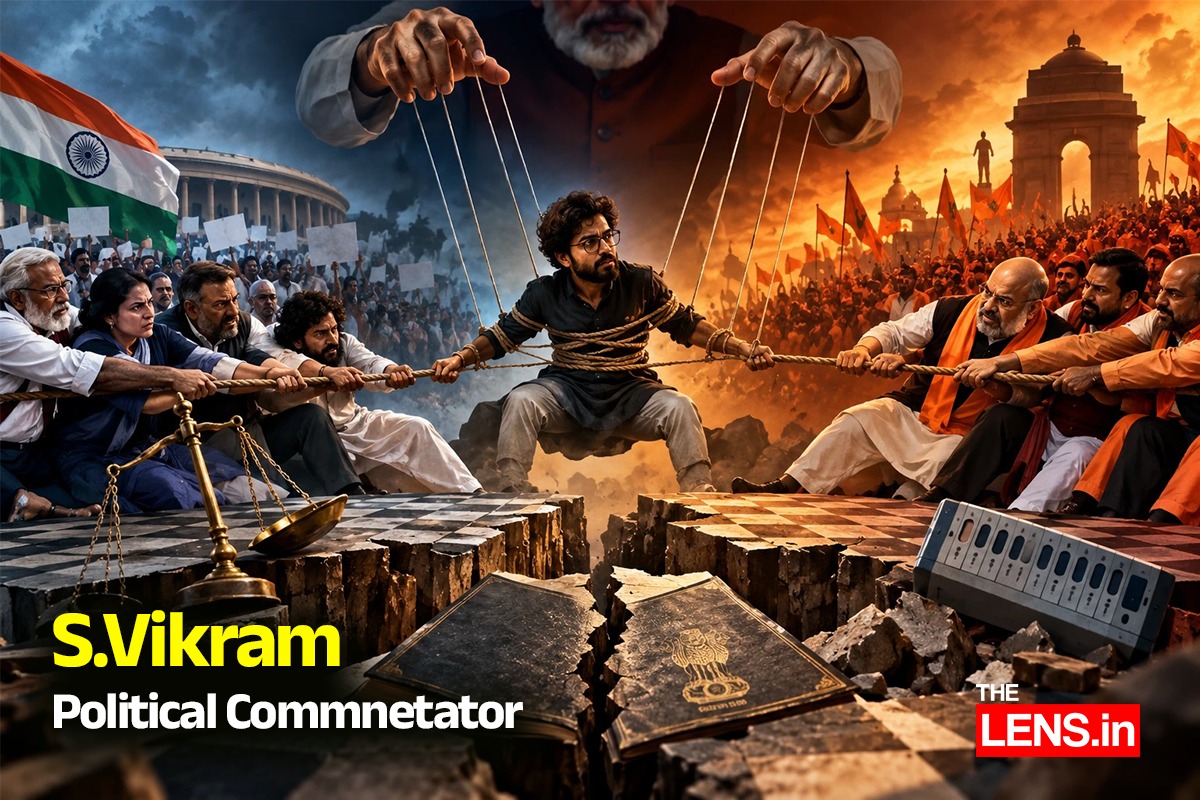
There is a story sitting in plain sight in India’s public records — in Election Commission filings, RTI replies, ADR reports, and now a BBC investigation — that has never been assembled into a single frame. Each piece, taken alone, reads as an anomaly: a cooperative bank’s unusual deposit spike, a party with no named treasurer, a cluster of obscure outfits in Ahmedabad collecting more money than the opposition combined. Put the pieces in order, however, and a shape emerges — not a proven conspiracy, but a documented pattern of asymmetry that the institutions responsible for explaining it have, so far, declined to explain.
This is that chronology. Where a claim is a matter of public record, it is stated as fact and sourced. Where it crosses into interpretation — into a claim about intent, design, or motive — it is marked as such. The distinction matters, because the pattern is strong enough to stand on the facts alone; it does not need to borrow strength from speculation.
I. November 2016: The night 86 percent of currency died
On 8 November 2016, Prime Minister Narendra Modi announced the withdrawal of all Rs 500 and Rs 1,000 notes — roughly 86 percent of currency in circulation — with immediate effect. The stated purpose was to strike at black money, counterfeit currency, and terror financing. What followed was months of economic disruption for ordinary citizens standing in queues, and a strange parallel story unfolding inside India’s cooperative banking network.
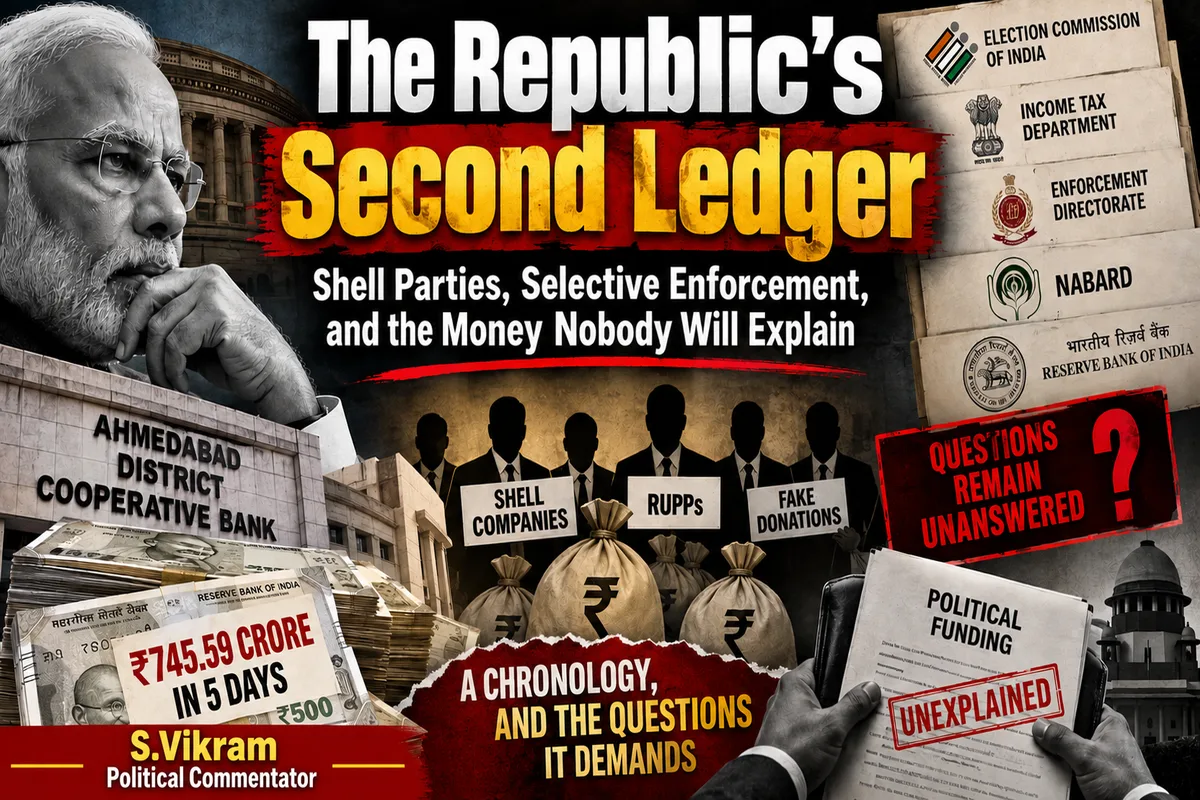
Within five days, one institution stood out: the Ahmedabad District Cooperative Bank (ADCB) received Rs 745.59 crore in demonetised notes — the highest deposit of any district cooperative bank in the country, ahead of even the Rajkot District Cooperative Bank’s Rs 693 crore. This came to light only in 2018, through an RTI reply obtained by Mumbai activist Manoranjan Roy via NABARD.
BJP president Amit Shah was, and had for years been, a director of ADCB — a fact confirmed on the bank’s own website, and one that included a stint as its chairman in 2000. The bank’s chairman at the time of the deposits, Ajay Patel, was described in contemporaneous reporting as a close associate of Shah.
Five days after the announcement, the Reserve Bank of India barred all District Central Cooperative Banks nationwide from accepting old notes at all — a decision widely understood, though never officially framed this way, as a response to the risk that these banks’ looser KYC norms made them conduits for laundering. ADCB’s extraordinary haul occurred entirely inside that five-day window, before the door shut.
Congress publicly cited data showing that BJP-ruled states received 64.18 percent of all district cooperative bank deposits nationally (Rs 14,293 crore of Rs 22,270 crore) in this period, and demanded an independent, time-bound probe into ADCB specifically.
NABARD’s on-record response was that it had conducted a “100 percent verification” of ADCB and found full compliance with RBI’s KYC guidelines, attributing the volume simply to the bank’s size. No independent probe of the kind Congress demanded appears to have followed.
Four months later, in February–March 2017, Uttar Pradesh — India’s largest and most politically decisive state — went to the polls. The BJP won a landslide.
II. 2017: The shell company purge, and where the money went next
In the aftermath of demonetisation, the government turned to a second front: shell companies. A task force under the revenue secretary and the corporate affairs secretary was formed to identify non-compliant companies suspected of laundering. The results were dramatic:
Over 2,09,000 companies were struck off the Register of Companies.
Bank data on just 5,800 of these companies (2.5 percent of the total) revealed 13,140 accounts that had deposited Rs 4,574 crore post-demonetisation and withdrawn a near-identical Rs 4,552 crore shortly after — cash in, cash out, company discarded.
Over 1,06,000 company directors were disqualified under the Companies Act for association with non-filing entities.
Kolkata was initially identified as the shell-company capital (16,000 such firms floated there 2011–2015); a follow-up round found Surat, in Gujarat, had overtaken it, with over 80 percent of a fresh batch of 2,138 shell firms — holding Rs 5,000+ crore in suspicious deposits — based there.
This was, on the numbers, one of the most aggressive corporate crackdowns in Indian regulatory history. And yet the underlying function shell companies had served — absorbing and laundering large volumes of unaccounted cash — did not disappear. The vehicle changed.
Registered Unrecognised Political Parties (RUPPs) — parties registered with the Election Commission but never having won enough votes for state or national recognition — began showing a donation profile that tracks almost exactly against the shell-company crackdown timeline. RUPP donations rose from Rs 24.6 crore (2017–18) to Rs 65.5 crore (2018–19) — a near-tripling — the same year the electoral bonds scheme was notified (January 2018). By 2021–22, declared RUPP income reached Rs 490 crore; by 2022–23, it had risen 223 percent to Rs 1,581 crore. Between 2022 and 2024, over 3,260 RUPPs collectively took in more than Rs 10,000 crore.
A 2022 income-tax search on what investigators called the “RUPP group of Ahmedabad” found 23 RUPPs, 35 bogus intermediary entities, and 3 major “exit providers” working in concert — donations received by cheque or bank transfer, routed out as fake “social welfare” expenditure to shell entities created for that purpose. This is not an inference; it is the description investigators themselves used.
III. 2022–2025: Six parties, more money than the opposition
In August 2025, Dainik Bhaskar reported that ten little-known Gujarat parties had collected over Rs 4,300 crore in donations between 2019–20 and 2023–24, while fielding just 43 candidates across three elections, who together won 54,069 votes. Their declared election spending was Rs 39.02 lakh; their audited expenditure claimed over Rs 3,500 crore — a gap that speaks for itself.
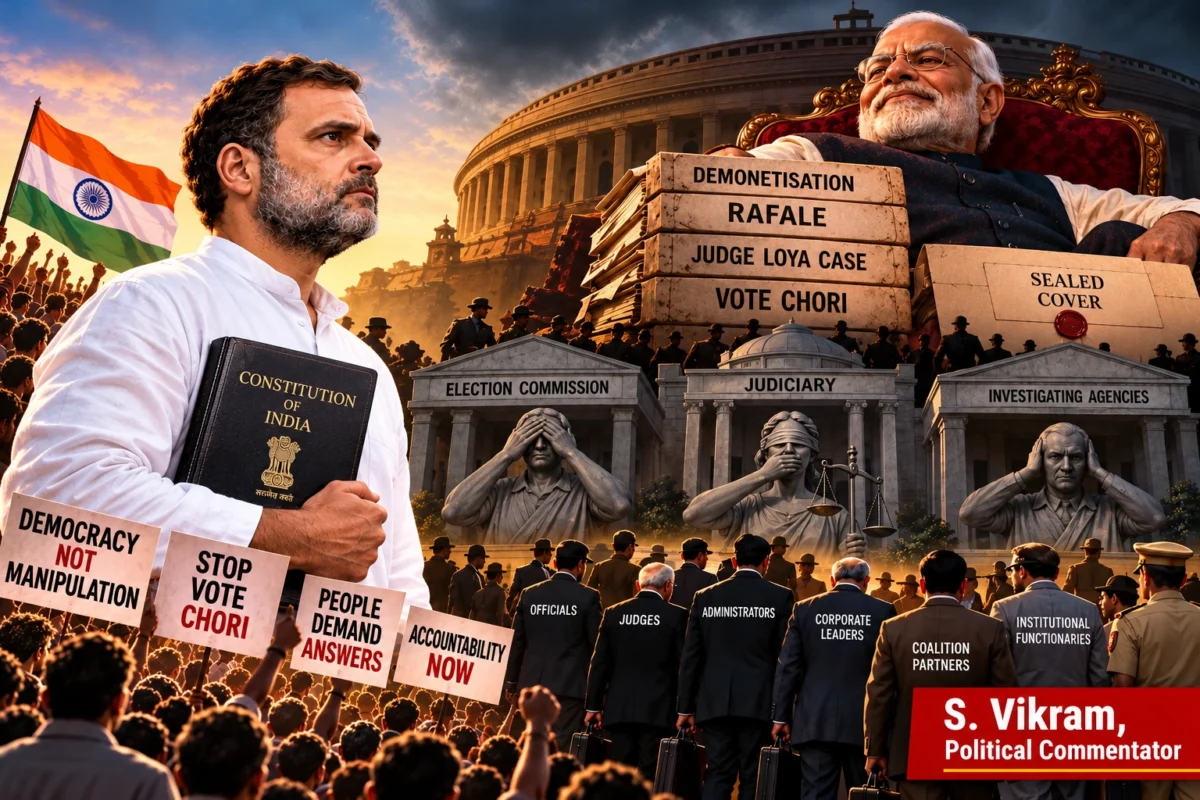
This report surfaced in the same month Rahul Gandhi launched the “Vote Chori” campaign against the Election Commission over electoral roll integrity — a story that dominated the news cycle through the Bihar election campaign that followed, and which appears to have absorbed most of the political and media attention that might otherwise have gone to the donations story.
In September 2025, a BBC Hindi investigation returned to the same terrain with sharper numbers: six Gujarat-based RUPPs — Aam Janmat Party, Satyavadi Rakshak Party, Gareeb Kalyan Party, Swatantrata Avivyakti Party, Bharatiya National Janata Dal, and New India United Party — received a combined Rs 1,700 crore in FY 2023–24 alone, more than the Rs 1,480 crore raised by five recognised national parties combined (Congress, AAP, BSP, CPI-M, NPP). The Aam Janmat Party alone raised Rs 620 crore — more than double the Congress’s Rs 281 crore — while fielding a fraction of the candidates.
Newslaundry’s parallel investigation (October 2025) found that of these parties’ declared donors, disclosure was often fictional: the Aam Janmat Party disclosed donor identity for just Rs 21 crore of Rs 220 crore received in 2022–23 — the remaining 95 percent marked simply “N/A.” Satyavadi Rakshak Party’s president, Swati Ben, who lives in the same residential complex as the party’s registered office in Anand, told the BBC the money was spent on “charity” — with no records kept.
Bharatiya National Janata Dal, founded by the father of Sanjay Gajera, reported Rs 957 crore in donations while winning 11,496 votes across eight candidates in two elections — and its office-bearer was found in possession of luxury vehicles, including an MG Gloster SUV and a Harley-Davidson, now under scrutiny as disproportionate assets.
IV. The regulator that could not, or would not, see
The Election Commission’s own transparency framework requires every registered party to file an annual audit report and a contribution report (Form 24A) disclosing donors above Rs 20,000, on pain of losing tax exemption under Section 13A. For years, large numbers of RUPPs simply did not comply — some, like Satyawadi Rakshak Party and New India United Party, did not file at all for 2019–2021.
The ECI’s only real tool against this is delisting — removing “inactive” status, which strips tax exemption and symbol rights but does not investigate, penalise, or recover a single rupee. It has used this tool with real force only recently: 253 RUPPs in 2022, then 334 in August 2025 and 474 more weeks later — 808 parties delisted in two months, including 11 from Gujarat. The Commission has asked the Law Ministry for actual de-registration powers since 1999; the request remains unresolved.
This is not the first time the ECI’s own transparency rules have gone unenforced against a convenient beneficiary. Between 2014 and at least 2018, the Bharatiya Janata Party filed its audited accounts with the Election Commission without a named treasurer — the returns signed only “for treasurer” by an unidentified signatory, in apparent violation of the Commission’s own 2014 transparency guidelines requiring the treasurer or an authorised person to sign. Two former Chief Election Commissioners, S.Y. Qureshi among them, went on record saying the Commission should have issued a notice demanding the party name its treasurer rather than “meekly accepting” a defective filing. No such notice was issued. This gap persisted through the years in which the BJP’s declared income rose 81 percent to Rs 1,034 crore (2016–17) — the same period covered by the demonetisation and shell-company events above.
V. Two speeds of enforcement
The clearest way to see the asymmetry is side by side.
Against the principal opposition party: In February 2024, weeks before the Lok Sabha election was announced, the Income Tax Department imposed a Rs 210 crore recovery demand on Congress relating to a 2018–19 tax return, placed a lien on its accounts, and confiscated Rs 110 crore — effectively freezing the party’s ability to function. Congress secured partial relief from the Income Tax Appellate Tribunal within hours. A separate freeze hit a CPI(M) district committee account in Kerala around the same period. Both parties called the timing political.
Against the Gujarat RUPP network: despite donation and disclosure irregularities visible in public ECI/ADR filings for years, and despite investigators’ own description of the mechanism as laundering, the Income Tax Department’s response has been limited to search-and-seizure raids — on Rashtriya Vikas Party in July 2025, and on Bharatiya National Janata Dal across 24-plus locations in December 2025 — with no reported account freeze against any of these parties, years after the donations in question were made.
The Enforcement Directorate, meanwhile, has registered PMLA cases and attached assets in Gujarat during this same period against a portfolio-management fraud (Rs 24 crore), a former IAS officer (Rs 6 crore), an extortion suspect (Rs 1.6 crore), and a PMO impersonator — real, if comparatively modest, sums. Against the RUPP network — hundreds of crores, explicitly described by tax investigators as routed through shell intermediaries and “exit providers” — no PMLA case has been reported. PMLA does not require the underlying offence to be recent; the Supreme Court held in 2025 (Pradeep Sharma v. ED, itself a Gujarat case) that money laundering is a continuing offence. The predicate material — the Income Tax Department’s own findings — already exists. The silence, so far, is unexplained.
VI. What is fact, and what is argument
The chronology above is documented: dates, figures, named officials, on-record statements, and reported investigative findings, each independently sourced. Two further claims are commonly made about this chronology, and they deserve to be separated from it rather than folded in.
The first — that the pattern shows a real asymmetry in how India’s enforcement institutions treat the ruling party’s financial ecosystem versus the opposition’s — is, on this record, a documented conclusion, not a speculative one. The Election Commission tolerated a missing treasurer for years; it took until 2025 to delist RUPPs at scale; the Income Tax Department froze an opposition party’s accounts within days over an ordinary dispute while raiding, but never freezing, parties its own officials describe as running a laundering operation; and the Enforcement Directorate, demonstrably capable of fast, forceful PMLA action on far smaller sums, has not touched this network at all.
The second — that demonetisation, the ADCB deposits, the shell-party ecosystem, and the pattern of selective enforcement together constitute a designed strategy to financially starve opposition parties ahead of costlier elections — is an interpretive thesis. It is not an unreasonable one, given the facts above; it is the inference many observers draw from them. But it is a claim about intent, and the documentary record — RTI data, NABARD’s clearance of ADCB, ECI filings — does not itself prove design as distinct from convenient, uninvestigated outcome. That distinction should be preserved, not because the thesis is weak, but because the documented asymmetry is strong enough that it does not need to borrow the certainty of an unproven motive to demand answers.
VII. The questions that remain unanswered
Why has the Election Commission never issued a notice over the BJP’s unnamed treasurer, given its own guidelines and two former CECs’ public criticism?
Why did RUPP delisting drives wait until 2025 to reach a scale commensurate with a problem visible in public filings since at least 2017?
Why has the Income Tax Department pursued raids but not account freezes against RUPPs demonstrating the exact “cheque-in, cash-out” signature its own 2016–17 shell company investigations flagged as a laundering hallmark?
Why has the Enforcement Directorate not opened a single PMLA case against a network its sister agency’s own findings describe in laundering terms — when it has moved quickly against far smaller, unrelated cases in the same state and period?
Was Ahmedabad District Cooperative Bank’s post-demonetisation deposit volume ever independently investigated beyond NABARD’s internal clearance, given the RBI’s own decision, days later, to bar all such banks from the same practice?
These are not rhetorical questions. Each has a specific institutional address — the ECI, the Income Tax Department, the Enforcement Directorate, NABARD and the RBI — and each institution owes the public a specific, factual answer, not a general reassurance. Until those answers arrive, the pattern stands as documented: a republic with two ledgers, one audited quickly and one that has waited the better part of a decade.