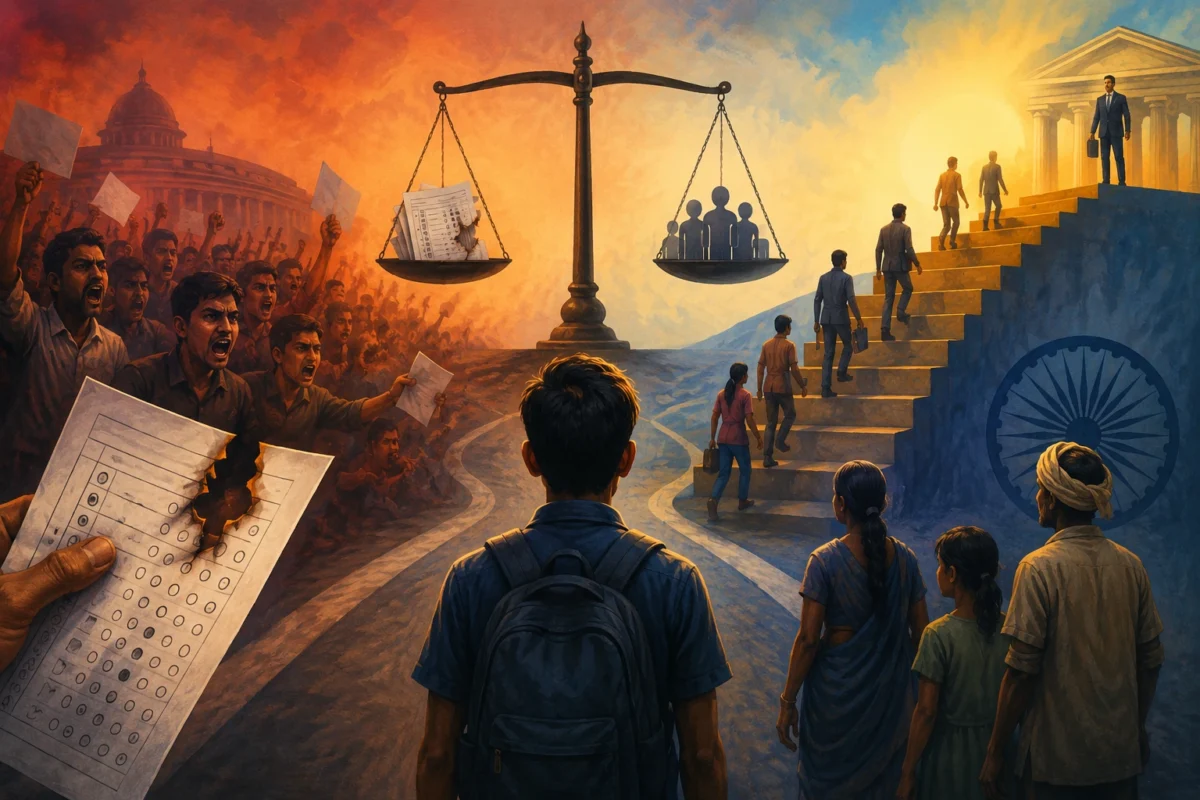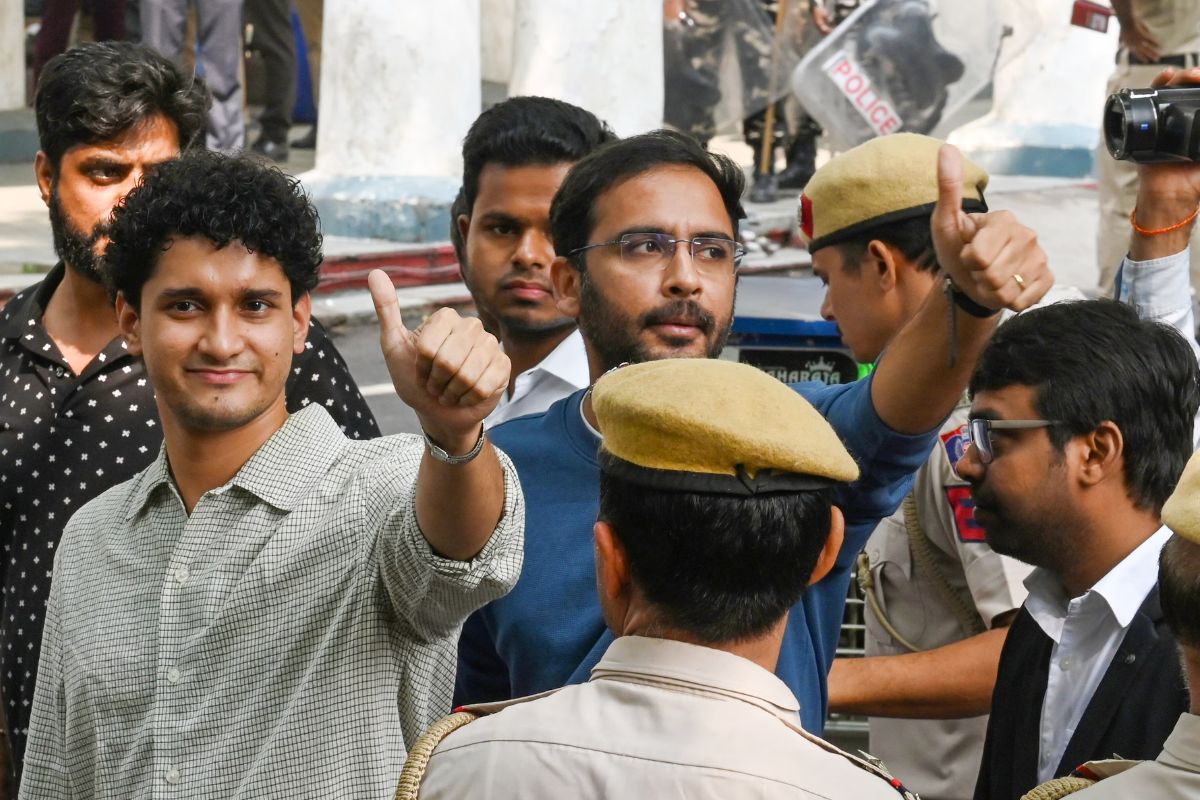
On 13 April 2026, with West Bengal five days from its first phase of polling, counsel for a group of excluded voters put a simple proposition to the Supreme Court: since these appellants had voted in every election since 2024, since their names sat on the rolls until an algorithm flagged them months ago, should they not be presumed eligible to vote now, pending the outcome of appeals the state’s own machinery had not yet found time to hear? Chief Justice Surya Kant’s reply has since become the most quoted line to come out of the entire Special Intensive Revision — not because it settled anything, but because it revealed, in a single sentence, how little thought the Court had given to the asymmetry it was being asked to correct. “What is the question of allowing them to vote?” he asked. “If we allow this, then let us stop the voting rights of people who are included then.”
It is worth sitting with that non-sequitur for a moment, because the entire architecture of what follows in this essay rests on the distinction the Chief Justice’s remark refused to draw. A voter already included in the rolls, whose inclusion the Election Commission is contesting, loses nothing by the pendency of that appeal — the roll as published continues to carry his name, and he votes. A voter excluded from the rolls, appealing to be restored, loses everything by the pendency of his appeal — the roll as published does not carry his name, and he does not vote, appeal or no appeal. These are not symmetrical positions. Treating them as symmetrical, as the Chief Justice did in refusing relief to the excluded, is not evenhandedness. It is a decision, dressed as an act of even-handed restraint, to let the burden of institutional failure fall entirely on the citizen already being asked to prove himself.
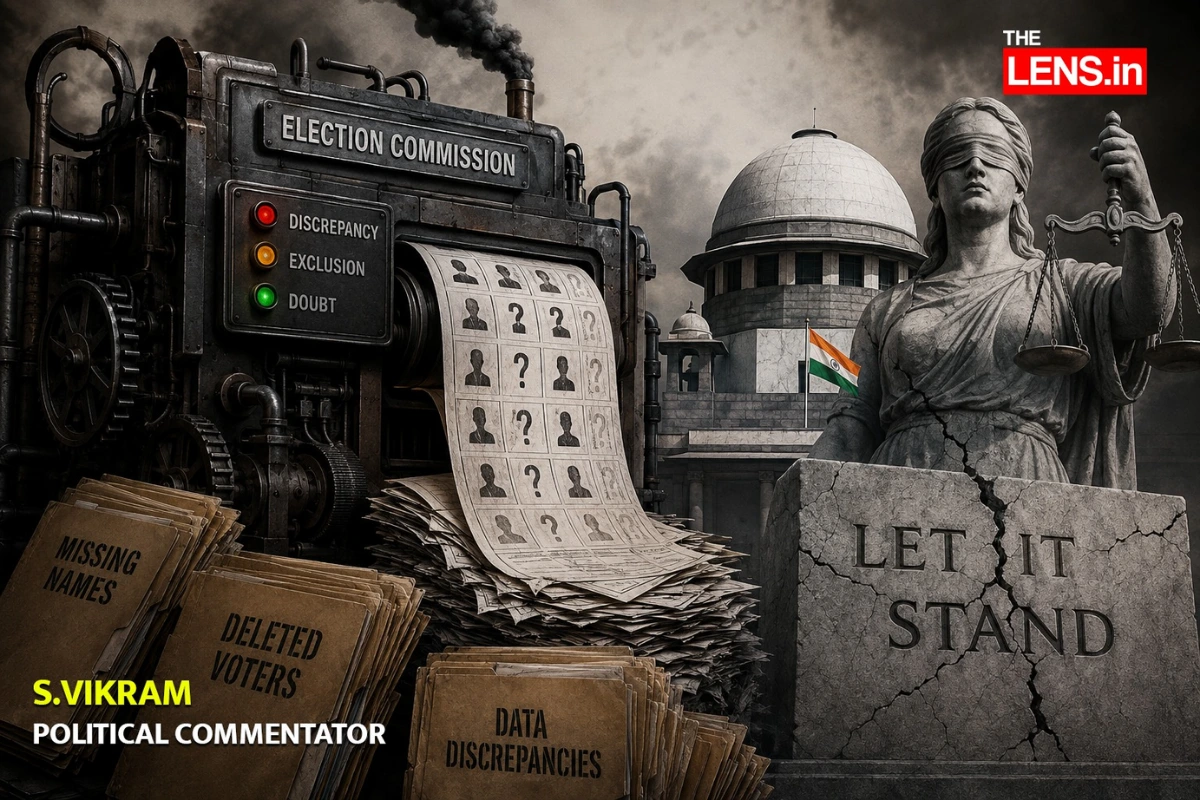
This essay makes three arguments, each built from the trail of Right to Information data, Supreme Court orders, and Election Commission notifications that the SIR exercise has left behind over the past nine months. First, that the Commission’s Special Intensive Revision in West Bengal — and, it turns out, well beyond West Bengal — deployed a purpose-built classification with no basis in electoral law, and then challenged its own adjudicators’ attempts to correct for it, producing an appeals machinery clogged as much by the state’s quarrel with itself as by citizen grievance. Second, that the judiciary, confronted with clear evidence that this machinery could not possibly function in time, chose procedural closure over the plain remedy of a presumption of eligibility, and did so on reasoning that does not survive its own transcript. Third, that the resulting pattern — invented categories, unaccountable software, tribunals sized for years of work compressed into weeks, and courts unwilling to intervene — is not a Bengal story at all, but a template already running in nine other states, at a scale in at least one of them an order of magnitude larger than anything West Bengal produced.
I. The Misdemeanor: Two Tracks, One Deletion Figure
Every account of the West Bengal SIR that treats “ninety lakh voters deleted” as a single fact obscures the story rather than telling it. There were, in truth, two entirely different operations running under one banner, and collapsing them into a single number is the first sleight of hand worth naming.
Track one was the SIR that most of the country understood it was getting: the removal of the dead, the shifted, the duplicated. This is the same mechanism deployed in Bihar’s first-phase SIR and in every other state’s Phase 2 exercise — routine roll maintenance, however aggressively timed. In West Bengal it accounted for roughly 65 lakh deletions, refined down from an initial draft-roll figure of 58.2 lakh. Nobody disputes that electoral rolls need this kind of housekeeping periodically; the argument about Track 1, everywhere it ran, was about pace and documentation burden, not about the legitimacy of the category itself.
Track two is where the Commission did something it had never done before, in West Bengal or anywhere else in the history of Indian elections. It invented a classification called “logical discrepancy” — a term appearing nowhere in the Registration of Electors Rules, unknown to a retired IAS officer with forty years in the electoral apparatus, who has said as much publicly. The category emerged gradually, through a series of instructions to Booth Level Officers beginning in November 2025, and its operative logic, once the Supreme Court forced its disclosure in a January hearing, turned out to be a set of software-generated triggers: a mismatch between a voter’s name and a parent’s name across differently transliterated documents; an age gap of more than fifty years between parents or less than forty between grandparents; and, most tellingly, any family in which more than five voters claimed the same father. None of these are markers of ineligibility. They are markers of exactly the kind of documentary untidiness — inconsistent Romanisation of Bengali and Arabic-Persian names, large sibling cohorts common to an earlier generation, women’s surname changes after marriage — that characterises ordinary family record-keeping across the subcontinent. At its peak, the logical-discrepancy list in West Bengal alone ran to 1.25 crore names. After adjudication by six hundred judicial officers drafted in from West Bengal, Jharkhand, and Odisha specifically to process this backlog, the list resolved into 33 lakh restored to eligibility and 27 lakh found ineligible — the latter a population with, as later reporting would establish, a markedly disproportionate concentration of Muslim names in constituencies like Metiabruz, where Muslims comprised sixty percent of the population but eighty-seven percent of those excluded on logical-discrepancy grounds.
The crucial fact, easy to miss amid the scale of the numbers, is that logical discrepancy was never a Bengal peculiarity. A Supreme Court hearing on 29 January 2026 — weeks before West Bengal’s SIR even concluded — heard Kapil Sibal, Abhishek Singhvi, Prashant Bhushan, and Gopal Sankaranarayanan arguing on behalf of the DMK that Tamil Nadu’s own logical-discrepancy list, running to 1.16 crore names, needed the same transparency the Court would later order for Bengal. The category, in other words, was deployed simultaneously across all nine states and three Union Territories of Phase 2 — Chhattisgarh, Goa, Gujarat, Kerala, Madhya Pradesh, Rajasthan, Tamil Nadu, Uttar Pradesh, and West Bengal — as a standing feature of the ECI’s revision architecture, not an aberration that spread outward from one contested state. It has since resurfaced in a further round of SIR in Haryana and Uttarakhand, where the same mechanism now treats temporary absence from a last-known address as evidence of migration. This is not a story about what went wrong in Bengal. It is a story about what a particular administrative category does, reliably, wherever the Commission deploys it.
What makes Track 2 more than a badly designed filter is what happened after judicial officers began correcting for it. A Right to Information response obtained by Dakshin Malda Congress MP Isha Khan Choudhury, submitted to the Supreme Court in August 2026 as part of an interlocutory application by the economist and petitioner Prasenjit Bose, shows that of 38.1 lakh appeals pending before West Bengal’s appellate tribunals as of early August, over 20 lakh were filed not by aggrieved citizens but by the Election Commission itself — the Commission appealing against its own judicial officers’ decisions to include voters they had already cleared. Set against the 33 lakh voters that Track 2’s own adjudication process found eligible, this means the Commission chose to contest a majority of its own officers’ inclusion rulings. An institution that disputes three in five of the decisions made by adjudicators it appointed, trained, and funded is not running a verification exercise. It is running a second, informal layer of exclusion, dressed in the procedural clothing of an appeal.
The disposal figures for this machinery are where the argument becomes difficult to answer on the Commission’s own terms. Of the 38.1 lakh total appeals, only 82,782 — 2.17 percent — had actually been decided as of the RTI response, more than ninety days into the process. But it is the composition of those 82,782 decisions, not merely their scarcity, that indicts the exercise. Of the cases the tribunals actually adjudicated, 75,443 — 91.1 percent — went in the citizen’s favour; only 7,339 upheld an exclusion. Even granting the Commission every benefit of the doubt — granting that a meaningful share of these “inclusion” outcomes are tribunals rejecting the Commission’s own appeals against voters its judicial officers had already cleared, rather than corrections of wrongful BLO-level deletions — the number remains remarkable. It means that in the small fraction of cases where the machinery actually completed its work, it found against the Commission’s position nine times out of ten, regardless of who initiated the appeal. Whether the tribunal was reversing a Booth Level Officer’s deletion or rejecting the Commission’s own appeal against its own adjudicator, the pattern holds: wherever this process ran to completion, it found the Commission’s prior position to be wrong. That the Commission has never disaggregated the 82,782 decisions by originating track — citizen appeal against exclusion, versus Commission appeal against inclusion — is itself a further indictment. The one breakdown that would settle whether this is a story of mass citizen vindication or of an institution quarrelling with its own officers has not been made public, five months after the fact, before a Court that has now twice asked the Commission for exactly this data and has not yet received it in usable form.
There is a further wrinkle to the 91 percent figure that sharpens the indictment rather than complicating it. The 82,782 cases actually decided by the appellate tribunals were not, for the most part, first challenges to a Booth Level Officer’s raw deletion or to an unreviewed algorithmic flag. They were appeals against determinations already made by the six hundred judicial officers — sitting or retired district judges, empowered by the Supreme Court itself precisely to correct for algorithmic and administrative error. A 91 percent reversal rate at this stage is not evidence that software made mistakes; software makes mistakes routinely, and a review layer exists to catch them. It is evidence that the review layer the Court trusted — staffed by judicial officers rather than Booth Level Officers, for that very reason — got the wrong answer more than nine times in ten, in the small fraction of its work that has actually been checked.
The arithmetic behind that first tier explains why. Between the Supreme Court’s 20 February order and the roll freeze of 6–9 April, six hundred judicial officers processed sixty lakh contested cases in roughly seven weeks. Divided evenly, that is ten thousand adjudications per officer — just over two hundred a day, or a decision every two to three minutes of an eight-hour working day, sustained for weeks. No process running at that throughput can meaningfully be called adjudication in the sense the word ordinarily carries: individualised examination of documents, an opportunity to be heard, reasons recorded and weighed. What the Court authorised as a judicial safeguard against algorithmic error functioned, at the speed it was actually run, as a second algorithm wearing judicial robes — constrained by the same compressed timetable that produced the errors it existed to catch.
This is the paradox at the centre of the entire SIR machinery, and it is one that neither speed nor patience alone can resolve. Run the adjudication fast enough to fit the election calendar, as the first tier did, and the result is a 91 percent error rate on the cases anyone has bothered to check — two to three minutes per decision does not produce justice, it produces a coin flip with better paperwork. Run it slowly enough to actually deliberate, as the second tier’s tribunals are now doing, and the result is a 2.17 percent disposal rate after well over a hundred days — a pace that would take years to clear the existing backlog, by which time several further elections will have been conducted on rolls nobody has finished checking. The SIR timetable did not merely strain the adjudicatory process past its ordinary capacity. It confronted every layer of review with a choice between being fast and wrong, or being right and too late to matter — and built an election calendar in which, whichever choice each layer made, the cost fell on the citizen and not on the institution.
II. The Omission: A Court That Did the Arithmetic and Proceeded Anyway
The defence available to the judiciary in most stories of institutional failure is that the Court did not see it coming — that the scale of the problem emerged only in hindsight, through data nobody could have modelled in advance. That defence is not available here, because the Supreme Court’s own judges did the arithmetic in open court, before the election, and let the process run regardless.
At the 13 April hearing, Justice Joymalya Bagchi, confronted with evidence that judicial officers working under extraordinary time pressure — instructed to clear a backlog of sixty lakh contested cases before an April 6/9 freeze date — were in some instances failing even to record reasons for their decisions, offered the following assessment: that if the officers had decided seventy percent of cases correctly, “that would be a good achievement.” This is a sitting Supreme Court judge conceding, on the record, that the Court’s own working assumption going into the freeze was an error rate that could plausibly reach thirty percent of sixty lakh adjudications — well over fifteen lakh potentially wrongful determinations, in either direction, baked into a roll the Court was about to certify as final for polling.
Set that concession against what we now know from the actual disposal data eighteen weeks later: not a thirty percent error rate, but a ninety-one percent reversal rate in the tiny fraction of appeals that reached a decision — and, as established above, a reversal rate measured against the very judicial officers the Court had installed to be the safeguard. If Justice Bagchi’s seventy-percent estimate was intended as a ceiling on how wrong the process might be, the subsequent evidence suggests the Court’s own sense of the damage was, if anything, conservative — and that the Court knew, from its own judge’s mouth, that the safeguard it was relying on carried a real chance of failing this badly, before it chose to freeze the roll on that safeguard’s word.
The Court’s response to this known uncertainty was not to build in a safeguard proportionate to the risk it had itself estimated. Petitioners had proposed exactly such a safeguard: since these voters had been present on the 2024 electoral roll, a presumption of continued eligibility, rebuttable only by an actual adverse tribunal finding, would have cost the tribunals nothing in terms of their caseload and would have protected against exactly the failure mode the Court knew it was risking. This is the proposal Chief Justice Surya Kant dismissed with the non-sequitur quoted at the top of this essay. The Court’s own subsequent order, issued in writing on 16 April, modified its earlier verbal position only to the extent of allowing appeals actually decided — not merely pending — by 21 or 27 April to count toward voting eligibility in the two phases of polling. Given that nineteen tribunals deciding roughly a hundred cases a day between them would require 526 working days to clear even ten lakh appeals — more than two years of continuous operation — this was not a remedy. It was, on the Court’s own numbers, a near-certainty that only a handful of the many lakhs of pending appellants would benefit from it before the polls closed, and everyone on that bench had the arithmetic in front of them to know it.
The Court did carve out four exceptions to its own frozen-roll rule — two for candidates whose nomination papers were held up by pending tribunal cases, and two for a well-connected Kolkata couple whose case attracted press attention because of their family’s association with the illustration of the original Constitution. That these four individuals received expedited hearings, while the general population of appellants received none, is not evidence of bad faith on any single judge’s part. It is evidence of something more structurally troubling: that the machinery could, in fact, move quickly when the right petitioner was in front of it, which means the 526-day estimate was never really about institutional capacity. It was about priority, and priority was not extended to the ordinary appellant.
This is the pattern this essay calls an omission rather than a conspiracy: not a Court that engineered an outcome, but a Court that possessed, in its own recorded exchanges, every fact needed to recognise the scale of the risk it was running, and chose proceduralism — freeze the roll, let the tribunals work at whatever pace they could manage, treat pendency and disposition as legally distinct even when the distinction meant disenfranchisement for one class and protection for the other — over the available and cost-free alternative of a presumption in the citizen’s favour. An omission of this kind does not require intent to be consequential. It only requires a judiciary willing to let its own stated uncertainty be resolved by default, against the citizen, rather than by rule.
III. The Implications: A Citizenship Test Nobody Legislated
Put the two failures together — an invented administrative category with a documented disparate impact, and a judiciary that saw the odds and declined to shift them — and what emerges is not merely a story about one state’s electoral integrity. It is a demonstration of how a citizenship test can be built and administered entirely outside the space where citizenship tests are supposed to be contested: no amendment to the Representation of the People Act, no parliamentary debate, no notified rule subject to challenge on its face, only a Commission notice, an algorithm, and a compliance timetable too short for the ordinary machinery of appeal to keep pace with it.
The geographic pattern in West Bengal’s own data makes the point without need of speculation about motive. The RTI figures show near-total non-resolution concentrated precisely in the districts where the Trinamool Congress has historically been strongest: Murshidabad at 99.93 percent pending, Malda at 99.72 percent, North 24 Parganas at a resolution rate of 0.077 percent, Purba Bardhaman at 99.97 percent pending. Contrast this with Purulia’s 24.62 percent processing rate or Bankura’s 23.05 percent — both weaker TMC territory. This essay does not claim to know why the tribunal system’s capacity happened to concentrate where it did; that would be an inference beyond what the data supports. What can be said, without speculation, is that the state has never had to answer the question, because the appellate machinery’s collapse absorbed it before it could be formally posed. A process too broken to function evenly is, for the purposes of political accountability, functionally indistinguishable from a process rigged to function unevenly — the citizen bears the same cost either way, and the institution bears none.
The scale of what comes next should discipline any temptation to treat West Bengal as the worst case rather than the best-documented one. Uttar Pradesh’s draft roll alone removed 2.89 crore names from a base of 15.35 crore — a single state’s deletion figure more than three times the size of West Bengal’s entire adjudicated total, in a state where this essay has found no confirmation that an equivalent judicial-officer-and-tribunal architecture was ever constituted. West Bengal received its two-tier remedy — six hundred judicial officers, nineteen tribunals staffed by retired High Court judges — only because the Supreme Court found a specific “trust deficit” between the state government and the Commission serious enough to warrant Article 142 intervention. No comparable finding, and no comparable remedy, appears to have been extended to Uttar Pradesh, Gujarat, or Rajasthan, even though Tamil Nadu’s own logical-discrepancy list was, in absolute terms, larger than Bengal’s. If the machinery that barely functioned in the one state that received a bespoke judicial remedy could not clear even three percent of its caseload in ninety days, the question the country has not yet been forced to confront is what happens in the states that received no comparable remedy at all.
This is what makes the SIR exercise, taken as a whole, a genuinely national story rather than a Bengal grievance dressed up in general language. A classification invented without legislative sanction, deployed simultaneously across a third of India’s states, producing an appeals backlog that the best-resourced version of the remedy could not clear in time, defended by a judiciary that calculated the odds correctly and chose not to act on them — this is not an account of administrative error. It is an account of how the boundary of the Indian electorate can be redrawn through categories too technical for public debate, on a timetable too short for judicial correction, with a resolution mechanism too under-resourced to ever catch up with the deletions it exists to review. The right to vote in India has never depended on a single dramatic act of disenfranchisement. It has depended, this year, on whether a software flag called “logical discrepancy” happened to fall on your family’s paperwork — and on whether, having fallen, anyone with the power to correct it found the time to look.