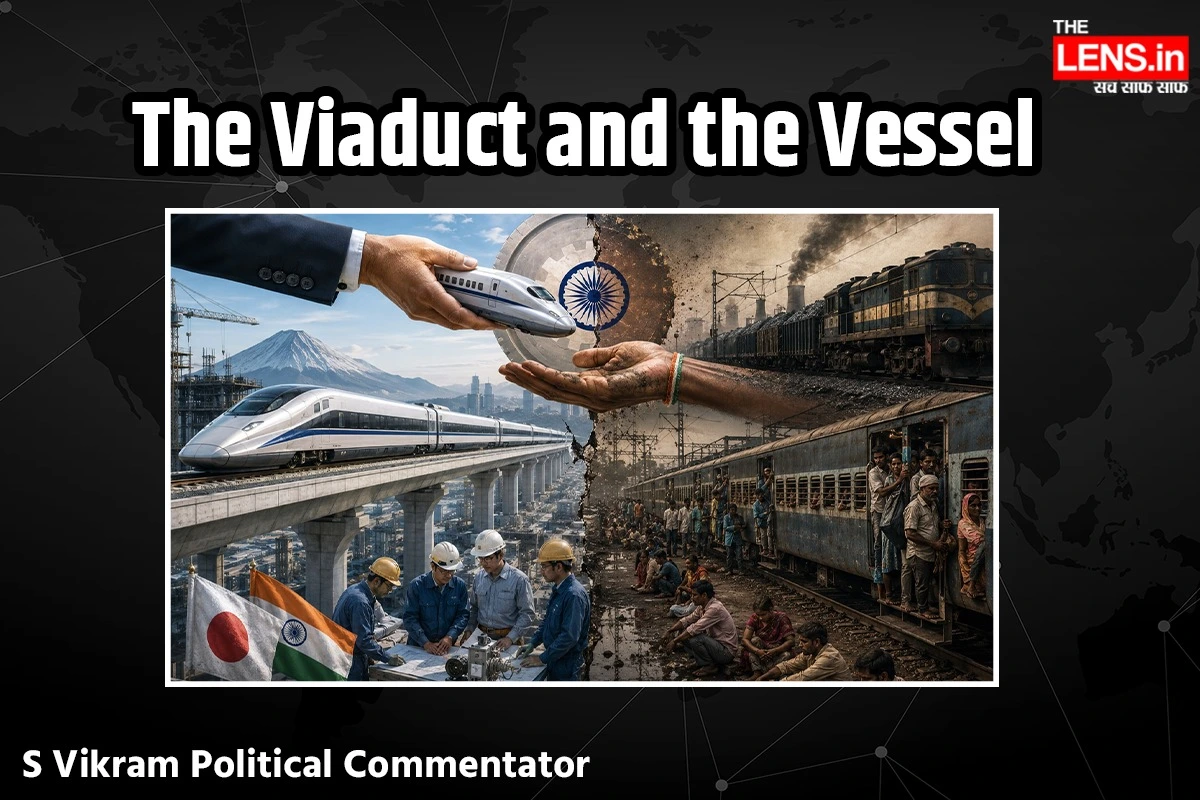
Last week, a former Japanese minister named Hideki Makihara posted what a million and a half readers evidently found irresistible: an account of the Mumbai–Ahmedabad bullet train marked by “the sheer recklessness of the Indian side,” a partner that “just doesn’t keep promises,” delays that were “entirely on the Indian side.” Indian commentary split along predictable seams — wounded nationalism on one bank, gleeful declinism on the other. Both missed what the tantrum actually illuminates. Makihara is wrong about the debt: India has serviced sixty years of yen loans without a missed rupee, and delivered Japan its global showpieces in the Delhi Metro and the Western Freight Corridor. He is right about something he does not name. India honoured the contract and cannibalised the deal — took the 0.1 per cent money, built the guideway, and then stripped out everything that made the project Japanese: the trainsets deferred in favour of an untested BEML–ICF machine, the signalling switched to European standards, the operating philosophy quietly localised. Japan financed, at a loss, a corridor that may open with Siemens electronics and an Indian train. No court would call it breach. No negotiator would call it good faith.
But the more instructive betrayal is not the one Tokyo suffered. It is the one the Indian state committed against itself, and it becomes visible only when you lay the bullet train’s twelve years alongside what happened, in the same twelve years, to the railway the poor actually ride.
Consider first what the dozen years built. The civil achievement is real and should be said plainly: 352 kilometres of viaduct stand complete, the land war that consumed four years in Maharashtra is finally closed, and the first stretch will open — with a symbolism nobody will miss — on 15 August 2027, five years to the day after the originally promised Independence Day launch. Indian contractors mastered full-span launching; fifteen geotechnical laboratories were raised to international standard; a generation of track engineers was certified in Japanese slab-track technique. India proved it could absorb the Shinkansen as concrete.
Now consider what it refused to build. Every country that ever created a high-speed rail industry built an institution before, or alongside, the track. Japan’s Shinkansen came out of the Railway Technical Research Institute, where displaced aircraft engineers spent a decade on vibration theory before a single train ran. China’s absorption of foreign technology worked because purchase contracts compelled transfer into state factories and laboratories staffed by tens of thousands of assigned engineers. Korea’s KTX transfer fed an indigenous programme within a decade. The mechanism is identical in every case: technology transfer follows procurement, and institutional capacity is the vessel that catches it. India inverted the sequence. It declined the Japanese trainsets on price, so the deep transfer — traction, bogies, train control — never had a contractual vehicle; and it built no vessel to receive what might have flowed anyway. Twelve years of Japanese specialists in Delhi produced trained users of a system, not designers of one, because nobody structured the relationship to produce designers. The “research centres” at the IITs remain chairs without budgets or mandates connected to any procurement pipeline. RDSO remains what it has been for half a century: a standards bureaucracy on career postings, not a research organisation; the Debroy committee’s proposal for a genuine one died in a drawer. And the wider modernisation is an archipelago of special-purpose vehicles — NHSRCL, DFCCIL, NCRTC, the metro corporations — each created precisely to bypass the Railway Board’s sclerosis, each with its own foreign funder and technology stack, each dissolving when its project ends, with no organ anywhere whose job is to compound what they severally learn. The SPV model solves the delivery problem by amputating the learning problem.
The arithmetic of the Vande Bharat states the consequence with cruel economy. The Bhopal Shatabdi ran at 150 kilometres per hour in 1988. The Vande Bharat’s ceiling is 160 — a gain of ten kilometres per hour in thirty-five years — and on many routes its commercial average is slower than the Shatabdi timings it replaced, because the constraint was never the train but the track, and raising speed on legacy track is an attrition war of fencing, level crossings and signalling that produces no ribbon-cuttings. The freight corridors were built expressly to free the trunk routes for exactly this upgrade; the freight moved, and the passenger dividend was never collected. The system multiplied the announceable component — the train, photographable, flag-offable in batches by videoconference — and let the unphotogenic permanent way crawl. This is not incompetence. It is a preference, consistently exercised.
And the preference has a class character, because in the same twelve years the railway’s political function was rebuilt from the foundations. The ministry that was once the crown jewel of coalition politics — Lalu’s, Mamata’s, a sovereign duchy of jobs and stoppages — was deliberately demoted: the ninety-two-year-old separate rail budget merged away in 2017, ending the annual parliamentary moment at which the railway had to account for itself as a social institution; the portfolio parked with technocrats who hold it alongside other ministries. What looks like depoliticisation was repurposing. The railway stopped being a distributive instrument, dispensing patronage downward to constituencies, and became a spectacular one, dispensing imagery upward to the regime. The clearest casualty was the one form of patronage the poor could actually eat — recruitment, throttled until it produced riots in Bihar.
The pandemic then consolidated the reorientation at a stroke. The first complete suspension in the railway’s history — a network that ran through wars, Partition and the Emergency — was ordered overnight; freight never stopped; the Shramik Specials began only after the walking migrations had become a national shame, and charged fares; aviation resumed while ordinary services crawled back over two years under “special” labels carrying premium prices. The senior-citizen concession, suspended “temporarily” in March 2020, was never restored — a permanent annual extraction of some two thousand crore from the demographic least able to contest it. Under cover of emergency, general and sleeper coaches were pared back as AC stock expanded, so that every festival season now produces the same diptych: compressed human mass in the unreserved compartments, vacant berths on flexi-fare premium trains.
Nowhere is the new ordering enacted more nakedly than in Chhattisgarh. In 2022 the Railways cancelled 753 passenger trips nationwide to prioritise coal rakes, the great bulk in the South East Central zone; an official explained that cancellations were confined to “non-priority sectors” — an immortal phrase for the routes the poor ride. The emergency passed; the cancellations did not. For five years, under the label of “infrastructure works,” the Korba–Bilaspur belt has watched its passenger and MEMU services suspended for months at a stretch while coal — the state’s SECL coal, and the coal that private mine operators cut from the Hasdeo forests — ran uninterrupted. The corridors that would have carried that coal off the passenger network were the portions of the freight-corridor programme that were deferred. The choice between the miner’s commute and the mine’s output did not have to be made; it was made anyway, daily, in one direction, and the same extraction that cancels the Adivasi’s train is clearing the Adivasi’s forest.
Set the two halves of the ledger side by side and the twelve years acquire their true shape. On one side: a state that can pour a Japanese-financed viaduct at heroic pace, choreograph two prime ministers aboard a Shinkansen to Sendai, and time an inaugural run to Independence Day. On the other: no research institute, no restored concession, no second sanctioned corridor among the seven left as PowerPoints, no train at the Korba platform. The common principle is a contempt — there is no softer word — for everything that compounds slowly and photographs badly: institutions, permanent way, the unreserved passenger, the trust of a lender. Even the Japan account closes on this logic. India ran a relationship as a transaction, and the visible saving — a few thousand crore on trainsets, perhaps two per cent of project cost — was purchased with the goodwill premium of its most patient creditor, a premium that will silently reprice every corridor, fab and co-development to come. The bullet train will run, and it will be, in its way, magnificent. But a railway, like a republic, is not its inaugurations. It is the boring vessel that catches what the spectacle spills — and the vessel, after twelve years, was never built.