On the commentary that grades the opposition while the field is carried away
Sekhar Gupta in his new video, has repeated what is now a cliché. Gupta, one of the country’s most practised political commentators, poses what it takes to be the hard question of the hour: why is the Congress such a convenient rival for the BJP, and how might it make itself a credible one? The analysis is fluent, the history deployed with the confidence of a man who has covered five decades of it, and the conclusion — that the Congress must reclaim nationalism or watch a two-party equation collapse into a one-party state — has the air of tough love. It is being shared as candour.
It is, in fact, a small masterpiece of inversion. Not because its observations about the Congress are false — many are painfully true — but because the entire grammar of the exercise concedes, before a single argument is made, everything that ought to be contested. To answer the question as posed is to have already lost. The task of this essay is to refuse the question and restore the one it displaced.
I. The concession in the grammar
Consider the vocabulary. The BJP runs on four “engines.” The Congress has a “strike rate” of roughly ten per cent. The parties are offering “products,” and the opposition must find “product differentiation.” Hindutva is “territory that is taken.”
This is the language of market analysis, and its application here is not a stylistic tic. To describe Hindutva as an engine is to have decided that it is a legitimate propulsive force in a competitive system — something a rival matches, counters, or concedes, like a fuel-efficiency advantage. But the Constitution of India does not treat the mobilisation of religion for state power as a competitive offering. Secularism is basic structure; the Supreme Court said so in S.R. Bommai. Section 123(3) of the Representation of the People Act was written precisely to make the appeal to religion a corrupt practice capable of voiding an election. The machinery to disallow this engine exists on paper.
What happened to it is a history of serial abdication: the 1995 judgments that defanged the provision with the “way of life” evasion; an Election Commission that ceased to enforce what remained, presiding over a 2024 campaign in which speeches that would once have invited disqualification invited nothing at all; courts that developed a selective velocity; and a press that quietly converted the question is this permissible into the question is this working.
The commentator’s genre is the terminal stage of that conversion. The analyst’s detachment is presented as neutrality about normalisation. It is the normalisation. There is even a small emblem of the method in the piece itself: the author fastidiously declines the word “juggernaut” because it derives from religious tradition, while treating the actual injection of religion into the state as settled competitive terrain. The metaphor is policed; the thing itself is scored on performance.
And once the genre’s grammar is accepted, the Congress’s position on this ground reads not as failure but as something closer to abandonment’s residue. The defence of the secular ground was never assigned to one party. It was assigned jointly — to courts, commissions, press, civil society — as a suprapolitical trust. Those posts have been vacated one by one. What remains on the ground is a single, weakened, often inept, frequently compromised formation, graded for its insufficiency by commentators whose own profession held one of the vacated posts. The Congress on this terrain is not a failed competitor. It is the lone remaining occupant of a line that was supposed to be jointly manned, audited for its porosity by the very trustees who left.
II. Who is the subject of politics?
Beneath the grammar lies the deeper inversion, and it concerns the most elementary question political theory knows: who is the subject of politics?
The classical answer is definitional. Edmund Burke defined a party as a body of men united to promote, upon some particular principle, the national interest. The party, by construction, is an instrument — a proposal about how the permanent subject’s interest is to be served. It competes with other proposals. It dies when its proposal fails. The nation is the principal: in Burke’s image a partnership among the dead, the living, and the unborn, and in the Indian case precisely what “We, the People” codifies — the constituent power that precedes and outlasts every constituted body. Parties have no permanent interests because parties are not permanent. Only the nation is, theoretically, permanent; only the nation has permanent and valid interests.
It is worth noticing that the Constitution of 1950 does not mention political parties at all. They entered the constitutional text only in 1985, through the Tenth Schedule — and observe what that entry accomplished: it made the legislator the property of his party rather than the agent of his electors. The single place where parties achieved constitutional existence is the place where representation was first subordinated to the instrument. The inversion has a statutory birthday.
The commentary genre completes the inversion discursively. In the horse-race grammar, parties are the persons of the drama — they have interests, strategies, engines, survival prospects — and the nation appears only as terrain: territory to be taken, vote banks to be harvested, states to be won. The subject has become the prize. And once that grammar is installed, the question what is the national interest and is it being served becomes literally unaskable — not forbidden, simply without a grammatical slot. The discourse of the moment can be summarised in one sentence: the BJP is destroying the Congress, which in turn, is failing to safeguard the national interest. Read it twice. It mourns the instrument and forgets the principal. It is a shareholder report grieving for the management while the company is stripped.
Restore the principal, and the audit standard restores itself, because the national interest of a constitutional people is not a mystery to be intuited by strategists. It is codified. The Preamble is India’s interest statement: justice — social, economic, political; liberty; equality; fraternity assuring both the dignity of the individual and the unity of the nation. Beneath the codification lie three material substrates: the capacity of the people to reproduce their lives; sovereignty, external and undivided; and the epistemic commons — the sovereign’s capacity to know its own condition, without which its final responsibility cannot be discharged.
Run the audit against that standard rather than against four engines, and the verdicts write themselves. Fraternity: formally repudiated by a politics of graded citizenship. Sovereignty: theatrically asserted inward against citizens, quietly traded outward — a government of maximal nationalist theatre that could not bring itself to contradict a foreign president claiming, repeatedly and publicly, to have ordered India’s ceasefire, and that absorbed tariff coercion with negotiating servility. A hyper-nationalism directed at the governed and a deference directed at the powerful is not a hard nationalism; it is the simulation of nationalism deployed as an instrument of internal hierarchy. Justice: unmeasured, because the measuring institutions have been captured, the datasets delayed or discontinued, the auditors defunded. Welfare: recoded from justiciable right to sovereign’s grace — the rights architecture of NREGA, the food security law, the right to information, in which the citizen was a bearer of claims and the state an auditable duty-holder, re-personalised into the face on the ration bag and the prefix on the scheme, gratitude replacing audit, the labhārthī replacing the citizen. Infrastructure: “visible to all,” in the commentator’s approving phrase — but what has also been visible is the falling: the bridges, the canopies, the tunnel, the leaking new buildings; and what has been kept invisible is the financing — monetisation of public assets, tolls in perpetuity, contractor concentration. The four engines are party performance metrics. The genre cannot return a verdict on the nation because the nation was never its client.
III. The interest prior to all interests
There is one interest of the nation that stands prior even to the Preamble’s substantive promises, because every other interest depends on it: the preserved capacity of the people to correct their own government. Call it contestability.
Here the obvious rejoinder must be met head-on, because it will be made: India was effectively a one-party state for its first two decades, under the Congress, and nobody calls the Nehru years sabotage. The rejoinder dissolves under one distinction, which is Rajni Kothari’s, sharpened by Adam Przeworski. Kothari’s “Congress system” was a dominant-party system: one party kept winning contests it could genuinely lose. Przeworski’s austere definition of democracy is exactly this — a system in which parties lose elections; institutionalised uncertainty. The Congress system passed that test repeatedly: in the states in 1967, nationally in 1977. The dominance was an outcome; the contestability beneath it remained intact, which is precisely why the dominance ended.
What is being constructed now is the inverse: not a party that keeps winning, but the progressive abolition of the conditions under which it could lose.
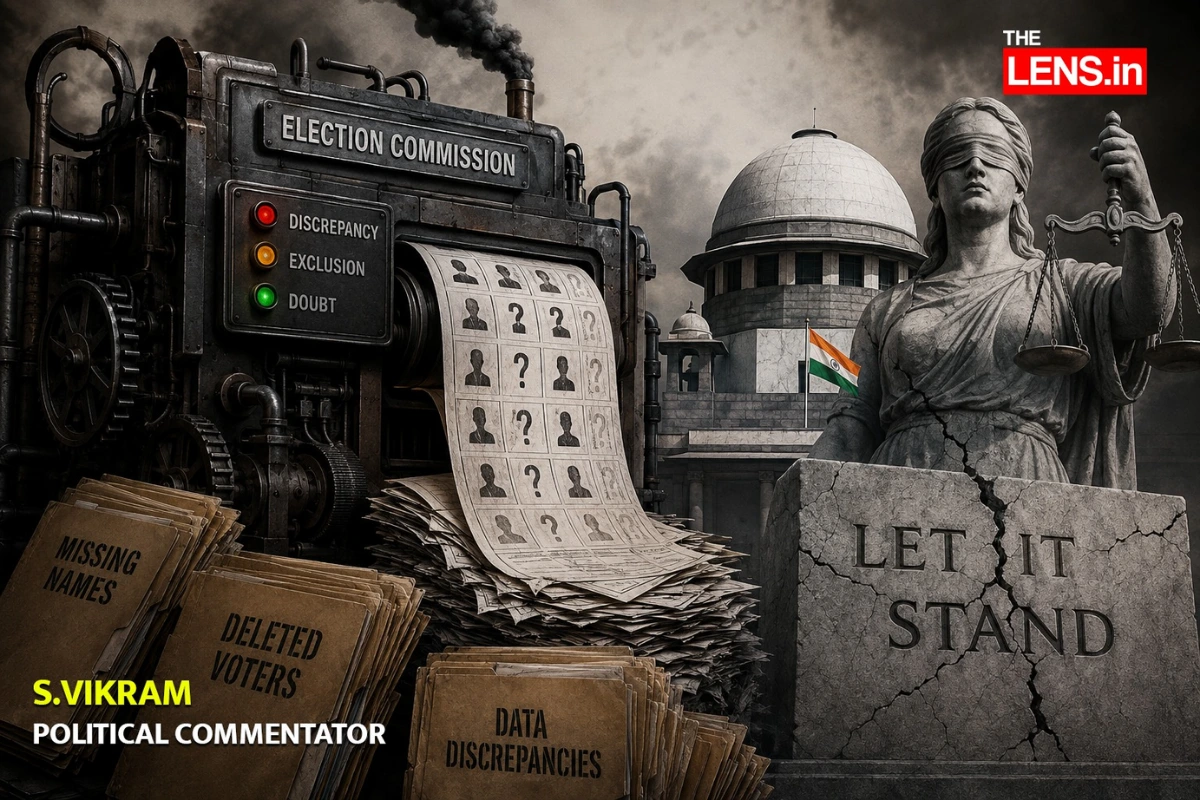
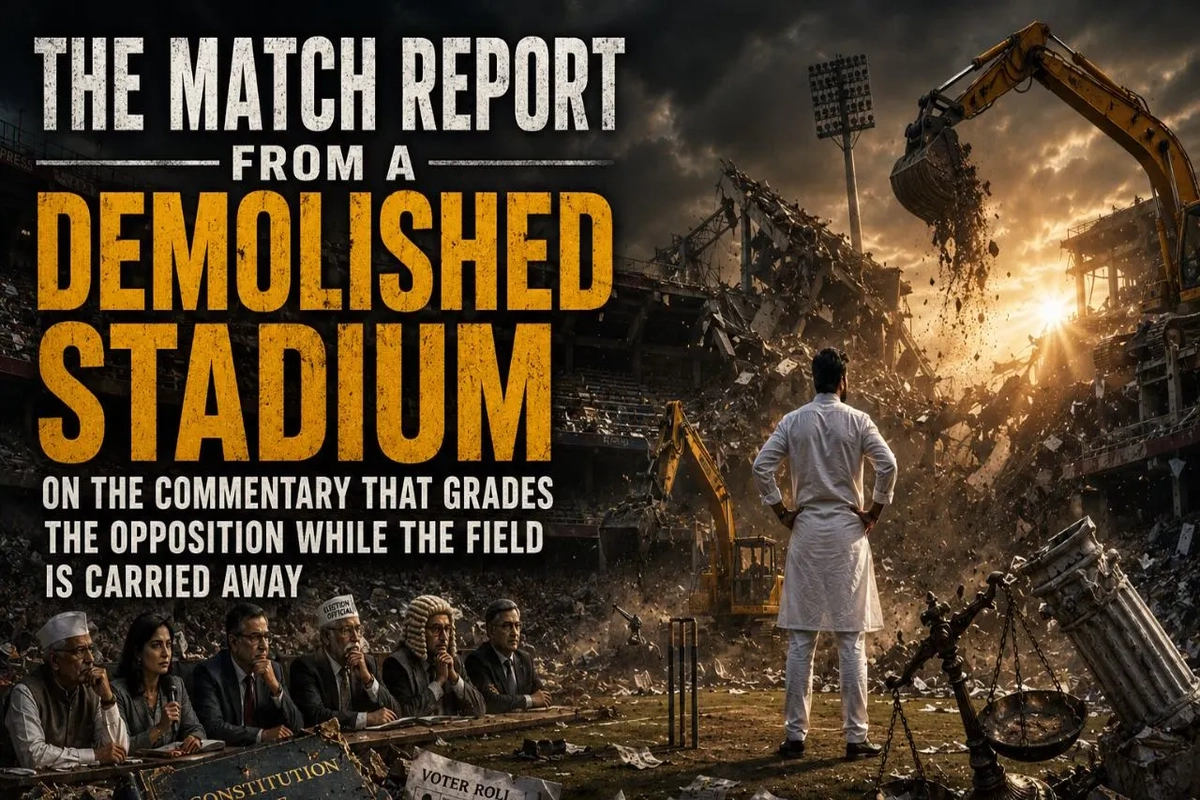
Bengal is the demonstration case, and its facts should be stated without adjectives because they need none. Before the 2026 assembly election, a Special Intensive Revision of the electoral rolls removed roughly 9.1 million voter entries — about twelve per cent of the state’s electorate. Over six million were categorised as absentee or deceased; the status of some 2.7 million remained pending before hastily assembled tribunals as the state voted. The election ended fifteen years of Trinamool rule in a landslide for the BJP. Perhaps the incumbent deserved defeat; fifteen-year governments often do. That is not the point. The point is that the terrain was rewritten before a single vote was cast, by administrative process, under legal colour, at a scale — twelve per cent of a sovereign electorate — that in any functioning discourse would be the only story. A commentator who surveys this field and files a column on the opposition’s strike rate is not analysing the contest. He is refereeing a match in a stadium that is being dismantled around him, and scoring the away team’s footwork.
Why does the destruction of contestability injure the nation itself, and not merely the parties that lose by it? Because a polity that cannot change its government loses its error-correction capacity. Information stops flowing upward: no one audits the unfireable. Policy mistakes compound without reversal. Federal counterweights collapse. The epistemic commons closes, because the incentive to know the truth about the nation’s condition dies with the possibility of acting on it. This holds for the ruling party’s own voters, and it should be said to them plainly: you cannot fire what cannot lose. The permanent interest of the nation includes, before any policy, any scheme, any temple or corridor, the preserved capacity to correct itself. One-party permanence is the abolition of exactly that capacity. The question the commentator poses at his conclusion — will the two-party equation collapse into one? — is thus not a horse-race question at all. It is the question of whether the principal is being destroyed. And it deserves a name.
Indian constitutional law has already supplied one, in a precedent whose provenance settles in advance every charge of partisanship this essay will attract.
In Indira Nehru Gandhi v. Raj Narain, 1975, the Supreme Court struck down a constitutional amendment that had immunised the Prime Minister’s own election from judicial scrutiny, and held that free and fair elections belong to the basic structure of the Constitution — beyond the reach even of constituent power. The doctrine was forged against the Congress, at the precise moment of its own authoritarian temptation. The yardstick is not the opposition’s. It is the Constitution’s, and it was first laid against the party that now holds the hose. On settled Indian doctrine, the deliberate engineering of the impossibility of electoral defeat is subversion of the basic structure. Not metaphorically. Doctrinally.
IV. The installer and its method
Who, then, is installing the single-party situation? The lazy answer — the BJP — fails on the installer’s own theory, for the party describes itself, through its parent, as one limb of a civilisational project whose horizon is measured in generations. The Sangh has never concealed the doctrine that supplies the justification: the claim to be the nation’s own self-awareness, the eternal people congealed into an organisation. Claude Lefort taught that democracy’s defining achievement is to keep the place of power empty — occupied temporarily, by permission, embodied by no one — and that the totalitarian temptation begins the instant a body claims to be the people. “Indira is India” was that claim in its crude form, and the demos rebuked it within two years. The present claim is the same identification, systematised, patient, and institutionally armoured. If the movement is the nation, then the elimination of alternation is not democracy’s death but its fulfilment: the people finally united with their true body. That is the doctrine. Everything else is execution.
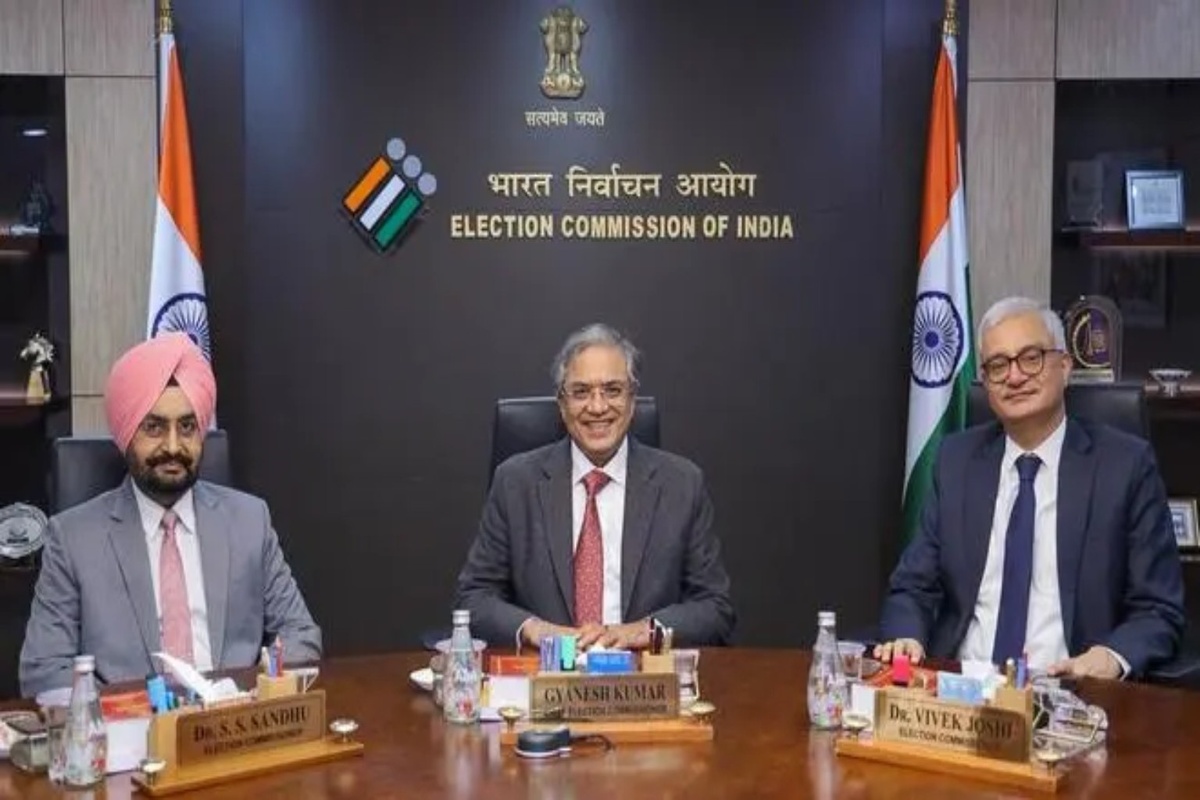
The execution is layered. The movement supplies the theology. The party executes. The captured referees — the Commission that revises the rolls and allocates the split parties’ symbols, the agencies whose docket so reliably tracks the defection calendar, the Speakers who sit on disqualification petitions until they ripen into governments — convert execution into legality. Concentrated capital finances the apparatus and is fed by it. And at the outermost ring stands the discourse class, which performs the operation on which all the inner rings depend: translation.
For the method’s genius — and Nancy Bermeo’s comparative work on democratic backsliding names it precisely — is legibility management. The coup and the declared Emergency are legible; the nation sees the knife. Indira’s Emergency was announced, visible, and therefore reversible in nineteen months by the very electorate it insulted. The contemporary method — executive aggrandizement, autocratic legalism — proceeds by increments, each defensible in isolation, each executed through law’s own instruments against law’s purpose. A roll revision is an administrative exercise. An agency acts under statute. A Speaker rules under the Tenth Schedule. A symbol is allocated under the Commission’s own rules. No single step is a knife. Only the vector is fatal — and the vector is exactly what the horse-race genre is structurally incapable of reporting, because the genre narrates each increment as ordinary competition. The demolition arrives in the newspapers as a match report. This is why the savvy commentary is not merely a failure to describe the apparatus. It is the apparatus’s outermost operating condition. The translation layer is load-bearing. No conspiracy is required and none is alleged; the genre’s own filters — access dependence on the establishment it analyses, a market that rewards insider knowingness over normative judgment, the professional pose in which detecting what works is sophistication and asking what is allowed is naïveté — produce the service organically. A system that generates its own translators without having to hire them is more durable than one that must pay. The reader may draw whatever further inference the evidence compels. The essay requires only the mechanism.
V. The satraps’ fall and the last formation standing
The same commentary school spent a decade insisting that the regional parties resisted the BJP better than the Congress, and that the Congress’s weakness was therefore the singular problem. Recent history has run the experiment. Odisha fell in 2024, the BJD dissolving into collaborative senescence and then defeat. Maharashtra fell the same year, both the Shiv Sena and the NCP split down the middle — not ideological schisms but hostile takeovers of firms whose principal asset was a family name, with the Commission adjudicating which faction owned the brand as if allocating a trademark. Bihar followed in 2025. And in 2026 Bengal — the one state where a satrap had actually beaten the full machine in open contest — fell after the electorate itself was revised. The thesis is dead. It was never true.
It was never true because the regional parties’ celebrated resemblance to the BJP — the centralised command, the clear designation of enemies, what the Sangh itself calls shatru bhav — was superficial in the one respect that decides survival. The BJP’s enemy is transcendent and its command is institutional: the shatru is written into a hundred-year ideological formation that no individual owns, and therefore no agency can attach. The satrap’s enemy is positional and his command is proprietary: the enemy is whoever obstructs the proprietor, and can be re-designated overnight — as one Bihar career has demonstrated serially. A friend-enemy structure anchored in a person’s interest is not a fortress; it is a tradable asset. When the party is the supremo’s estate, you capture the party by encumbering the estate. That is why the machinery of decapitation, splitting, and succession-engineering works on these formations and why it has now worked on nearly all of them.
The true cleavage in Indian party politics is therefore not regional versus national. It is movement-anchored versus proprietor-anchored. The DMK still stands, and Kerala’s CPI(M) still stands — regional formations both, but neither a proprietary firm: each is a congealed movement, sitting atop a century of Dravidian or communist ideological infrastructure that no summons can reach. Proprietor parties fall to the estate-capture toolkit. Movement parties can be defeated only by counter-movement. And on that map the Congress is simply the only national movement-anchored formation left — the congealed form of the freedom movement itself, which is why it has survived every split since 1969 while every splinter either merged back or shrivelled. You cannot serve a summons on the freedom movement. The legacy is a commons, not an estate.
One further structural fact deserves naming, because the commentariat scores it as weakness. The Congress tradition, at its Gandhian best, is constitutively without shatru bhav: opponents to be persuaded, never enemies to be annihilated. In a friend-enemy age this is an electoral liability, and honesty requires saying so. But it is also the reason the formation cannot be digested by the machine, because capture operates through the enemy-switch — you flip a party by re-designating its enemy — and a party without a designated enemy offers the mechanism no purchase. What the match report grades as the Congress’s competitive deficiency is, structurally, the sole reason it is still on the field being graded.
VI. The dyke and the flood
None of which makes the Congress the protagonist of this story. The restoration of the principal demotes it, correctly, to what it is: an instrument — and at present a poor one. An old dyke, cracked, badly maintained, holding a family where an engineering department should be. Its errors of political craft are real and this essay will not launder them: a leadership that cannot separate the armed forces from the government in its criticism, that raises questions where its grandmother’s generation would have first heaped praise and then attacked, that lacks the footwork to walk back a misstep while its opponent walks back three in a week and never repeats them. All true. All secondary.
Because the dyke, whatever its masonry, is the last structure standing between the water and the plain — every other structure built to hold that line having been dismantled, captured, or having dissolved itself. And the genre under review, restated in this frame, becomes almost grotesque: it measures the dyke’s porosity, publishes learned assessments of its cracks, and never once names the flood or asks who opened the sluices. The fire brigade is graded on hose pressure while the arson is scored for efficiency. At worst — and this is the harshest thing that can truthfully be said of it — the Congress is a weak force trying to stem an onslaught. The commentary’s framing, in which a virile party is regrettably destroying an incompetent one, is not analysis of that situation. It is its inversion, and the inversion is not innocent, whatever the innocence of any individual who performs it.
The Congress’s standing as last defender does not exempt it from the Preamble audit. It raises the standard, because a weak defender of a permanent interest owes the principal its own reform. The rulebook must become its contest: the rolls, the referees, the schedule of the game itself, made the national question with the pan-Indian constitutional legitimacy that only the freedom-movement inheritance confers — for a regional party contests within a single arena and has no standing when the arena itself is rigged, but the heir of the constituent generation does. Welfare must be re-grounded as right against grace: the citizen restored as bearer of claims, the state as auditable duty-holder, audit itself made the visible thing. And nationalism — the ground the commentator correctly identifies as open and incorrectly frames as product — must be reclaimed not by competing for the temple but by re-founding on the Constitution: the nationalism that is analytically entailed by popular sovereignty itself, in which the nation just is the body of equal citizens, so that a politics grading citizenship by faith is exposed not as a harder nationalism but as a rival theory of the nation that negates the very demos it claims to exalt. The nation is entitled to a better instrument. It is simply not obliged to pretend, while the water rises, that the instrument is the flood.
VII. The empty chair
A closing discipline, held against the essay’s own temptation. “National interest” is historically a dangerous phrase; every authoritarian has claimed it, and the present one claims it hourly. The cure for the inversion is not a truer claimant to the nation’s voice. Part of the nation’s permanent interest is precisely that its interest remain contestable — that no body, no party, no sangh, no commentator, ever finalise its content. The Preamble gives the frame; the demos fills it, generation by generation, in freedom. The chair at the head of the table stays empty. That emptiness is not a vacancy to be filled by the strongest engine. It is the constitutional form of the people’s permanence — the only permanence in the room.
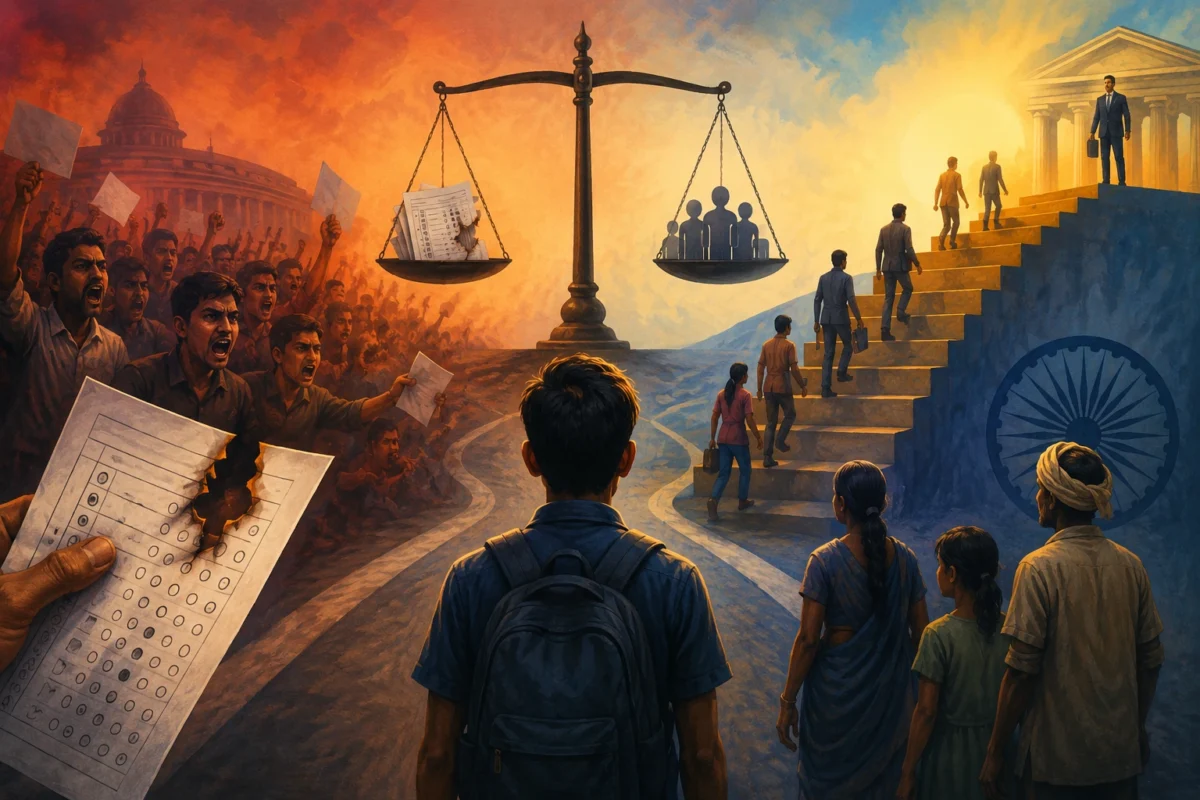
The subject of politics is the nation. The parties are its instruments; the commentators, its trustees; the elections, its instrument of self-correction; the Constitution, its interest statement and its memory. Every one of these propositions was once too obvious to state. That they must now be argued — against an apparatus that has made one party the nation’s body, and against a commentary that has made the parties the nation’s subject — is itself the measure of how far the inversion has gone. The video asks how the Congress can become a convincing challenger. The prior question, the only permanent question, is how the people remain the sovereign. Answer that one first. The strike rates can wait.