A Reckoning or a Risky Overreach?
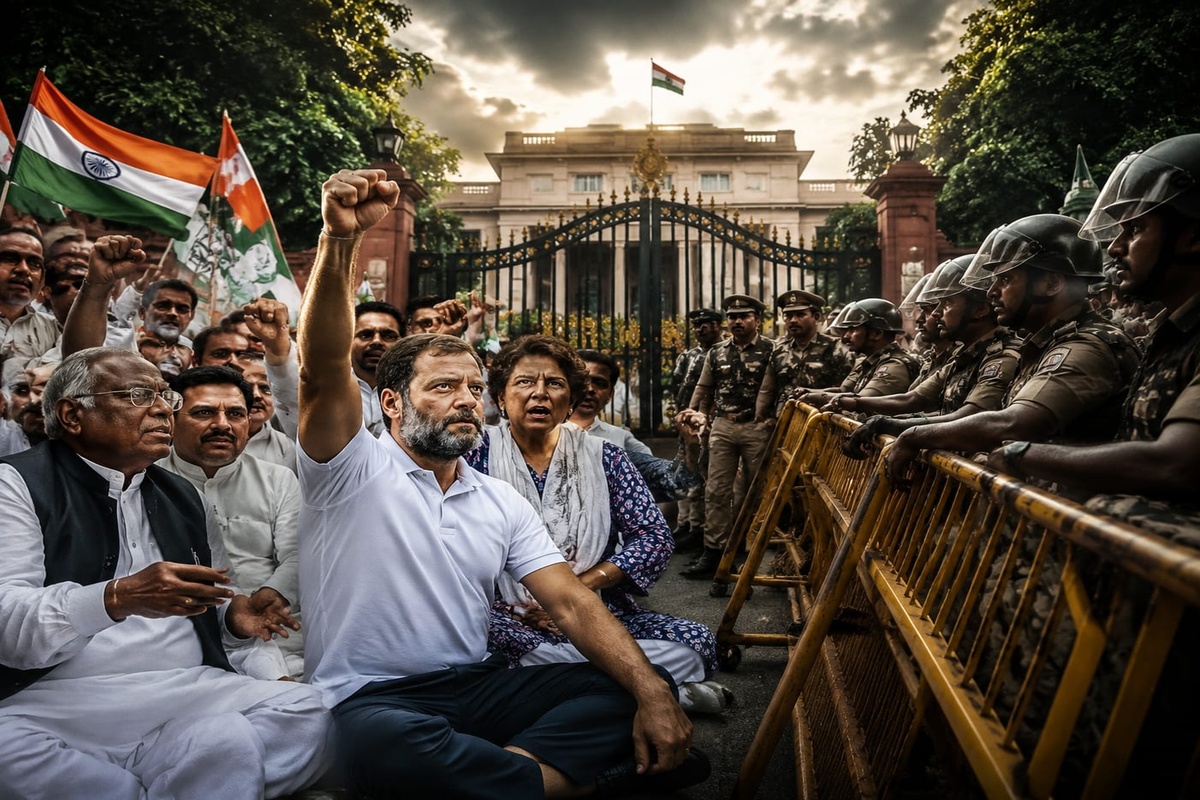
The political landscape in New Delhi has been dramatically reshaped today, with the Congress party executing a political maneuver that has caught everyone—from the security establishment to political pundits—off-guard. In a move that signals a radical departure from its recent political strategy, the grand old party, under the leadership of Rahul Gandhi, transformed what was presumed to be a birthday celebration for party president Mallikarjun Kharge into a high-stakes sit-in protest directly outside Prime Minister Narendra Modi’s residence . This act of defiance, a “dharna” at the gates of 7, Lok Kalyan Marg, represents a critical test of strength and will between a resurgent opposition and a government that has often appeared impervious to street-level dissent.
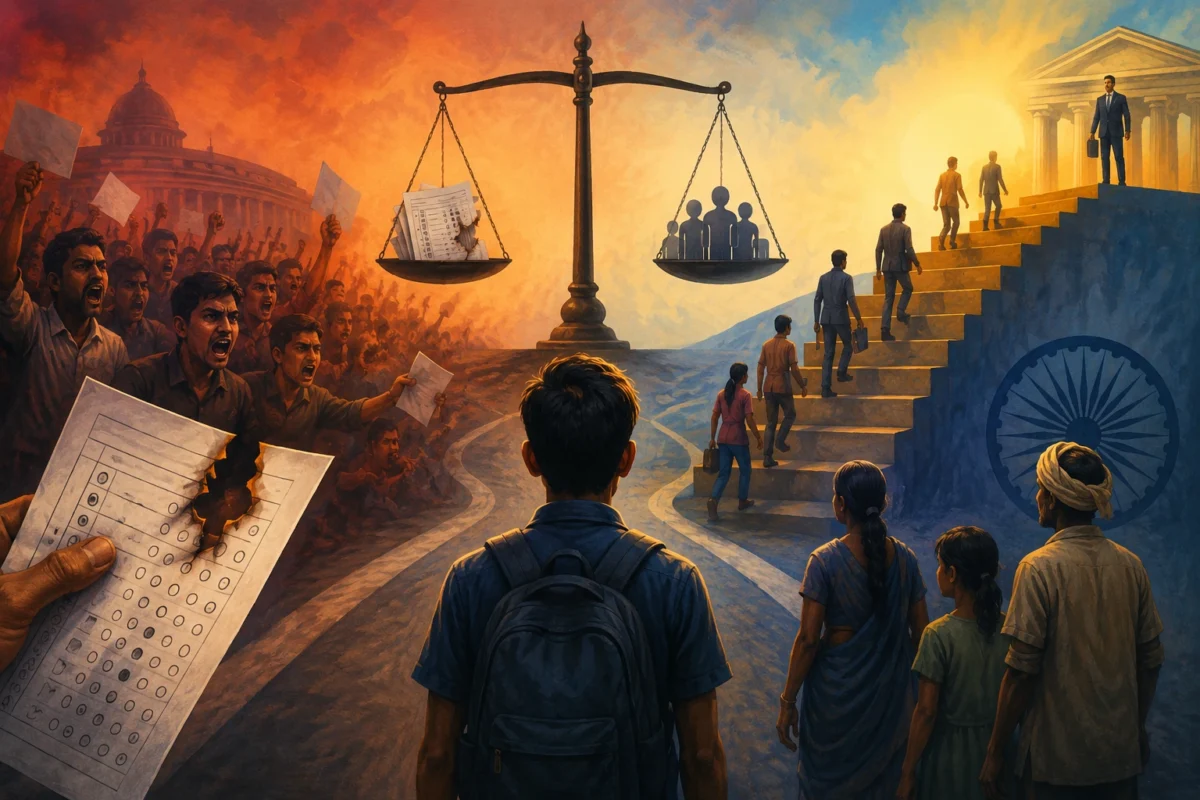
The protest was not merely a symbolic gesture. It was the culmination of a 40-day campaign, ‘Chhatron Ki Goonj,’ which was strategically designed to galvanize student and youth sentiment against the government over the alleged NEET paper leaks and widespread examination irregularities . The immediate trigger was the violent police crackdown on the ‘Chalo Sansad’ march organized by the Cockroach Janta Party (CJP) and activist Sonam Wangchuk the previous day, an event that saw the deployment of tear gas and lathi charges against protesting students . For Rahul Gandhi and the Congress, this was the final straw, a moment to escalate from parliamentary demands to direct political confrontation.
The Strategy of Surprise and the Power of Street Politics
The Congress leadership executed a masterstroke in political tactics. By using Kharge’s birthday as cover, they assembled a formidable force of their parliamentary party, including the “big 3” of Kharge, Rahul, and Priyanka Gandhi, and marched the 2.3 kilometers to the Prime Minister’s residence . The element of surprise was crucial. It allowed the opposition to bypass heavy security barricades and occupy a space where they could force a direct political dialogue, catching security personnel off guard . This marks a significant shift in the Congress’s approach. For the first time in years, it has demonstrated a capacity for tactical agility and a willingness to take its fight from the debating halls of Parliament to the streets, riding on a wave of genuine popular sentiment surrounding youth unemployment and educational reform .
However, the protest raises questions about the limits of this new militancy. While the government, through Minister of State for PMO Jitendra Singh, engaged in a rare moment of dialogue with Rahul Gandhi, the administration quickly reverted to form, deploying the Rapid Action Force to forcibly remove and detain the protesting MPs . The message was clear: while the government is willing to talk, it will not tolerate any challenge to the sanctity of the Prime Minister’s high-security residence. This dynamic has fueled allegations from the Aam Aadmi Party (AAP) of a “jugalbandi” between the Congress and the BJP, citing the government’s swift engagement with Congress while stonewalling the CJP’s agitation for weeks . Whether this charge holds merit or is a cynical political potshot, it highlights the complex and often murky nature of the current political battlefield.
A Perfect Storm or a Political Overreach?
The Congress’s gamble is multifaceted. On one hand, it seeks to align itself with a new, non-partisan social movement embodied by the CJP, tapping into the widespread anger and anxiety of India’s youth. Rahul Gandhi has been relentlessly building this narrative, framing the issue not just as a technical failure but as a “broken system” that oppresses young people and their families . By marching to the PM’s residence, he is attempting to position himself as the uncompromising champion of this cause, willing to face arrest and state force for the sake of the nation’s students.
Yet, the political calculus is fraught with risk. The mainstream political discourse, particularly for the vast base of Hindutva sympathizers, may not be significantly swayed by the issue of paper leaks, which, while a matter of deep concern for the aspirational middle class, might be viewed as a single-issue grievance in a broader landscape of national pride and security. The government seems to understand this, betting that Rahul Gandhi’s protest will be perceived as a disruptive, anti-national act rather than a legitimate democratic exercise. The security establishment’s framing of the protest as a threat to public order, drawing unflattering comparisons to the crises in Sri Lanka and Bangladesh, is designed to delegitimize the Congress’s actions in the eyes of the aam aadmi .
The Forthcoming Crucible: The Unpredictable Variable
Despite the police action, the political standoff is far from over. Rahul Gandhi’s political persona is defined by a stubborn refusal to back down, even in the face of personal risk or state power. The Congress’s ability to continue the protest is bolstered by a strategic geographic position: the “Jat belt” of Haryana is in turmoil, and the state borders Delhi are just a stone’s throw away. As the BJP-led government learned during the farmers’ movement, it cannot easily outmuscle the Jat community, who forced a political reckoning over the now-repealed farm laws.
Adding to the government’s complications, farmers from Punjab have already begun marching towards Delhi to protest a proposed US trade deal, citing fears of devastating agricultural imports . While they have been stopped at the Shambhu and Khanauri borders , their proximity to Delhi creates a potential tinderbox. If the Jat farmers from Haryana successfully join the Punjab farmers en route and march into the capital, their numbers could dramatically escalate the scale of the protest. This convergence of student and farmer discontent—historically a potent combination in Indian politics—presents the Modi government with a formidable challenge. The Ram Mandir donation scam has also, as the text notes, arguably defanged one of the BJP’s most potent political weapons—the ability to deflect criticism with the “anti-Hindu” jibe. At the same time, global events, including the Trump administration’s trade policies and China’s geopolitical rise, have diminished the government’s hyper-nationalism plank, forcing it to navigate this crisis within a more conventional political vocabulary.
A Hinge Moment for Indian Democracy
The events of July 21, 2026, mark a pivotal moment in Indian politics. Rahul Gandhi has taken a political risk of the highest order, using his final weapon of street protest to directly challenge the Prime Minister. The government has responded with force, but the politics will not die down. The Congress now has a unique opportunity to sustain the momentum by opening its party offices and MP residences to the thousands of students stranded in Delhi, creating a semi-permanent center of resistance that could serve as a constant check on the government’s actions .
The coming days will be a test of endurance and political skill. Can the Congress convert a moment of tactical success into a sustained political movement that reshapes the narrative against the Modi government? Or will this high-stakes gamble be dismissed as a political overreach by a government that remains unshaken by moral challenges? One thing is certain: Rahul Gandhi has committed himself, and for the first time, he appears to have his party backing him fully. The steel of this political clash is far from being tested to its breaking point.