What remains of the first independence, and what is at stake
- CHAPTER EIGHT
The Second Independence Re-examined
Twelve years on, we can answer with more confidence than the anniversary’s partisans would prefer: What was the second independence?
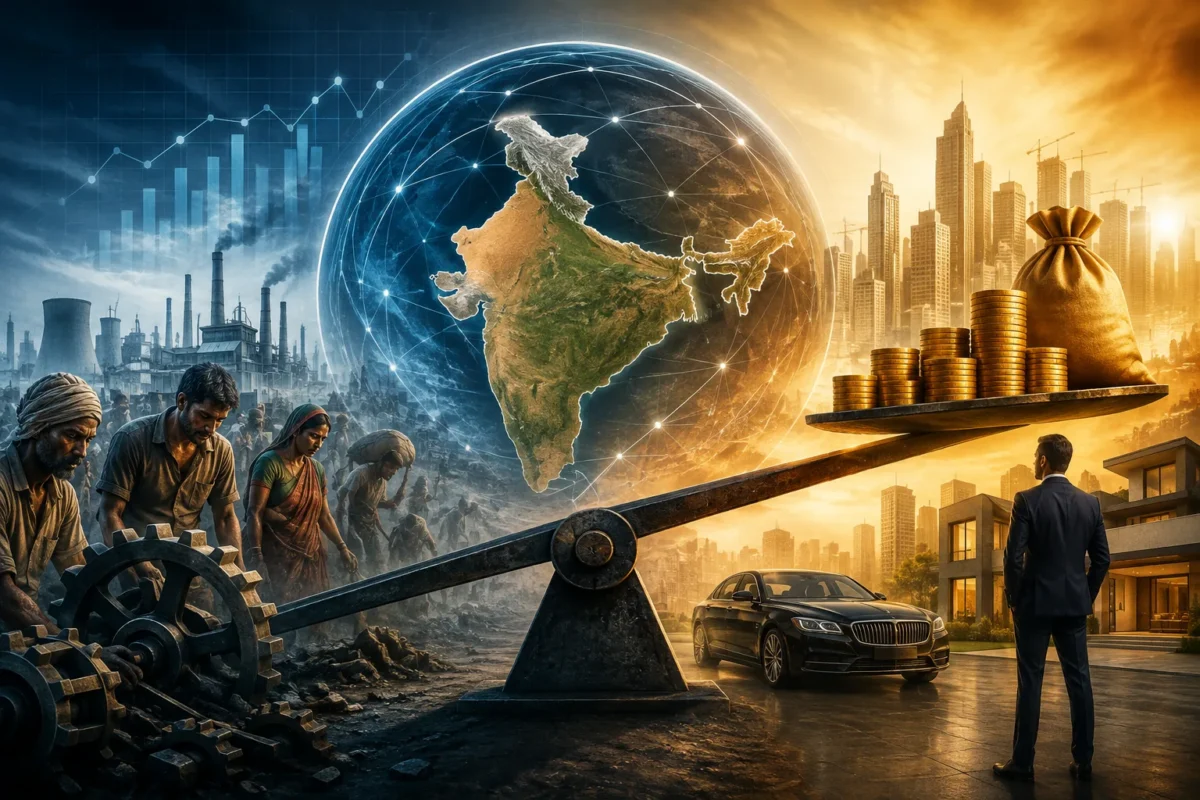
It was not a liberation of the poor from corruption and misgovernance. The poor remain poor. Inequality has deepened dramatically, in ways measurable by every serious index. The corruption has not diminished; it has been restructured — moved from the petty extortion of the lower bureaucracy to the grand larceny of policy capture, where decisions are made between the Prime Ministerial Office and a small circle of favoured corporate interests, and where the Electoral Bond scheme was the formal architecture of exchange.
It was not a liberation of states from the Centre’s authority. The constitutional design of federalism has been operationally hollowed out even while its textual provisions remain unchanged — the most sophisticated kind of demolition, because it leaves no rubble to point to, only the ghost of what once functioned.
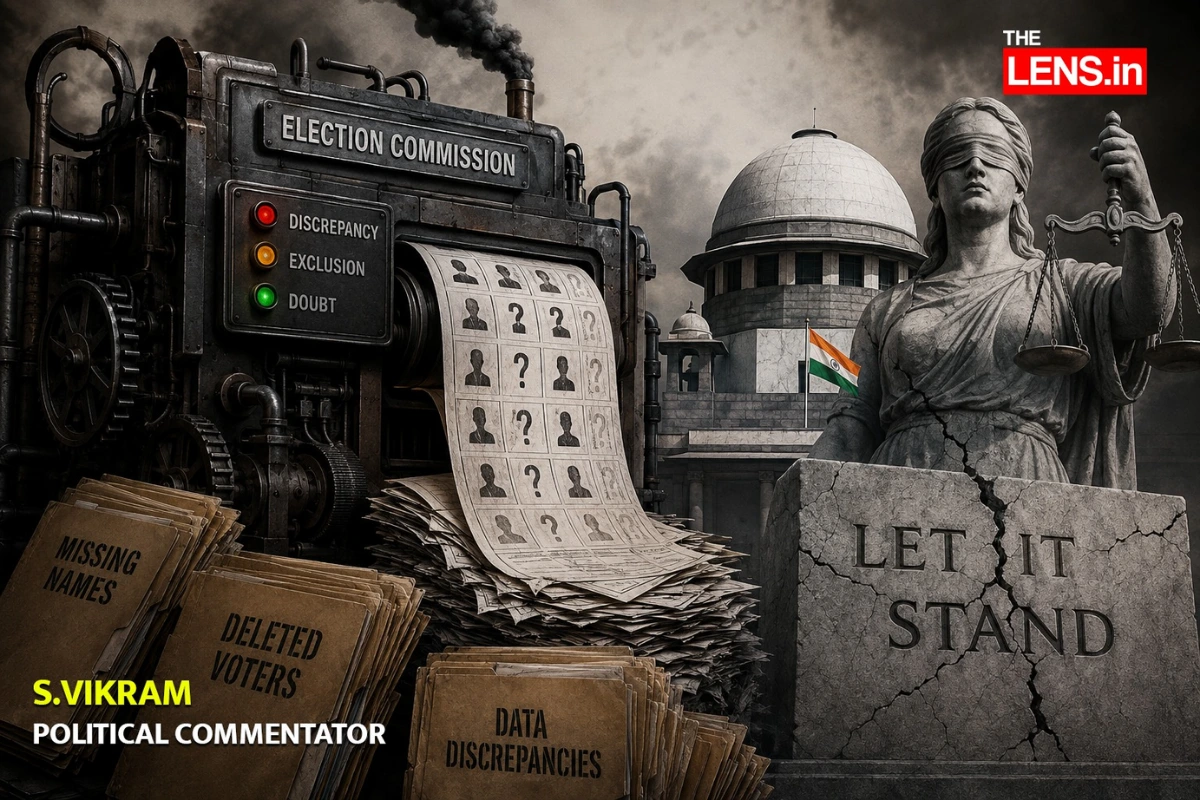
It was not a liberation of institutions. The institutions — the RBI, the CBI, the ED, the Election Commission, the CAG, the statistical agencies, the press — have been weakened, politicised, co-opted, or silenced. India fell from 140th to 161st on the World Press Freedom Index over the decade.
It was not even a liberation in the narrow economic sense. The impossible triangle — simultaneous peak tax extraction, peak sovereign debt, and the largest planned liquidation of public assets in Indian history — describes an economy whose proclaimed growth is a linguistic veneer over a reality of extraction, informalisation, and transfer. The ninety-four percent of the workforce that occupies the informal economy has received from the second independence neither the vikaas it was promised nor the institutional protections that the first independence’s Constitution had guaranteed. It has received, instead, the spectacle of growth: photographs of new airports and new highways built on land whose acquisition they could not contest, connecting cities whose prosperity they cannot access, serving a formal economy to which their exclusion is structural and permanent.
What the second independence was — and what twelve years, these seven chapters, and the full weight of the evidence makes unmistakable — was a liberation of Hindu nationalism from the constitutional constraints that the first independence had imposed upon it. Not merely through the laws it passed or the minorities it intimidated, but through the patient replacement of the governing class that interprets those laws. Not merely through the rhetoric of the campaign, but through the surveillance architecture that ensures the rhetoric’s critics are visible, traceable, and vulnerable. Not merely through the crisis of the moment, but through the permanent emergency that the pandemic normalised and the second independence sustains.
This is what BJP leaders mean when they call May 16, 2014, the second independence. They mean that India was freed not from a party but from a constitutional settlement — from the Nehruvian idea that the secular, pluralist republic was India’s authentic political form. The first independence delivered India from British rule but handed it to Nehru’s idea of India. The second delivered it from that idea and toward something older — toward the vision articulated in 1939 by the RSS ideologue M.S. Golwalkar:
No BJP leader quotes Golwalkar directly today. But the governing class that the RSS has built, the surveillance architecture that tracks dissent, the pandemic powers that remain normalised, and the fiscal transfer mechanism that enriches the connected while the ninety-four percent remain invisible — these are Golwalkar’s programme, implemented through the instruments that the twenty-first century provides. The second independence has not merely told its minorities that their belonging is conditional. It has built the apparatus to enforce that condition.
- EPILOGUE
The Manifesto That Remains
The Constitution of India — the manifesto of the first independence — is still in force. Its words are unchanged. The Preamble still opens:
These words have not been amended out. They sit in the stone of the constitutional text, accessible to every citizen, invocable before every court. This is the fundamental difference between what happened during the Emergency — when the Constitution was visibly suspended — and what has happened in the Modi years: the Constitution has not been abrogated but systematically voided from within, like a building whose beams are removed one by one while the facade remains standing.
The three new chapters of this essay make the voiding more visible, and the recovery more clearly difficult. The change of governing class means that the institutions which give the Constitution life are now staffed, at the level that matters most — the level below the elected politician, the level of the permanent administrator — by people formed in an ideology that regards the Constitution’s secular pluralism as an error to be corrected. The surveillance architecture means that the citizens who might contest that error are visible, their communications archived, their faces mapped. The pandemic has normalised the emergency powers through which, if contestation becomes serious, those citizens can be reached.
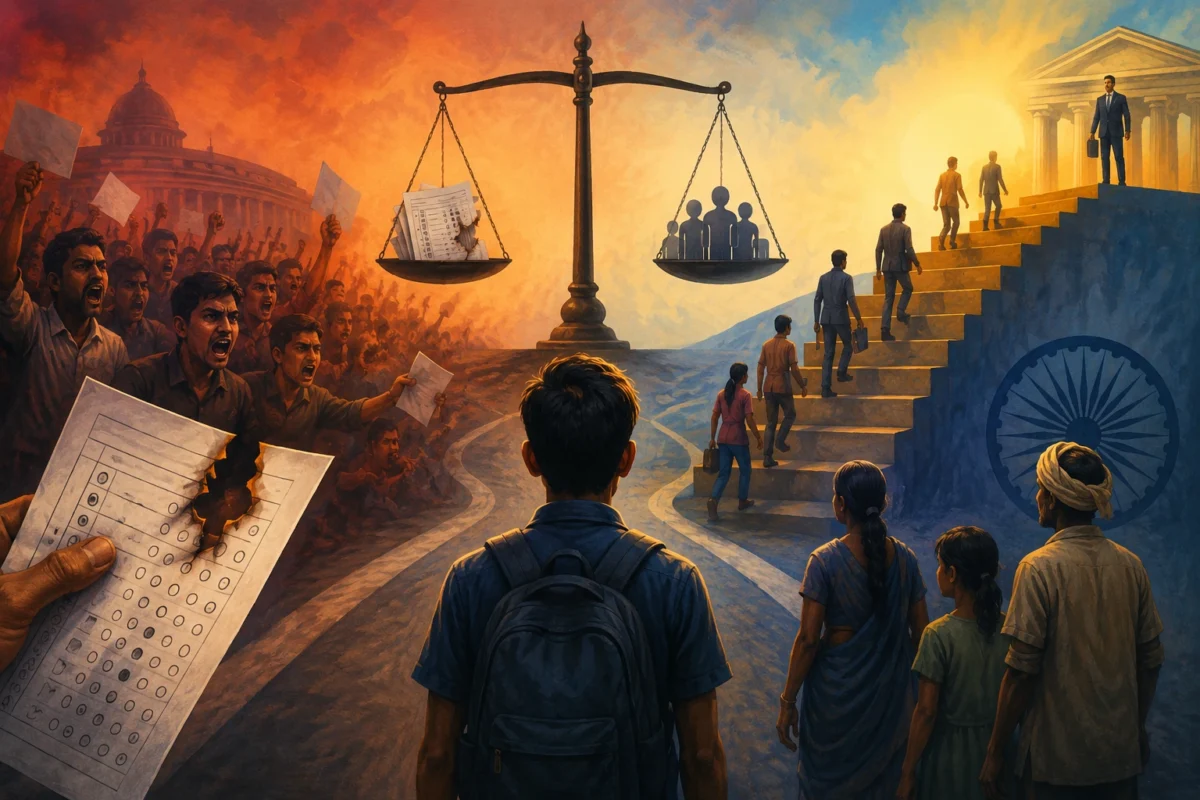
History is not destiny. The manifesto of the first independence was written by people who had lived through colonisation and Partition and still chose to imagine the possibility of a just, secular, federal, democratic republic. They made that choice against the evidence of human nature as it had just displayed itself in the most catastrophic terms. The Constitution they produced was not a description of what India was. It was an argument about what India could become.
That argument is not yet lost. But it is losing — and it is losing now on three fronts simultaneously that an essay focused on policy and rhetoric alone would not have fully mapped. The parivar is building the governing class that will administer the second independence when its founding generation has gone. The surveillance state is building the architecture that will make dissent legible and costly for any future government that inherits it, regardless of its politics. And the pandemic has demonstrated that the population will accept emergency concentrations of power when they are frightened — a demonstration that has not been forgotten by those who govern.
Twelve years is enough time to see clearly. The question now is whether seeing clearly is enough to change course, and whether the institutions and the people through whom a course-correction would have to flow retain enough integrity to make it possible. The first independence promised India to all its people equally. The second independence has delivered it, in practice if not in law, to some of its people more than others. That is not liberation. It is a different kind of subjugation, wearing the face of the liberated, staffed by the cadre of the patient, watched by the eye of the state. The first manifesto, in its imperfect way, knew this. It had been written by people who had seen what the other path looked like. Twelve years of the second independence has given India the opportunity to see it again — from the inside, in slow motion, with the full apparatus of the modern state making the seeing itself an act of courage. The hope is that the seeing is not too late. The risk is that the architecture of the unseen is already complete.
Read Also: The Consequences