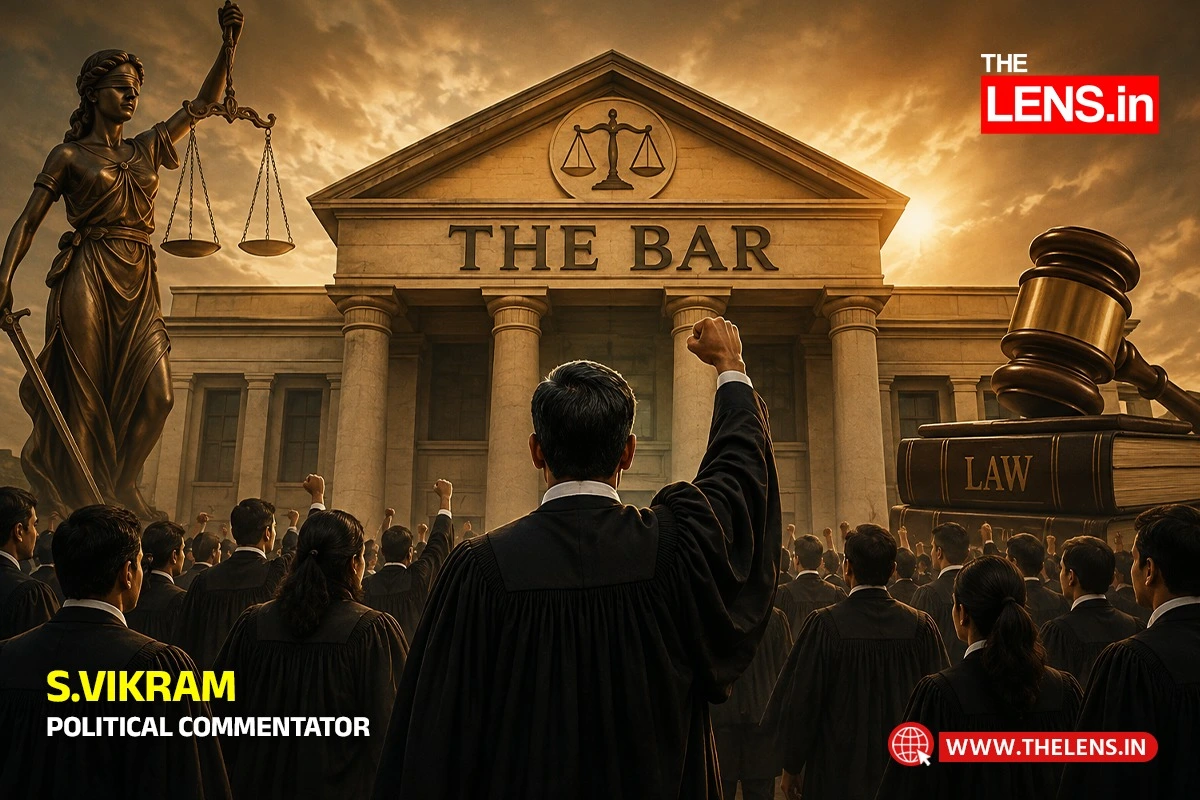
Seventy years ago, when a colonial state tried its last political trials, the men who filled the docket of the freedom struggle were, disproportionately, lawyers. Gandhi, Nehru, Patel, Ambedkar — the profession did not merely supply the movement’s leadership; it supplied its idiom. India’s founding text is rightly called a lawyer’s constitution. That inheritance has been sitting unclaimed for a generation. This week gives the profession a reason to pick it back up.
On August 13, the Bar Council of India — the statutory body that licenses every advocate in the country — directed state bar councils to withhold enrolment from NALSAR University’s entire graduating class of 2026. Their offence: nearly 450 students had petitioned their own university not to invite the Chief Justice of India as chief guest at their convocation. The BCI wanted names — of “teachers and outsiders” it accused of instigating “innocent students.” Within hours, public outrage forced a withdrawal. By Independence Day, BCI chairman Manan Kumar Mishra had apologised in writing. It should never have needed to come to that.
Mishra has chaired the Bar Council of India for fifteen years, elected unopposed six terms running, while sitting simultaneously as a Rajya Sabha member of the ruling party. A statutory regulator of the entire legal profession, doubling as a sitting parliamentarian of the government whose judiciary that profession is supposed to hold independent — this is not a technical irregularity. It is a standing conflict of interest that the bar has tolerated for a decade and a half, and it is the reason the BCI’s first instinct, when law students exercised their plainest constitutional right, was to reach for the enrolment register as a weapon.
The students did what the profession as a whole has not: they refused. They forced an apology out of a man six unopposed terms deep in office. That is not a small thing. It is the first crack in fifteen years of institutional deference, and it came from the bottom of the profession’s hierarchy, not the top.
The bar’s elite — senior advocates, the Supreme Court Bar Association, the constitutional law professoriate — carries the prestige to speak. It does not carry the numbers to move anything. That capacity sits elsewhere: in the district and mofussil courts, where more than fifty million cases lie pending, and where the profession’s day-to-day power over the machinery of justice is total, whatever its declining intellectual standing. A profession that has lost its claim to being the country’s foremost intellectual class has not lost its claim to being the country’s largest organised body with a direct stake in judicial independence. Fifty million pending matters is not only a crisis statistic. It is leverage, if the bar chooses to use it as something other than the blunt instrument of the local strike that helped create the backlog in the first place.
Pakistan showed what this leverage looks like when it moves. In 2007, General Musharraf suspended Chief Justice Iftikhar Chaudhry for the offence of insufficient pliability. There was no organised democratic opposition to answer the provocation — Benazir Bhutto and Nawaz Sharif were both in exile. The lawyers moved anyway. What began as a Supreme Court Bar Association protest became a long march from Karachi to Islamabad, carried town to town by district bar associations that had no national profile and no claim to intellectual leadership — only numbers, organisation, and a shared professional injury. Two years and one more suspension later, the marches restored Chaudhry to the bench and helped end Musharraf’s rule. A profession under martial law for most of its modern history did what India’s bar, under no such constraint, has not yet attempted.
India’s judiciary does not need a general to capture it. It has been captured by omission — collegium complaints against successive Chief Justices left unexamined across elevation after elevation, discretionary and undeclared rather than announced like Indira Gandhi’s 1973 supersession. That makes it harder to organise against, because there is no single dramatic villain to march on. But it does not make the profession’s obligation smaller.
The bar’s party-affiliated lawyer cells are already organised, already national, already capable of mobilising law students campus to campus. Use that structure for what it was never built for: solidarity with NALSAR and every campus willing to say what NALSAR said; a formal no-confidence motion against Manan Kumar Mishra’s chairmanship; a public reckoning with corruption in the higher judiciary that the collegium has spent a decade declining to examine; and a renewed insistence on the civil and constitutional liberties that a captured judiciary and an emboldened Hindutva executive have spent that same decade eroding together.
The freedom struggle’s lawyers did not inherit their legacy. They built it, case by case, arrest by arrest, until the profession’s authority and the nation’s liberty became the same project. The bar can either be the last institution to notice its own capture, or it can be the one that reverses it. NALSAR’s students have shown which choice costs less courage than it looks.