S.Vikram
Political commentator
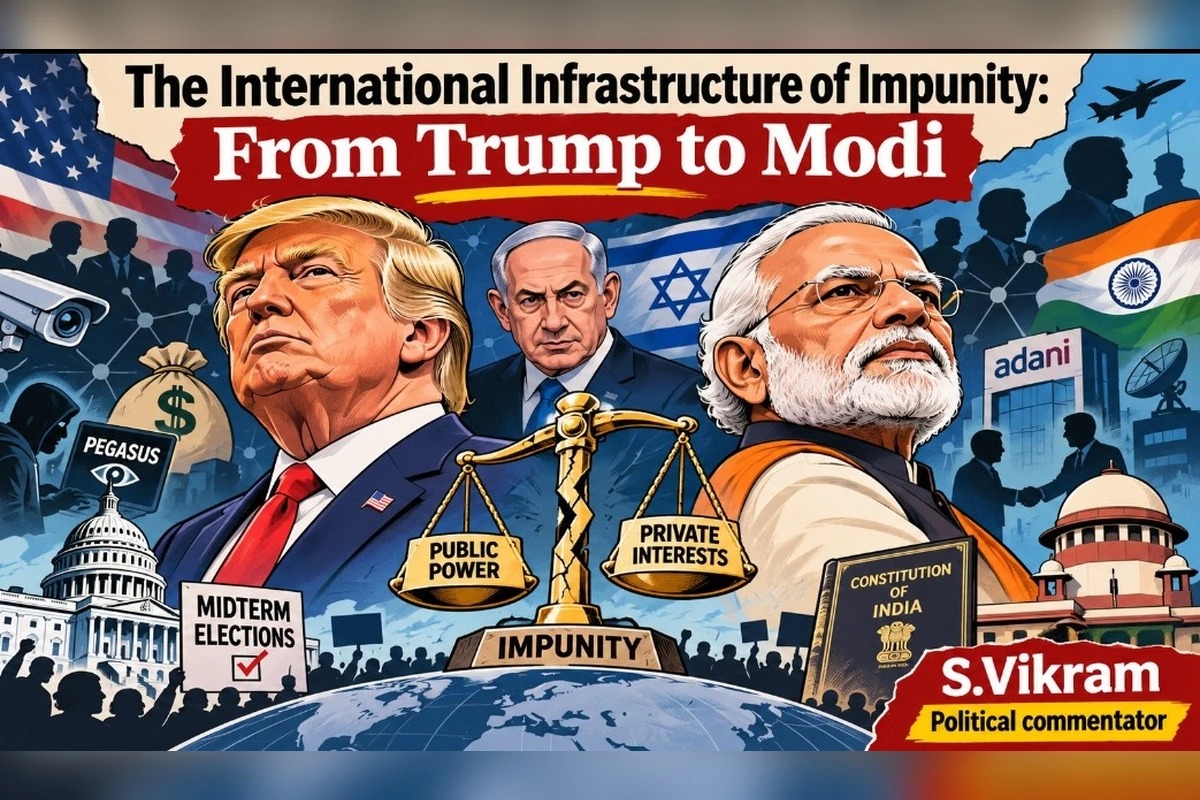
The American midterm elections may have produced something more consequential than a change in the balance of power in Washington. The Democratic victories in both chambers of Congress, accompanied by significant gains in state governments, represent a repudiation of Donald Trump’s politics on a scale that few anticipated. The immediate explanations are familiar: inflation, the cost of living, the consequences of war, immigration, and the growing perception that the administration has placed private interests above public responsibility. But the deeper significance of the result may lie elsewhere. It may have weakened the political confidence of an international network that has increasingly treated public authority as an instrument of private power, and accountability as an inconvenience to be circumvented.
Trumpism is often described in terms of aggression, authoritarianism or populism. These descriptions are not wrong, but they miss something fundamental. Its defining characteristic is brazenness: the conviction that power, once acquired, confers immunity; that the distinction between public office and private interest is negotiable; and that institutions exist to be managed, intimidated or bypassed rather than obeyed. Its methods are not confined to the formal machinery of government. They extend through family members, private intermediaries, informal emissaries, business interests and relationships with foreign governments. The result is a political order in which decisions of immense public consequence can be negotiated through channels that escape the ordinary requirements of transparency and democratic accountability.
This is why the election matters beyond the question of legislative control. Congress can investigate, obstruct, expose and restrict appropriations. It can summon officials, demand disclosures and make executive conduct politically costly. But it cannot exercise complete control over presidential discretion, informal diplomacy or the private relationships through which influence is exercised. The more immediate test of Trump’s authority may therefore lie within his own party. Trump will not have to face the American electorate as a presidential candidate again. Republican legislators and future Republican candidates, however, will. They must decide whether their political survival requires continued submission to him or whether they can reclaim some independence from a leader whose electoral liabilities have become increasingly difficult to ignore.
The larger question concerns the network of relationships Trump has assembled around himself: political power, private wealth, family interests, foreign governments, authoritarian rulers and the commercial opportunities that arise from war, diplomacy and trade. This is not necessarily a centrally directed conspiracy. It need not be. Networks of mutual advantage can operate through convergent interests, privileged access and reciprocal protection. Their power often lies precisely in the absence of formal accountability.
The involvement of Jared Kushner in sensitive diplomatic negotiations while managing a major investment fund backed by substantial foreign capital is an especially revealing example. The Trump family’s international business ventures, meanwhile, have raised questions about the proximity of commercial opportunity to political authority. These circumstances do not, by themselves, establish quid pro quo arrangements. But they expose a fundamental problem: how can citizens distinguish the national interest from the private interests of those who exercise national power when the two repeatedly occupy the same political space?
The disclosures surrounding Jeffrey Epstein have also brought renewed attention to the access enjoyed by powerful people and the informal networks connecting wealth, influence and political privilege. They do not establish a single political conspiracy. Their significance lies in the wider question they raise about elite impunity: whether relationships that would expose ordinary citizens to scrutiny are protected, for the powerful, by money, influence and institutional deference.
And here comes India.
For years, there has been speculation about the extent to which Narendra Modi’s political project has been connected to, or benefited from, this wider international constellation of power. The relationship between the Modi government and Israel has deepened dramatically, particularly in defence, intelligence and surveillance cooperation. The relationship has also been cultivated within an American political establishment that increasingly views India through the prism of strategic competition with China. Under Trump, the personal and political dimensions of this relationship became more pronounced.
The Pegasus affair brought the relationship between surveillance technology, state power and democratic accountability into sharp focus. The reported inclusion of Pegasus spyware in a wider defence procurement package following Modi’s 2017 visit to Israel raised questions that have never been satisfactorily resolved in the public domain. The Supreme Court’s investigation did not establish that Pegasus had been used on the devices examined, but neither did the government’s lack of cooperation help restore public confidence. The controversy was not simply about a piece of software. It was about the possibility that the instruments of state surveillance could be deployed without adequate democratic oversight.
Allegations of electoral manipulation have added to public suspicion, including claims about electronic voting machines and speculation that influential interests favoured Modi’s rise even before he assumed office in 2014. These allegations must be distinguished from established facts. There is no demonstrated evidence that Israel or the United States engineered an Indian electoral outcome. But the political significance of the questions cannot be dismissed merely because the most serious allegations remain unproven. The integrity of elections and the independence of institutions that administer them are matters on which public confidence is indispensable.
The more demonstrable issue is the growing entanglement of India’s domestic political project with an international environment increasingly permissive of executive exceptionalism. Modi has gained from the international legitimacy, strategic cooperation and diplomatic access that accompany his relationships with powerful governments. But such relationships also carry costs. They can narrow the space for independent policy, create dependencies and make strategic autonomy more difficult to sustain.
Consider the trajectory of India’s relationship with Israel and its position on Palestine. India once occupied a prominent place among the countries that supported Palestinian self-determination, while maintaining relations with Israel. The subsequent transformation of that relationship has been substantial. India’s strategic and defence cooperation with Israel has become increasingly important, even as the humanitarian catastrophe in Gaza has placed the question of Palestine at the centre of international debate. This shift cannot be explained by Trump alone, nor should India’s independent strategic calculations be ignored. But it does raise a larger question about the price of political alignment.
The same question arises in India’s relationship with the United States. The trade framework announced by the Trump administration, including the pressure surrounding India’s purchases of Russian oil, illustrates how strategic relationships can translate into economic leverage. India’s claims to strategic autonomy must be measured not by official declarations but by its capacity to make independent choices when those choices are inconvenient to powerful partners.
The Adani controversy raises another dimension of the same problem. The intersection of major corporate interests, political influence and international finance demands scrutiny. It would be irresponsible to assert that particular American legal proceedings or settlements prove a political bargain. But it would be equally irresponsible to treat the relationship between concentrated private wealth and political authority as irrelevant to democratic accountability. The question is not whether a businessperson is entitled to pursue commercial interests. It is whether the institutions of the state remain sufficiently independent to ensure that public power is not exercised to protect private advantage.
Operation Sindoor introduced a different but related tension. Trump’s repeated claims that he had helped bring about the cessation of hostilities between India and Pakistan were rejected by New Delhi, which insisted that the understanding had been reached through direct military communication. The disagreement was not merely about diplomatic credit. It concerned India’s ability to control the narrative of its own strategic decisions. A government that claims sovereign autonomy must be able to resist the appropriation of its decisions by even its closest partners.
The weakening of Trump and Netanyahu may therefore have consequences beyond their respective domestic political fortunes. Netanyahu’s electoral position has become precarious, with his bloc falling short of a parliamentary majority. Trump, meanwhile, has suffered a decisive electoral setback. These are not the same kind of defeat, and neither automatically dismantles the relationships that have sustained their influence. But together they may weaken the political confidence of an international dispensation that has relied on personal authority, informal networks and the selective application of rules.
It would be premature to celebrate the return of international law. The international legal order was already compromised long before Trump. Powerful states have routinely invoked international conventions when convenient and ignored them when inconvenient. The weakness of international institutions is not a uniquely American or Israeli creation. It is the cumulative consequence of selective enforcement, great-power exceptionalism and the gradual substitution of bilateral bargains for multilateral obligations.
Yet the defeat of political actors who have made this exceptionalism unusually brazen may reopen the space for institutional resistance. A Congress more willing to investigate executive conduct, a changing political equation in Israel and a less certain international environment could make it more difficult for governments to operate on the assumption that their actions will be protected by powerful friends. The consequences may be felt in India, too.
This does not mean that Washington will suddenly become the guardian of Indian democracy, or that the weakening of Modi’s international relationships will automatically restore the independence of Indian institutions. That would be to mistake international pressure for domestic constitutional renewal. India’s democracy cannot depend on the electoral fortunes of an American president. Its institutions must recover their authority through their own constitutional responsibilities.
But international conditions matter. Diplomatic legitimacy, strategic cooperation and the protection afforded by powerful relationships can reduce the external costs of domestic political conduct. A less permissive international environment can remove some of that protection. It can make it harder to normalise surveillance without accountability, to treat constitutional institutions as instruments of the executive, or to blur the boundary between public interest and private capital.
The deepest question, then, is not whether Modi belongs to a syndicate, or whether Trump has lost his place at its head. It is whether a political order built on reciprocal impunity can survive when its most powerful patrons become vulnerable to accountability themselves.
A republic cannot indefinitely outsource its immunity to an international network of powerful friends and still claim to be sovereign. Nor can it claim constitutional legitimacy while treating the institutions that restrain executive power as obstacles to be overcome.
The American election may not have ended the international politics of impunity. But it has introduced uncertainty into its most powerful centre. For India, that uncertainty could be an opportunity—not to exchange one patron for another, but to recover something more fundamental: the authority of its own Constitution.
The return of international law and the recovery of constitutional accountability at home are ultimately parts of the same struggle. A world in which the powerful are answerable to rules is possible only when nations are willing to hold their own powerful to account. Democracy is not merely the right to elect a government. It is the insistence that no government, however popular, is entitled to govern without restraint.