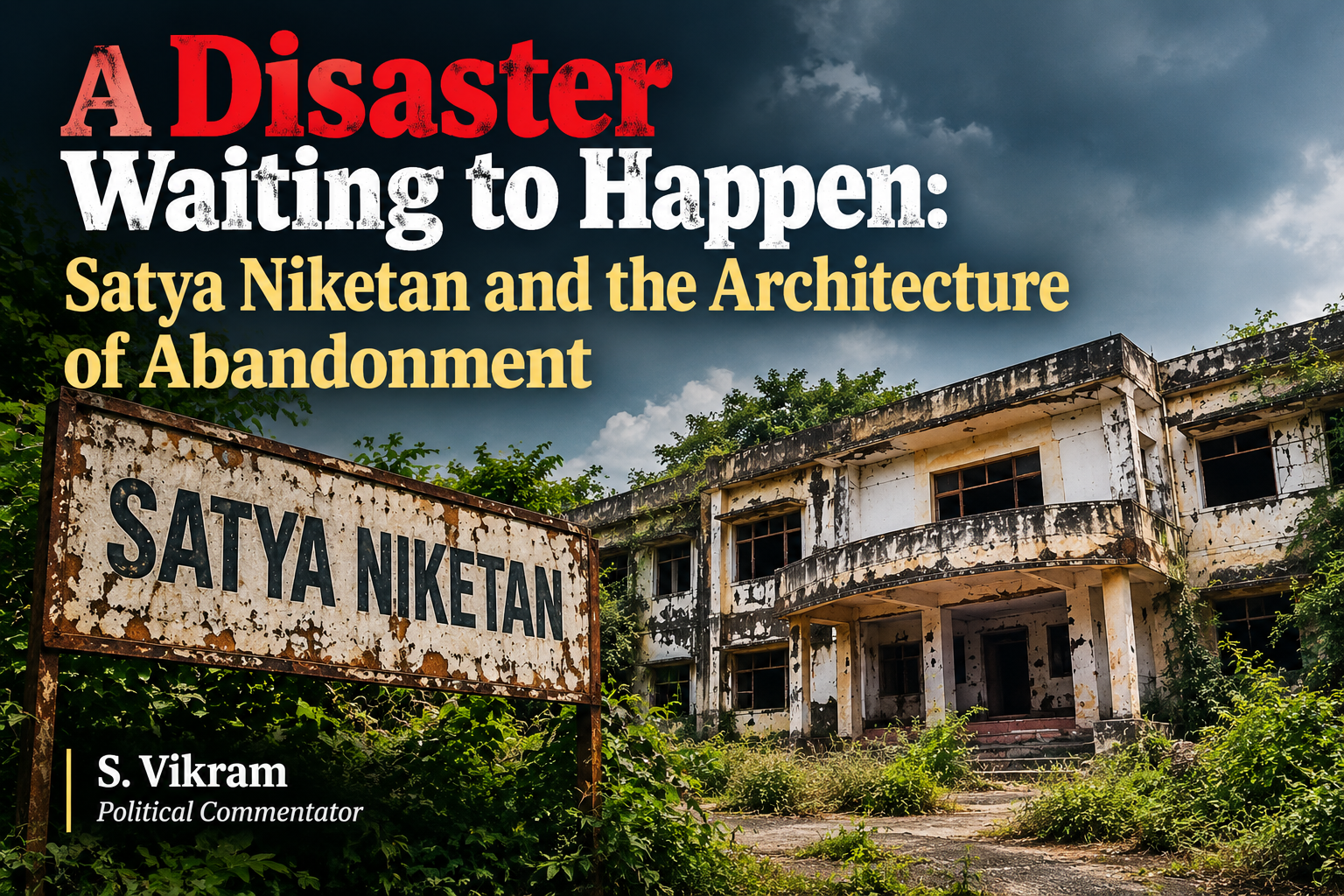
On the afternoon of September 6, 2026, a five-storey building near Delhi University’s South Campus came down. It was known as Hostel Daze, a paying-guest accommodation for young men, and it fell the way these buildings always fall — quickly, without warning, while construction work continued somewhere in its basement. It should not need saying that this was not new. Satya Niketan had already collapsed twice before, in 2019 and again in 2022 — both times a building undergoing unauthorised renovation, both times labourers pulled from rubble rather than students, both times a notice served, a probe announced, and nothing that followed. The 2022 collapse happened in a building that had been renovated, an official later admitted, specifically to convert it into a PG — the same economy, the same area, the same failure of nerve on the part of every institution meant to stop it. What is different this time is only the body count and the identity of the dead. Everything else is inherited.
I want to resist the temptation to treat Hostel Daze as an aberration — a single criminal landlord, a single lapse in inspection, a single tragedy requiring a single inquiry. It is not that. It is the visible edge of a much larger structure: a state that has, across nearly every institution meant to protect its youngest and most precarious citizens, chosen the appearance of governance over its exercise, and left an entire generation to discover the difference the hard way.
The hostel that was never built
Begin with the plainest fact. Delhi University houses a small fraction of its enrolled students. Across Indian higher education more broadly, hostel capacity was designed for an era when university enrolment was the privilege of a narrow, largely well-off cohort — Gross Enrolment Ratio in Indian higher education stood at just 12.2 percent in 2001-02. It has since risen to roughly 28 percent, and the National Education Policy targets 50 percent by 2035. The subsidised, near-free hostel — a handful of seats for a handful of students — was never rebuilt for a system now admitting three times as many people, headed toward five times as many. The gap between enrolment and hostel capacity did not appear through negligence; it appeared because nobody redesigned the provision for the scale of the system it now serves.
Into that gap has poured the informal PG economy — Satya Niketan, Mukherjee Nagar, Old Rajinder Nagar, and their equivalents in every Indian city with a floating student population. This is not, on its own, an Indian peculiarity. The comparison is instructive rather than exculpatory. American universities typically house barely a fifth of their student bodies on campus; the shortfall against projected 2030 demand runs into the millions of beds. British purpose-built student accommodation is short by an estimated 600,000 beds and counting. What distinguishes India’s version of this near-universal shortage is not that a gap exists, but what has been permitted to fill it. In the United States and Britain, the private capital that steps into the housing gap — real-estate investment trusts, purpose-built student accommodation developers — is expensive, but it is bound by planning law and building code. It produces overpriced, occasionally exploitative, but structurally survivable housing. In Delhi, the same gap is filled by individual landlords illegally converting basements and floors, precisely because no regulatory apparatus exists to discipline the informality the way it does elsewhere. The shortage is universal. What kills students in Delhi and not in Manchester is what each state allows to grow in the shortage’s place.
India has, in fact, already legislated for something better. The Affordable Rental Housing Complexes scheme, launched in 2020, explicitly names students among its intended beneficiaries alongside migrant labour and the urban poor — a formal recognition that mobile, non-owning populations need a legal rental category built for them. Five years on, a parliamentary answer in February 2025 disclosed that only about seven percent of the scheme’s housing units had actually been allotted. The policy imagination existed. The execution never followed it.
Notice, then nothing
The second failure is administrative, and it has a signature: notice, then negligence. In the 2022 Satya Niketan collapse, a notice had been served to the building’s owner the month before, for the same category of unauthorised renovation that later killed two labourers. The notice changed nothing. Nobody sealed the site. Nobody stopped the work. The paper trail existed so that liability could be assigned after the fact, not so that the building would not fall.
This is not confined to one neighbourhood. In April this year, a fire tore through a hotel operating as an unlicensed bed-and-breakfast in Hauz Rani, Malviya Nagar, killing twenty-one people — permission for six rooms, twenty-five in actual operation, an illegally excavated basement, a single sealed exit. It took the deaths to trigger an arrest. The pattern across both incidents is identical: permission exists on paper for a fraction of what is actually built or operated; the excess is illegal, known to be illegal, and tolerated until it kills someone. That is not municipal incompetence. It is a functioning system, just not the one it claims to be — a system optimised to produce documentation of oversight rather than the fact of it.
There is a structural reason to call this a system rather than a series of failures. Delhi’s municipal capacity to enforce building safety has, when it has been measured at all, been almost comically thin. At one point only seventy-four structural engineers were empanelled across the city’s three municipal corporations to vet safety on the roughly forty-five thousand buildings constructed in Delhi every year, against a total stock of some thirty lakh buildings. No enforcement regime built at that scale was ever going to catch what Hostel Daze’s basement work represented. The absence of capacity is not a gap in an otherwise functioning system. It is close to the whole of the system.
The city that was never allowed to expand
Behind the enforcement failure sits a planning failure with an even longer horizon, and here I write from inside the institution that carried it. As Director, Land Pooling at the Delhi Development Authority, I watched from within the exact apparatus this argument indicts.
Delhi’s land pooling policy — the mechanism by which the DDA proposed to aggregate agricultural land at the city’s edge into planned, serviced, legally developed sectors, precisely the kind of formal housing supply that could have absorbed decades of demand instead of ceding it to unauthorised colonies — was first drafted in 2013 and formally notified in 2018. As of this year, barely a fifth of the eligible land has been pooled, most of it non-contiguous, and not one of the three “model” sectors the DDA itself selected for fast-tracking has cleared the basic eligibility threshold.
The conventional explanation for this — Centre-versus-Delhi-government obstruction, the peculiar dual jurisdiction of the National Capital Territory — does not survive scrutiny. The DDA answers to the Union Ministry of Housing and Urban Affairs, not to whichever party governs Delhi’s assembly. The land pooling policy has been under continuous central control by one political dispensation since 2014. Since February 2025, the same party has also governed the Delhi Assembly. There is, for the first time in over a decade, no Centre-state conflict left to blame — and the pooling figures have barely moved in that window. A stalemate that survives total political alignment across every layer of the city’s governance is not a stalemate produced by political conflict. It is one that serves interests indifferent to who happens to be in office.
Those interests are not mysterious. Regularising unauthorised colonies after the fact — a single Cabinet decision, delivered as patronage to lakhs of voters at once — is immeasurably more electorally rewarding than the multi-year, politically thankless grind of consortium formation and infrastructure build-out that land pooling actually requires, work whose benefits a minister who authorises it may never live to see completed. Builders and local intermediaries profit directly from an unenforced, informally constructed housing stock that formal planning would eliminate. This is close to what Partha Chatterjee described as the state’s relationship to its poorer citizens through “political society” rather than through law — governed not by rules equally applied but by discretionary, extra-legal accommodation that happens to be more useful to power than planning ever was. Ananya Roy’s account of urban informality as a mode of governmentality makes the same point more bluntly for a city like Delhi: informality is not a gap in state capacity. It is a zone the state produces and manages on purpose, because it is more governable — and more profitable to more of the actors involved — than the alternative.
The ground itself
Delhi sits in Seismic Zone IV, the second-highest of India’s four-tier risk classification, close to the Delhi-Haridwar Ridge and the Mahendragarh-Dehradun fault, in the shadow of one of the world’s most seismically active mountain ranges. The Delhi High Court has already litigated the consequences of this twice, a decade apart, in nearly identical language. In 2015, a bench found that only ten to fifteen percent of Delhi’s building stock complied with the seismic norms mandated for its own zone classification, and wrote into its order that the city was “a disaster waiting to happen.” Years later, a different bench revisited the same question and arrived at essentially the same number the other way round: roughly nine of every ten Delhi buildings structurally unsafe for the earthquake risk the city actually carries. Seismic-risk modelling puts the potential death toll from a high-magnitude quake in Delhi-NCR between 150,000 and 250,000, driven by exactly the combination this essay has been describing — density, informality, and construction with no engineer anywhere near it.
Hostel Daze is not separable from this. A gravity collapse triggered by illegal basement excavation and a seismic collapse triggered by a moderate earthquake are the same failure with two different triggers, sitting on top of the same unenforced, non-engineered building stock. The court flagged this catastrophe in writing in 2015. Nothing that has happened since suggests the warning was heard as anything more than a sentence in an order.
Who gets sorted into the danger
Not every resident of Delhi’s informal housing stock arrived there by the same route, and this is where the crisis stops being only about scarcity and starts being about who scarcity is permitted to fall hardest on. A substantial scholarly literature — Ghazala Jamil’s study of Muslim localities across Old Delhi, Seelampur, Jamia Nagar, and Nizamuddin among them — has documented how urban governance itself, not only private prejudice, produces and sustains religious residential segregation in this city. Cross-city research has found Delhi-NCR among the most segregated urban regions in the country by this measure. An audit of Delhi’s rental market found landlords roughly 60 percent less likely to respond to a Muslim applicant than to an upper-caste Hindu one with an otherwise identical profile. And there is a directly student-shaped version of this exclusion: in the weeks after Jammu and Kashmir’s special status was revoked in August 2019, Kashmiri students living around Jamia Millia Islamia in Jamia Nagar were evicted or turned away by brokers who told them plainly that Kashmiris were not being shown flats there. Reporting has since traced a further hardening of Muslim residential self-segregation to the 2020 Delhi riots specifically, families choosing safety in numbers over whatever housing options the open market still notionally offered them.
This matters for the argument, not as an additional grievance appended to the end of it, but because the neighbourhoods this literature identifies as Delhi’s core segregated enclaves are substantially the same neighbourhoods the seismic-safety record singles out as least compliant — the Walled City’s narrow lanes and cramped, back-to-back construction chief among them. Communal and caste-driven exclusion from the open rental market does not merely inconvenience the people it targets. It sorts them, disproportionately, into the specific building stock a Delhi High Court bench has already told the city, in writing, is most likely to fail first.
A country that punishes struggle
There is a psychological register to this crisis that resists tidy citation but should not therefore be left out. India’s competitive examination culture — coaching hubs like Kota chief among them — has produced a documented, sustained toll of student suicide: roughly a hundred and fifty deaths across the last decade in that city alone, the worst year on record only three years ago. Some of those deaths occurred inside the exact category of housing this essay has been about — students found in their PG rooms, the same informal accommodation that kills through gravity and seismic failure elsewhere in this argument now implicated in a second, psychological register.
The mechanism is not difficult to name, even without romanticising it. A fixed, brutally narrow number of seats set against an enormous applicant pool guarantees that most participants will “fail” by the only measure anyone around them is counting. A comparison culture explicitly invokes a family’s financial sacrifice against a student the moment they underperform. And Indian society, for all its energy around achievement, offers almost no socially legible category for a good-faith attempt, a partial success, or an honourable second try — you have cleared the exam or you have not, and the second condition carries a social cost that has, repeatedly, proven fatal. A society that treats any deviation from a single sanctioned path as catastrophe gives its young people every incentive to optimise for safe, legible credentialing and none whatsoever to take the genuinely uncertain risks that original research or unconventional intellectual work require. The absence of a serious research culture in Indian higher education is not simply a funding problem. It is the predictable output of an incentive structure that punishes exactly the kind of failure genuine inquiry cannot proceed without.
The exits that are also closing
It might be argued that none of this matters if India can simply out-educate its way into a high-end, post-industrial service economy — medical value travel, global capability centres, elite consulting, the export of skilled labour rather than manufactured goods. The case for this is not fanciful. India’s service exports crossed 341 billion dollars in the 2024 fiscal year, the third-largest such export economy in the world, running a surplus of over 160 billion dollars that offsets the country’s chronic goods deficit. It has become the world’s largest hub for the Global Capability Centres multinationals now use for genuine research and strategy work, not merely cost-cutting. Medical tourism, worth an estimated 8.7 billion dollars this year, is projected to nearly double by 2030.
Manufacturing, meanwhile, looks close to a foreclosed path rather than merely a neglected one. India’s manufacturing employment peaked at a meagre 13 percent back in 2002 and has trended down since — Dani Rodrik’s “premature deindustrialisation,” developing economies hitting their manufacturing ceilings at income levels far below what the historical industrialisers reached before their own factories began to shrink. The share of manufacturing in India’s GDP has sat close to flat, around fifteen to seventeen percent, since the 1980s, through successive government campaigns explicitly built to break that ceiling. Even the countries best positioned to inherit China’s old role — Vietnam, Cambodia — are hitting their own early plateaus, because automation has permanently reduced how much labour manufacturing absorbs even where it does happen. The bus, in other words, may genuinely be lost, and not only for India.
But the service-economy exit is narrower than it looks. India’s entire IT-BPM sector, built over three decades, employs somewhere in the region of five to six million people — roughly equivalent to a single year’s fresh graduate output, of which the country now produces something close to fifty lakh annually against perhaps twenty-eight lakh new graduate jobs of any kind. And there is a live paradox in the data worth sitting with rather than resolving too quickly: measured graduate employability has risen substantially over the past decade, even as youth graduate unemployment has climbed toward forty percent in the same period. Both are true at once, and the gap between them is the entire argument of this essay in miniature — India is getting steadily better at producing employable people and no better at all at creating enough jobs to employ them. Nor does this exit escape the planning crisis already described. The cities where this economy actually clusters — Bangalore, Hyderabad, Pune, the Gurgaon-NCR corridor — are each now running versions of Delhi’s own housing-supply and infrastructure paralysis. Selling high-end services to the world does not bypass the planning failure this essay opened with. It depends on exactly the urban capacity that failure has spent fifteen years refusing to build.
What Hostel Daze actually proves
It would be conventional, at this point, to call for a comprehensive policy overhaul — a panoramic system correction touching housing, planning, education, and enforcement all at once. I want to resist that ending, because it is not, in the end, honest about what the preceding argument has shown. Every reform this crisis calls for already exists in some form on paper. Land pooling was notified in 2018. The National Building Code has specified Delhi’s seismic obligations since 2005, reinforced by an explicit court order a decade ago. The Affordable Rental Housing Complexes scheme already names students as intended beneficiaries. The Model Tenancy Act has existed since 2021. The National Education Policy already promises a fifty percent enrolment ratio within a decade. None of these are missing instruments. Each is a formal, complete, well-drafted document sitting inert beside a seven percent allotment rate, an eighty-five percent seismic noncompliance rate, a twenty percent land-pooling rate. Calling for a further overhaul risks becoming, in effect, a call for a seventh version of the exact paper gesture this essay has spent its length diagnosing as the disease rather than the cure.