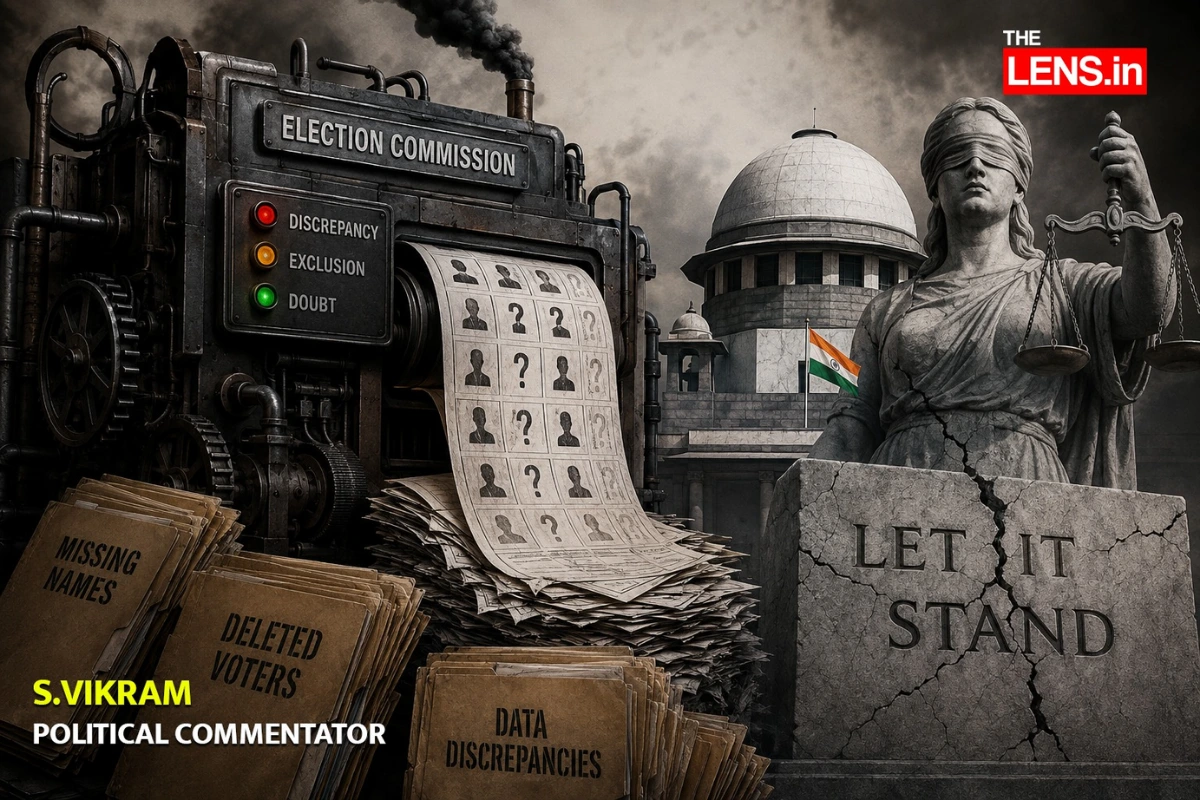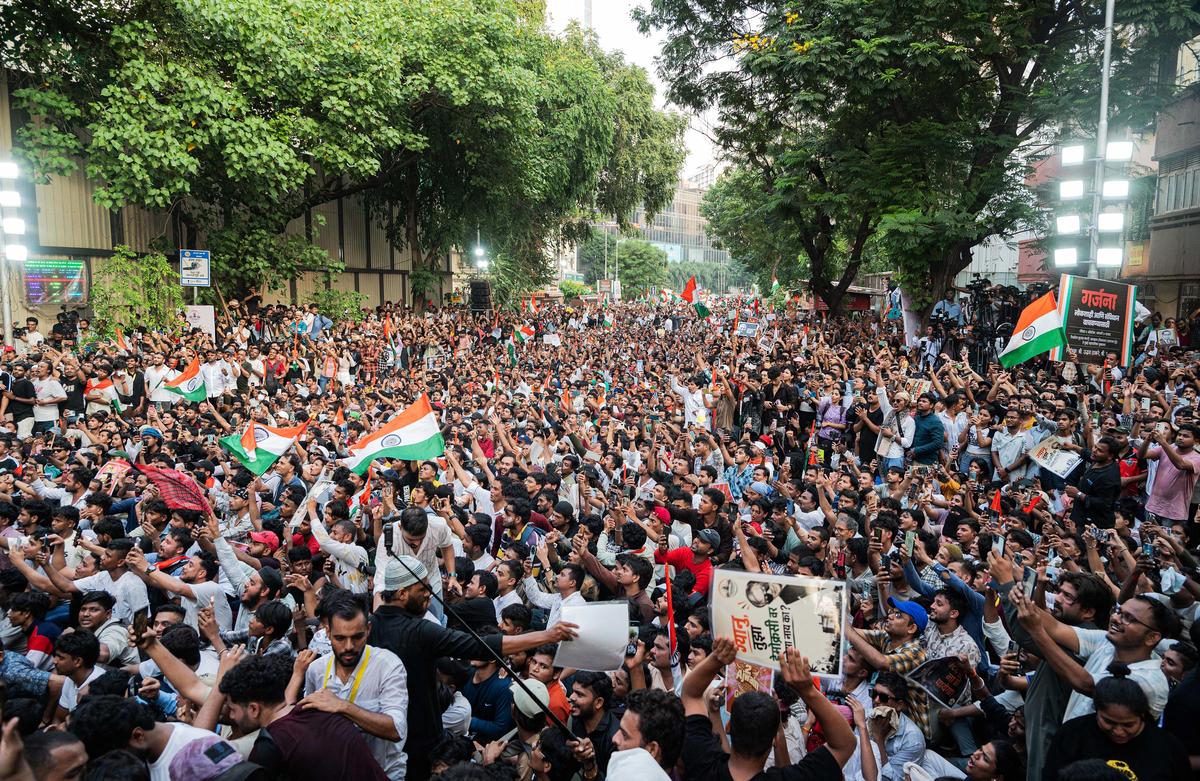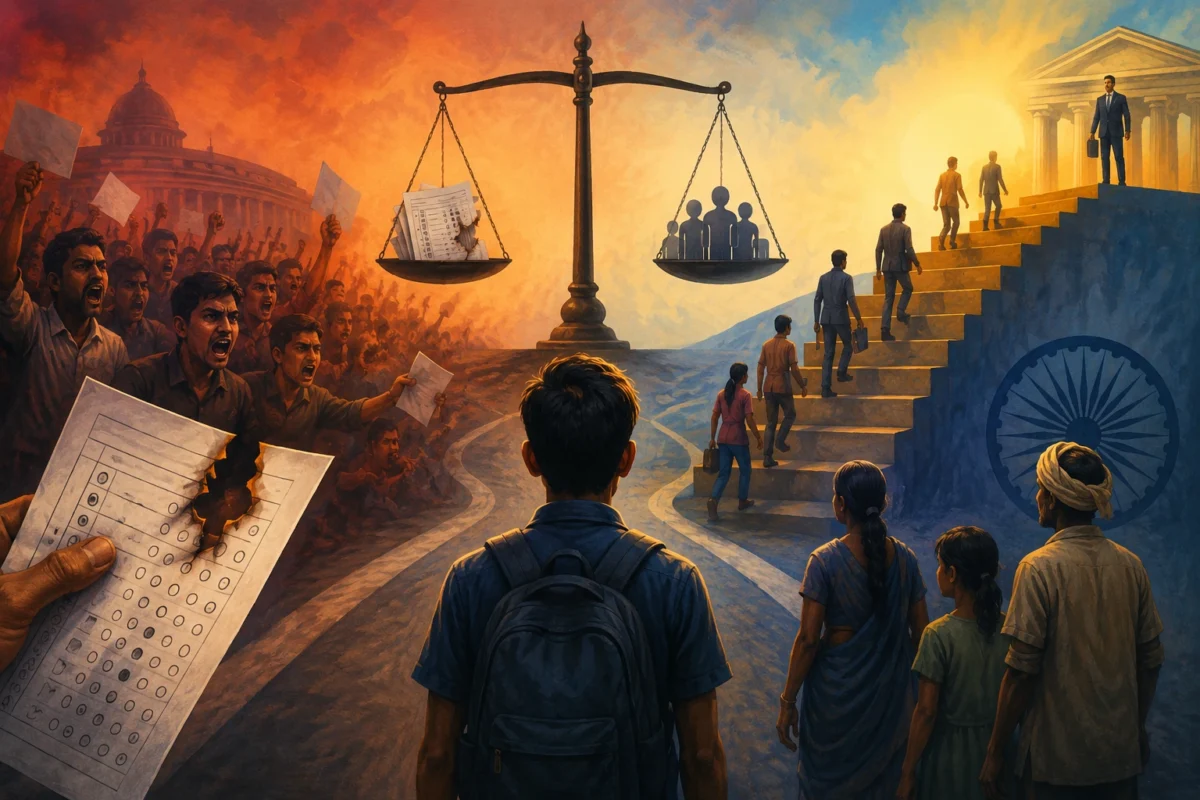
The latest wave of anti-reservation sentiment has emerged from an unlikely place: the protests over the NEET paper leak. The original grievance was straightforward. An examination on which young people had spent years preparing had been compromised; the state had failed to protect the integrity of a competition it had itself created. But alongside that grievance, another argument has begun to circulate: whatever opportunity was lost through the leak is supposedly dwarfed by the opportunities permanently lost to caste-based reservation.
The comparison is revealing precisely because it is so difficult to make analytically. A paper leak is a criminal distortion of an otherwise agreed system; reservation is part of the system itself, a constitutional decision about how scarce public opportunities are distributed. To say the latter “costs” more seats than the former assumes what it claims to prove — that every seat not allocated through open competition is an illegitimate loss. The real argument is not about numbers. It is about the legitimacy of the distributional order.
Who is protesting, and against what
The aspirants most visible at Jantar Mantar, and most exposed to the leak’s damage, skew upper-caste — coaching access and the capital required even to purchase a leaked paper track existing privilege. Their immediate grievance was defensible: a corrupted exam, a captured testing agency, a state that had failed at the one thing it owed them. But within weeks the protest’s own demands had been overtaken online by a second, unrelated campaign arguing that reservation, not the leak, was the real theft — converting “the exam system failed us” into “the exam system is corrupted by quotas,” a formulation that quietly exempts the actual corrupt actors from scrutiny while leaving the far larger management-quota economy untouched.
Part of this is a delayed reaction: for most of the post-independence era, Indian discourse was dominated by a progressive consensus with little patience for an openly hierarchical vision of society, and 2014 is widely read as the moment that consensus broke, letting long-unspeakable resentments find a vocabulary. But underneath the redirected grievance there is something harder to name and more important to understand honestly. The young person who believes reservation has deprived him of a rightful place is not necessarily imagining an injustice — he may genuinely feel he has done everything the modern system asked. What is harder to see is that the anxiety attached to reservation may be larger than reservation itself. Modernity destroyed something caste society had made almost unconditional: ascribed status. Recognition and deference were once inherited, not prizes won afresh each generation. Modern citizenship and competitive institutions changed the principle — status became something acquired and defended, repeatedly. That is a profound loss for anyone who had occupied a superior position under the old order, and no individual achievement, however globally validated, can restore what disappeared — because what disappeared was the guarantee that status would not have to be earned at all.
Reservation therefore becomes an unusually convenient object of resentment: visible, measurable, nameable, in a way the much larger transformation of Indian society is not. Reservation cannot restore hereditary dominance; abolishing it could not restore that dominance either. A specific reform is blamed for a structural transition it did not cause and whose reversal could not undo it.
The constitutional backdrop
The strongest defence of reservation cannot be that today’s citizens must compensate today’s beneficiaries for every injustice committed by their ancestors — history has no natural closing date, and if the republic inherits every historical debt, there is no principled way to know when the account is settled. Nor is poverty by itself sufficient justification: if economic deprivation were the relevant problem, economic criteria would be the appropriate instrument. Nor is it enough to say reservation is necessary because discrimination continues; much discrimination should be dealt with through law. But caste is not merely individual acts by identifiable offenders — it is also a social structure of networks, trust and access whose influence is itself a function of who holds political power, which formal equality does not automatically dissolve.
There is a more fundamental reason reservation exists. The Indian Republic was not created out of a society that had already become a nation. India’s primary social organisation was not that of a modern nation-state; people lived through villages, castes, regions and religions. The modern territorial nation was a political construction, and the anticolonial movement faced a problem harder than defeating British rule — it had to establish that the people inhabiting this differentiated society constituted a political people entitled to sovereignty. Once that claim was made, a question followed: what was the nation offering to the people it was asking to become Indians?
The upper castes entered the transition with an enormous structural advantage, disproportionately educated and familiar with colonial institutions, so that independence threatened to become a transfer of the state from British hands into the hands of those already best positioned to inherit it. The subordinated communities did not merely need freedom from the British; they needed assurance that freedom would not simply replace a foreign ruling class with an unchanged domestic hierarchy.
This is where the Poona Pact’s significance exceeds the narrow question of electoral machinery. Ambedkar had demanded separate electorates so the Depressed Classes would possess an independent political voice; Gandhi’s fast against separate electorates forced a settlement within a common electorate instead. It is difficult to call this a bargain between equals — Ambedkar negotiated from real weakness, and his later break with Congress reads as the record of a man who regarded the settlement as inadequate even while honouring it. Yet that asymmetry is what makes the episode important: caste-Hindu opinion accepted the terms not because they were fair but because of the moral theatre surrounding them — Gandhi’s fasts, framed as atonement for what he called Hinduism’s greatest sin, and his assassination in 1948, sealing the debt further into the settlement that followed. Notably, the pact was not designed as perpetual — it reserved seats for ten years. Every renewal since has been an affirmative political choice, which locates the source of perpetuity in seventy-five years of continuous renewal, not in anything unbounded about the original claim.
The bargain, in short, was not “you oppressed us, so we owe you compensation.” It was closer to: “you are asking us to become part of a common political nation; in return, our standing within it cannot be left entirely to the hierarchy we are being asked to transcend.” That makes reservation neither charity nor punishment but part of the architecture of political incorporation — and why merit alone is insufficient as an objection: an upper-caste student may possess genuine merit, but individual merit does not automatically create an exclusive moral title to the institutions of a state whose own legitimacy was founded on incorporating people who had not entered the modern order on equal terms.
OBC reservation belongs to a related but distinct history and should not be collapsed into the same founding transaction. It arrived later — the Mandal Commission’s report, shelved a decade, implemented in 1990 by executive order, upheld in 1992 only with a fifty percent ceiling and a creamy-layer exclusion. No fast preceded it; no leader staked his life on persuading its opponents. It was an exercise of democratic numerical strength rather than a negotiated pact, and it inherited none of the moral architecture that protects SC/ST reservation — not because backward-caste disadvantage is less real, but because it was sold through arithmetic rather than conscience, which generates compliance without the same felt obligation in the losing side.
The consequential nature of Hindutva
Hindutva has functioned as a broad coalition precisely because it means different, non-competing things to its constituent parts, and reservation is the point at which those differences stop being compatible. For upper castes, it can signify a return to a scriptural order in which they command social precedence. For many lower-caste and Dalit communities, historically denied full standing within the Hindu fold, it has offered a different promise: inclusion through the nationalisation of Hindu identity, membership defined against an external religious other rather than an internal caste one. For Muslims, the same movement reads as a project of disenfranchisement. These readings coexist only as long as “Hindu unity” never has to be cashed out against a scarce, countable resource.
Reservation is exactly that resource. The moment the question becomes who gets the seat, Hindu political unity collides with the hierarchy inside Hindu society that the rhetoric of unity otherwise leaves unspoken. An upper-caste campaign to dismantle reservation is a direct threat to the coherence of the lower-caste reading of Hindutva as inclusion rather than subordination — a genuine stress test of whether the coalition survives contact with the one issue symbolic unity cannot resolve.
Where the social contract now stands
The anti-reservation objection is understandable on its own terms: why should I answer for a debt I never signed for? The answer is that this was probably never an individual debt. A republic is not a collection of private contracts between isolated citizens; it is a political settlement that precedes the citizen. None of us signed the Constitution, and yet we inherit both its rights and its obligations. The Indian state was constituted on the premise that radically unequal communities could become one political people, and that required more than declaring everyone equal before the law — it required institutional arrangements capable of making equality politically credible. Reservation was one such arrangement.
That does not make it eternal. A settlement does not become permanently legitimate merely by growing old, and reservation can be reviewed, redesigned or narrowed — its different forms deserve evaluation according to their own distinct histories, not a single undifferentiated grievance. But legitimate revision is not resentment, and a media campaign parasitic on an unrelated exam scandal is not a renegotiation. If the settlement is to change, the question is who has standing to declare its conditions lapsed, and what process — resembling the original negotiation rather than online backlash or judicial patchwork — would give those most affected an equal voice. Neither Gandhi’s moral authority nor Ambedkar’s stands available to broker that today, and no substitute has yet emerged.
The paper leak was a failure of the rules. Reservation is a rule. The first demands prosecution. The second demands a political argument — one that cannot begin from the assumption that the winner of a competition is automatically entitled to the institution being competed for, without first asking what that institution is for, and what bargain made it possible for all of us, across so vast a difference of birth, to call the same state ours. The deepest unfinished business of 1950 is not whether one caste owes another a historical debt, but whether India has yet completed the harder transformation — from a society of inherited communities into a political nation of equal citizens.