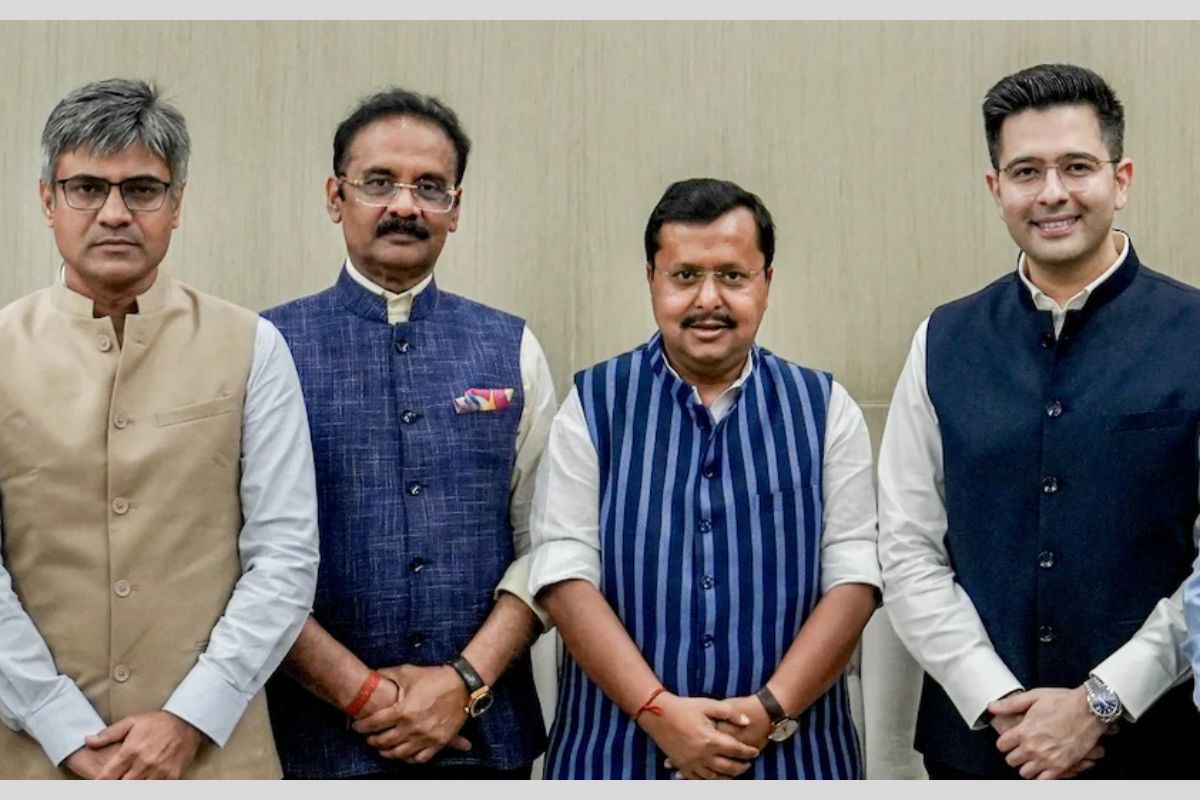
On April 24, 2026, seven Rajya Sabha MPs of the Aam Aadmi Party — Raghav Chadha, Sandeep Pathak, Ashok Mittal, Harbhajan Singh, Rajinder Gupta, Vikramjit Singh Sahney, and Swati Maliwal — announced their merger with the BJP. Six of the seven are from Punjab. Together they constitute two-thirds of the AAP’s Rajya Sabha legislature party. By the arithmetic of the Tenth Schedule of the Constitution, they violated no law. The anti-defection law’s merger exception protected them entirely. They keep their seats. The BJP gains seven Rajya Sabha members. The Punjabi voters whose MLAs sent these MPs to the Upper House are not consulted.
The episode has exposed — with unusual clarity — several overlapping crises in India’s constitutional and democratic architecture. Each deserves careful examination.
The Tenth Schedule and Its Internal Contradiction
The anti-defection law enacted in 1985 was a serious response to a serious problem. The horse-trading of the 1960s and 1970s — MLAs bought and sold, governments toppled by mercenary floor-crossing — had become a national embarrassment. The Tenth Schedule’s answer was to make defection costly: the individual legislator who crosses the floor loses the seat.
But the law contained a seam — Paragraph 4, the merger exception. If two-thirds of a legislature party agrees to merge with another party, no disqualification follows. The logic was defensible in 1985: a genuine ideological merger of a significant faction should not be treated identically to individual mercenary defection.
The AAP defections reveal how completely this logic has been inverted. As the Outlook India analysis notes with precision: a single legislator who votes her conscience against a party whip commits an offence grave enough to cost her seat. Seven legislators who walk out together, taking their seats with them, commit no offence at all. The lone dissenter is disqualified. The coordinated collective is licensed.
The threshold that was designed to identify genuine political realignment has become the operational manual for organised defection. Two-thirds is not a test of conviction. It is a threshold above which conviction becomes unnecessary.
The Rajya Sabha context makes this particularly troubling. The Tenth Schedule was designed primarily to protect the stability of elected governments — governments that depend on Lok Sabha confidence, not Rajya Sabha composition. The Rajya Sabha cannot move a no-confidence motion. It cannot topple a government. Its composition does not determine who is Prime Minister. And yet the anti-defection law applies equally to both houses — and the merger exception applies equally — despite the fundamentally different character of the two mandates.
The MLAs of Punjab who elected these seven MPs on the AAP’s symbol are not asked whether they endorse the merger. The voters who elected those MLAs are not consulted. The state whose electoral verdict sent AAP MPs to the Rajya Sabha will find itself represented, for the remainder of those terms, by the very party its voters had defeated at home. The arithmetic of two-thirds is the only question the Rajya Sabha Chairman must answer.
The Constitutional Silence on Political Parties
The deeper question your analysis raises is the one the Constitution itself has never answered: what is a political party?
The Constitution does not acknowledge political parties. The Representation of the People Act deals with them only through their participation in elections — the registration, the symbol, the candidate. The Tenth Schedule references the “legislature party” — the elected members — but not the organisation that nominated them, funded them, and built the political movement through which they reached office.
This creates the fundamental ambiguity at the centre of the defection question. When voters elect an AAP candidate, whom are they electing? The individual? The party organisation — Arvind Kejriwal, the national council, the workers who campaigned? The legislature party — the MPs and MLAs who hold elected positions? These are not the same entity. The Constitution offers no clear answer.
The question of who negotiated independence from the British illuminates the problem from its historical root. The Indian National Congress had no elected members when it negotiated the transfer of power. Jawaharlal Nehru joined the Viceroy’s council before the 1946 elections on the authority of the Congress as an organisation, not as an elected representative. The transfer of power was effectively to a party — its membership, its property, its institutional inheritance — not to an electorate or a legislature. The party preceded the democracy. The constitutional architecture of the democratic state was built on top of a pre-existing political organisation whose own internal structure the Constitution did not define or regulate.
Party membership has no legal cognizance in the Indian system. The primary members who build the organisation, canvas constituencies, fund campaigns, and provide the movement’s mass base have no enforceable rights within the system. There is no equivalent of the American primary through which the party’s base participates in candidate selection. The party’s elected legislators are legally recognised. The party’s millions of ordinary members are legally invisible.
This means that when someone challenges the party leadership — whether a faction of MPs claiming ideological divergence or a breakaway group claiming the party has deviated from its principles — the legal question of whom they are actually fighting is genuinely unclear. They are fighting an organisation whose legal personality the Constitution does not acknowledge, whose membership the law does not regulate, and whose relationship to the elected legislators it nominates the Tenth Schedule addresses only partially and contradictorily.
The party has members and property. When a member leaves, they are not shareholders who can liquidate a proportionate share. When a faction breaks away, the party’s assets do not automatically divide. The legal position of the rump and the splinter is determined by a combination of election commission recognition, court orders, and constitutional provisions that were designed for a different political era.
The AAP’s Specific Ideological Vulnerability
The defecting MPs claim the AAP has deviated from its principles, values, and core morals. Raghav Chadha said at his press conference that “the party has now completely deviated from its principles, values and core morals.” AAP says this is a cover for Operation Lotus — the BJP’s systematic use of investigation agencies and political pressure to engineer defections from opposition parties.
Both claims are probably partly true. But there is a structural dimension that goes beyond this specific episode.
The AAP was founded on the explicit claim of post-ideology politics. It presented itself not as a party with a coherent position on social order, economic models, foreign policy, or national interest — but as a vehicle for a specific idea of administration: responsive, corruption-free, delivery-oriented governance. This was its genuine innovation and its genuine appeal. It attracted support from across the traditional political spectrum because it promised competent administration rather than ideological commitment.
This post-ideological positioning is precisely what made it constitutionally and politically vulnerable to defection of this kind. A party with a coherent ideology — a party whose members share a substantive view of how India’s society should be organised, what economic model it should pursue, what foreign policy it should maintain — provides its members with a genuine reason to remain together even when individual circumstances make defection attractive. The ideology is the constraint on opportunism.
The AAP’s members were not bound by shared ideology. They were bound by shared association with a specific administrative project and a specific political movement. When that association became personally costly — when investigative agencies created legal pressure, when internal political dynamics diminished individual roles, when the party’s national prospects dimmed — the ideological glue that would have held a committed partisan to the party in adversity was not present.
Six of the seven defecting MPs are from Punjab. They were elected primarily because AAP’s Punjab government represented a genuine alternative to Congress and SAD in a state that was desperate for clean administration. Their association with AAP was always contingent on AAP’s effectiveness as a governing vehicle in Punjab. When that effectiveness came under pressure — from the BJP’s investigative agencies, from the party’s internal dynamics, from the blurring of the distinctive administrative project — their reasons to remain diminished faster than an ideologically committed party member’s would.
The AAP’s post-ideology politics created a party that was specifically unable to generate the loyalty that ideology provides — the loyalty that survives personal adversity because the member believes the party’s project is more important than his individual circumstances.
The BJP’s Calculation
The BJP’s interest in the defection is multiple and each element is worth examining.
The Rajya Sabha arithmetic is the most obvious. The BJP currently controls the Rajya Sabha through a combination of its own members, allied parties, and nominated members. Seven additional members strengthen this position and give the BJP greater command of the Upper House’s legislative business.
But the strategic calculation regarding AAP is more important than the arithmetic. AAP was a useful opposition from the BJP’s perspective when it functioned as a Congress replacement — drawing votes away from the BJP’s principal national rival. In the 2022 Punjab elections, AAP’s victory came substantially at Congress’s expense. In the 2024 Delhi elections, however, the BJP won Delhi back comprehensively, and AAP’s national project has not produced the Congress replacement the BJP might have hoped for.
AAP has now, from the BJP’s perspective, outlived its utility as a strategic asset. It is no longer reliably drawing votes from Congress at the national level. Its government in Punjab represents a genuine opposition administration in one of India’s significant states. The defection of its Rajya Sabha members weakens the party nationally, signals to its Punjab politicians and businessmen that association with AAP carries investigative risk, and potentially destabilises the Punjab government ahead of the next assembly elections.
The timing matters. Punjab’s next assembly elections will be a genuine contest. The defection of six Punjab MPs — including prominent businessmen and public figures who provided AAP with credibility and resources in the state — is designed to signal fragility before that contest begins.
The Punjab Puzzle
The Punjab dimension of this crisis is the most consequential and the most complex.
AAP won Punjab in 2022 on a wave of anti-incumbency against Congress and the weakened Shiromani Akali Dal, drawing support from across the traditional Sikh political spectrum including the radical vote that the independents who won Lok Sabha seats in 2024 reflect. After Amarinder Singh’s departure, the Congress has no figure capable of claiming the Panthic vote — the Sikh community’s specifically religious and political identity that has historically been organised through the Akali Dal.
The Akali Dal is a spent force. Its institutional and spiritual authority has been damaged by association with the BJP during the farm laws crisis — an association that produced the catastrophic Lok Sabha results. The two extremist independents who won Lok Sabha seats in 2024 reflect a radical Sikh vote that is now homeless — that cannot find a political home in any of the established parties and is expressing its frustration through candidates who represent Sikh grievance in its most assertive form.
The BJP has no natural locus in Punjab’s Panthic politics. Its Hindu nationalist cultural identity is precisely what the Sikh community’s political consciousness has historically defined itself against. The AAP defections do not solve this problem for the BJP. They weaken the party currently governing Punjab, which may create electoral opportunity, but the BJP cannot fill the political space that AAP’s weakening might create.
The Congress’s Punjab revival depends on finding a leader who can credibly claim the Panthic vote — who can speak to the Sikh community’s political identity without being captured by its most radical expression. No such figure has emerged. The Congress’s national leadership has not resolved the Punjab succession crisis that Amarinder Singh’s departure created.
This creates the possibility of genuine political fragmentation in Punjab — a state where the radical Sikh vote has no home, the Congress has no Panthic leader, the BJP has no Sikh identity, the Akali Dal is discredited, and the AAP is being systematically weakened by the BJP’s Operation Lotus. In this vacuum, the politics of grievance and identity assertion that the two 2024 Lok Sabha independents represent could expand — creating instability that serves neither democratic consolidation nor the region’s specific security requirements.
The Democratic Question
The AAP defections reveal the limits of the anti-defection law in its current form — limits that are structural rather than incidental.
The law was designed to protect the mandate that voters expressed through their votes. But it cannot answer the prior question: whose mandate? The voter who elected an AAP candidate in a Punjab constituency voted for a combination of the individual, the party organisation, the party’s governing record, and the political movement that the party represented. The Tenth Schedule attributes the mandate entirely to the party legislature party — and then provides an exception for two-thirds of that legislature party to transfer the mandate elsewhere.
The democratic question your analysis raises — whether parliamentary democracy can ever determine whether voters elected the individual or the party — cannot be resolved by the anti-defection law. It is a question about the nature of representative democracy in a party system that the Constitution addressed incompletely and that the anti-defection law addressed only partially.
What can be said clearly is this: the anti-defection law’s merger exception, as currently drafted, is more useful as an instrument of organised defection than as a protection against it. The threshold that was designed to identify genuine ideological merger has become the operational threshold for coordinated floor-crossing. The law that was designed to protect the integrity of electoral mandates has become the legal framework through which mandates are transferred.
The Outlook India analysis proposes a sensible amendment for Rajya Sabha specifically: require the assent of the state legislative assembly whose MLAs elected the defecting MPs, through a resolution passed by a majority of the assembly’s total membership. This would close the most obvious gap — the gap between the mandate that sent these MPs to the Rajya Sabha and the merger that transferred them to a different party — without abolishing the merger exception entirely.
The broader question — what is a party, who speaks for it, and how the democratic mandate should be allocated between the organisation and its elected representatives — cannot be resolved by a single amendment to the Tenth Schedule. It requires a more fundamental reckoning with the constitutional silence on political parties that India’s democracy has been built around since independence.
The democratic mandate cannot be held hostage to the tyranny of the unelected party high command — your formulation is correct. But neither can it be transferred by the coordinated action of two-thirds of a legislature party to a party that received no votes in the election that sent them to Parliament. Both represent failures of democratic accountability. The anti-defection law, as currently designed, prevents the first and enables the second.
That is the constitutional problem the AAP defections have made impossible to ignore.