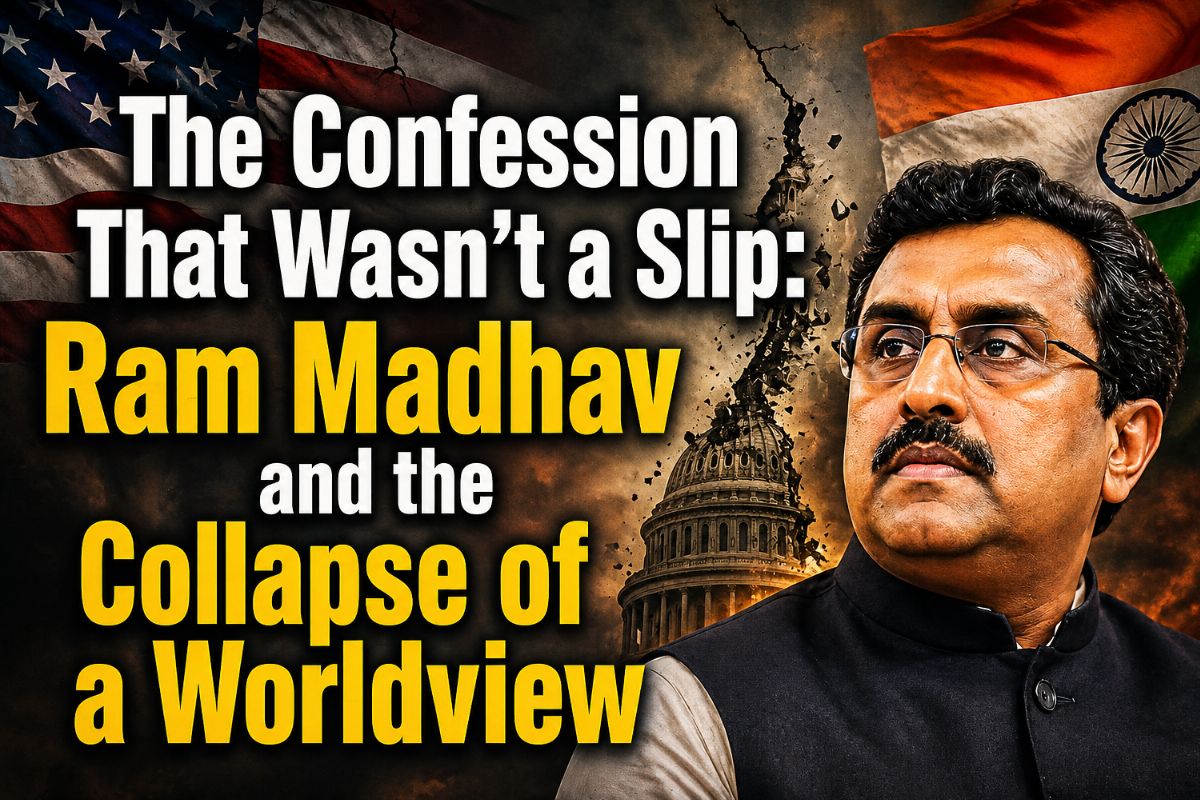
The remarkable “gaffe” by RSS leader Ram Madhav at the Hudson Institute last week—in which he listed India’s concessions to Washington on oil imports and tariffs, then frantically retracted his words—was treated as a political embarrassment. The Opposition pounced. The social media warriors scrambled. And within hours, the official narrative was restored: he misspoke.
He did not misspeak. He told the truth, and in that moment of unguarded honesty, he revealed something far more significant than a diplomatic indiscretion. He exposed the intellectual and moral bankruptcy of an entire strategic worldview. But more devastatingly, he revealed that the external anchor of that worldview—American global primacy—is itself crumbling. The RSS has not merely been let down by a patron. It has tethered itself to a collapsing empire.
The Caste Worldview and the Search for a Master
To grasp the depth of this crisis, one must understand the ideological architecture within which the RSS operates. It is a worldview that springs not from the Enlightenment tradition of individual rights and sovereign equality among nations, but from the deeply internalized hierarchies of the caste order.
In this framework, power is not negotiated among equals. It is arranged vertically. The formula is ancient and brutally simple: accept the domination of superiors and exert dominance over inferiors. This is not seen as subservience or tyranny, but as the natural, righteous flow of authority—a cosmic dharma that applies as much to nations as to communities.
This explains the instinctive, almost gravitational pull towards a patron-client relationship with the United States. The US is the successor to the British imperium, which was itself the successor to the Turkic and Mughal courts that Indian upper-caste elites served for centuries. The historical muscle memory is long. The US is not an ally to be engaged transactionally; it is the natural “senior” in a hierarchical order, the legitimate master whose dominance one internalizes in exchange for a free hand over one’s own subordinates.
The Israeli Model and Its Broken Promise
Into this hierarchical schema entered Israel—the ideal type, the successful “senior client” whose achievements the RSS dreams of emulating. Israel enjoys unconditional American patronage, total escalation dominance over its regional adversaries, and unchallenged internal consolidation of its ethno-state—precisely the trifecta the RSS seeks for India. The ideological analogy between Hindutva and Zionism, both ethno-geographic fusions of blood, soil, and sacred space, made the mentorship feel almost providential.
The intelligence relationship, with Mossad at its nodal point, became the primary diplomatic channel, bypassing a Foreign Service still suspected of carrying Congress-era non-alignment instincts. The transmission belt was meant to run seamlessly: RSS ideology would deliver India’s strategic submission to the US, with Israeli mentorship smoothing the path, and the reward would be regional dominance and internal consolidation.
Ram Madhav’s confession is the sound of this entire structure collapsing.
The Patron That Cannot Patronize
Here is where the strategic tragedy deepens into farce. The entire RSS edifice was premised on a patron that was powerful, stable, and willing to reward faithful clients. That America no longer exists.
The United States is an empire in visible, perhaps terminal, decline. Its deindustrialization has hollowed out the productive base that once underwrote its military and economic dominance. Its defence commitments now exceed its actual capabilities, forcing humiliating prioritization exercises between Europe, the Middle East, and the Indo-Pacific. Its political system oscillates wildly between isolationist retrenchment and overstretched intervention, unable to sustain either course coherently. Its debt burden—the silent engine of its consumption—grows by the trillions without any credible path to stabilization.
This is not a temporary downturn. It is a structural contraction of imperial capacity. The America that built the post-war order, that could credibly offer security guarantees and market access in exchange for strategic alignment, is being replaced by something far more volatile: a wounded, inward-turning power that lashes out at friends and foes alike, seeking to extract maximum short-term tribute while offering minimum long-term commitment.
This is the context Trump represents. He is not an aberration from American empire. He is its symptom—the political manifestation of an imperial center that can no longer afford the costs of hegemony but cannot psychologically accept its diminishment. Hence the tantrums, the tariffs, the “hellhole” insults. The client is not being rewarded for its loyalty; it is being shaken down for cash by an empire that has become a protection racket it can no longer afford to run.
The Worst of All Worlds
For the RSS, this is the worst possible outcome. It has made the substantive concessions of a client state—on oil imports, on trade, on strategic autonomy—to a patron that is now both abusive and incapable.
Israel can survive this moment because its relationship with the US is deep, institutionalized, and legislated into permanence by Congress. The RSS, for all its ideological mimicry, never achieved that. It bet instead on personal chemistry between Modi and Trump, a wager that has spectacularly backfired. The personal bond has given Trump a direct channel to extract concessions without any corresponding institutional commitment to India’s interests. The client is left exposed, having surrendered its negotiating leverage for a patron that treats it with public contempt.
Meanwhile, the multi-polar world that the RSS ideologically rejected—the world of BRICS, of non-aligned maneuver, of multi-vector foreign policy—is consolidating. Powers that preserved their strategic autonomy are now better positioned to navigate the American decline. India, having burned those bridges in its pursuit of a singular patron-client relationship, finds itself dangerously isolated.
The Inability to Calculate Interest
But the deepest flaw remains philosophical, and it is here that the absence of the individual citizen as the unit of political calculation exacts its final revenge.
A foreign policy rooted in the welfare of individual citizens could navigate this transition. It would ask: what serves the prosperity and security of actual Indians? It could diversify partnerships pragmatically, secure energy supplies from multiple sources, maintain trade relationships across geopolitical divides, and demand reciprocal respect as a nation of sovereign individuals.
The RSS cannot do this because it does not recognize the individual as a meaningful political unit. It calculates in civilizational abstractions—glory, prestige, the organic strength of the rashtra. These abstractions cannot be measured, cannot be traded, and cannot provide a stable compass. They led the strategic establishment to make massive, tangible concessions in exchange for an intangible metaphysical payoff that was never going to materialize.
The result is now on public display: a leadership that has given away concrete national assets for the promise of a respect that an empire in decline is structurally incapable of offering. The “gaffe” in Washington was not a slip of the tongue. It was a system of thought encountering the hard wall of reality and cracking open. The humiliation is not temporary turbulence. It is the logical destination of a worldview that tethered itself to a dying hegemon while refusing to take its own citizens seriously as the true bearers of national interest.
The cracks that appeared at the Hudson Institute will not be papered over by diplomatic denials. They will widen, because the patron is collapsing, the client has no other plan, and the intellectual framework that guided them both into this cul-de-sac offers no exit.