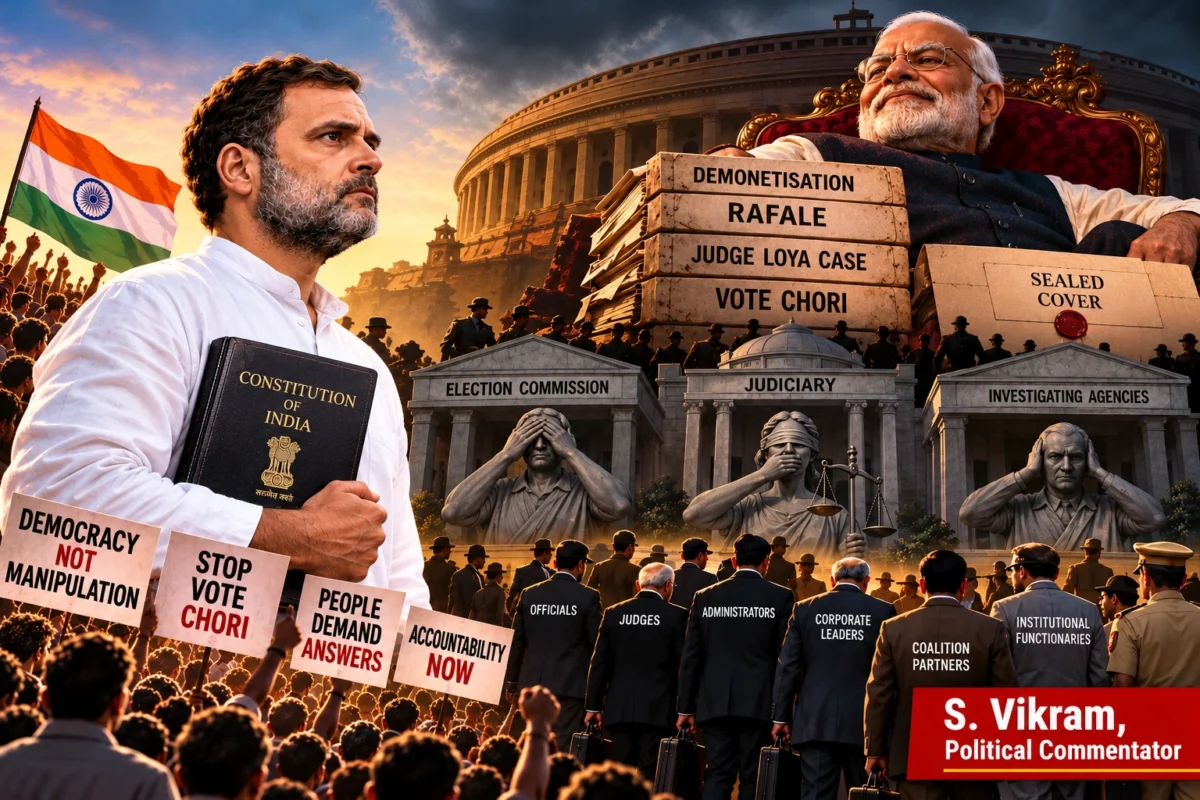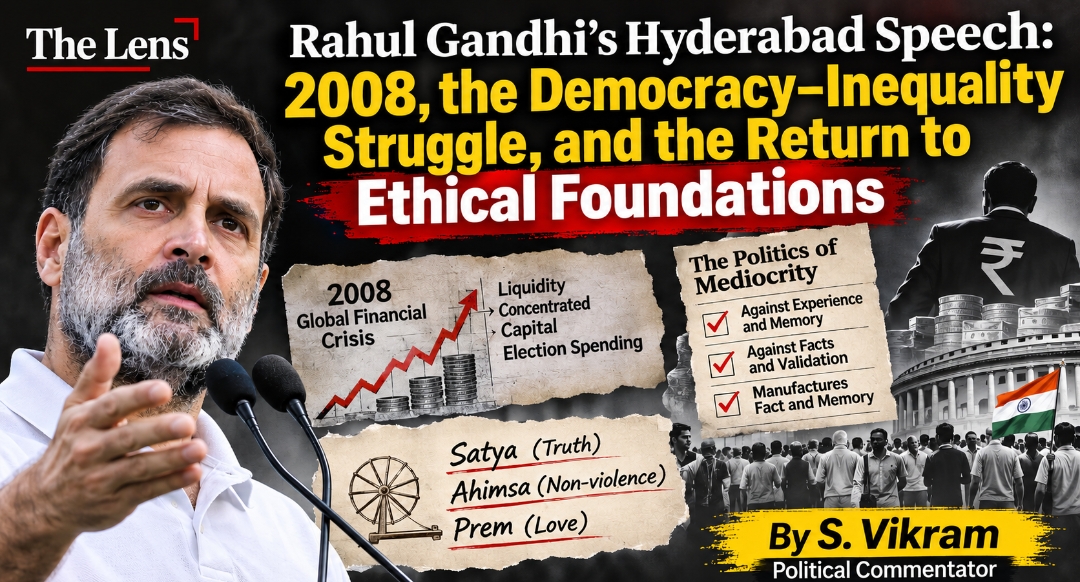
In his valedictory address at the Bharat Summit in Hyderabad on 14 November 2026, Rahul Gandhi presented a sweeping account of the last decade and a half of Indian politics. The 2008 global financial crisis, he argued, killed the economic model that had delivered growth to cities such as Hyderabad and Bengaluru and flooded the political system with liquidity. The result was a “completely new election” in 2014, a prolonged shock for democratic forces, and the rise of what he termed fascist methods — the fusion of concentrated capital with political power. Conventional instruments failed. Only a return to the primary Gandhian sources — truth (satya), non-violence (ahimsa), and love — restored the capacity to fight. He concluded that this rediscovery has already decided the outcome.
This diagnosis sits inside a longer historical struggle between democracy and inequality.
The post-war settlement and its unravelling
After the Second World War, many democracies consciously used political power to constrain market-generated inequality. The Beveridge Report in Britain, the expansion of social insurance across Western Europe, progressive taxation, strong trade unions, and public investment in health and education formed part of an “embedded liberal” order. Democracy was expected not merely to reflect existing distributions of wealth but to reshape them in the direction of broader security and opportunity. For a generation this compact largely held: inequality fell or stabilised in much of the developed world, and democratic institutions retained legitimacy as instruments of social balance.
From the 1980s onward, and with particular force after 2008, the relationship reversed. Rising inequality began to feed back into the political system itself. Concentrated wealth sought to loosen the constraints that democracy had earlier placed upon it — through campaign finance, media ownership, regulatory capture, and the rewriting of rules governing elections and institutions. In Gandhi’s formulation, the post-2008 liquidity shock accelerated this process dramatically. Cheap money and inflated asset values enriched those already holding capital; where legal channels remained open, that capital flowed into politics on an unprecedented scale, seeking to “defang” democracy as a countervailing force.
Comparative evidence: liquidity, open channels, divergent outcomes
The transmission from economic shock to political distortion was not automatic. It depended on whether national rules allowed the new pool of money to enter elections freely.
India left the channel widest open. Estimated total election spending rose roughly six-fold between 2009 and 2024. Electoral Bonds and the effective removal of limits on corporate donations turned post-crisis liquidity into political dominance.
The United States saw a near-threefold rise in federal election spending after Citizens United (2010) opened the Super PAC route.
The United Kingdom recorded a more moderate increase under spending caps and the ban on paid political television advertising.
Brazil experienced a sharp surge in corporate money, followed by scandal (Lava Jato); after the 2015 Supreme Court ban on corporate donations, costs fell and the system shifted toward public funding.
France kept ceilings, public reimbursement and advertising bans in place throughout; candidate spending remained stable or declined.
The pattern is clear. Quantitative easing created a global pool of cheap money. Where the law left the electoral door open, costs and the influence of concentrated capital exploded. Where the law kept the door shut or later closed it, the same liquidity did not produce the same political capture. India’s experience sits at the extreme open-channel end of this spectrum.
Local manifestations and the South Indian shift
Gandhi linked the death of the pre-2008 growth model to a shift in South India’s political position. Hyderabad and Bengaluru continued to grow, but growth no longer bought the region independent leverage. After 2014, even when Karnataka and Telangana returned BJP MPs, those MPs were products of a centralised, capital-intensive machine rather than of regional political formations. Economic success persisted; political autonomy diminished. That is the concrete form the open-channel model took in the South.
Fascist methods and the decade of shock: the celebration of mediocrity
Gandhi’s definition of fascists in Hyderabad was behavioural: those who “know it all,” who shout and refuse to listen, and who emerge when systems collapse. But this is not just a temperament. It is, in the argument he has been building since 2023, an ideology – the ideology of celebrating mediocrity and denying excellence.
He had named it on his US tour of May-June 2023 – at Santa Clara, then at Stanford, then at the Harvard Club in New York. There he said of the ruling group:
“There’s a group of people who understand everything. They can explain science to scientists, history to historians, warfare to the Army, and at the heart of it is mediocrity, they actually don’t understand anything.”
“I think if you sat Modi ji down next to God, he would start explaining to God how the universe works, and God would get confused about what I have created.”
“Because in life you cannot understand anything if you don’t listen.”
That last sentence is the bridge: 2023: mediocrity = doesn’t listen. 2026 Hyderabad: fascists = shout, scream, don’t listen. Same diagnosis, three years apart.
Mediocrity, in this reading, is not a failure to achieve. It is a political project. It offers refuge to those who fear comparison, who fear the discipline of learning, who fear being measured against a standard outside themselves.
And so it must do three things to survive:
- It must be against experience and memory.
Excellence is cumulative. It lives in institutions, in apprenticeship, in the memory of what has been tried and what has failed. A surgeon remembers a thousand operations. A historian remembers a thousand documents. A civil servant remembers a thousand files.
Mediocrity cannot compete on that ground. So it must declare experience itself suspect – “elitist,” “Lutyens,” “colonial,” “out of touch.” It must flatten memory, so that yesterday’s failure can be presented as today’s invention. This is why the same slogans return, the same promises return, the same enemies return. Without memory, there is no accountability.
- It must be against facts and validation.
Excellence requires validation – peer review, audit, election, examination, experiment. A fact is what survives being checked.
The celebration of mediocrity reverses this. If you cannot pass the test, you abolish the test. If you cannot win the argument, you shout over it. If the data contradicts you, you attack the data collector. This is the Hyderabad line made precise: “They shout, they scream, they don’t listen.” Listening is itself a form of validation. It admits that the other person might know something you do not. The fascist method cannot afford that admission.
- It must manufacture fact and memory.
Once real fact and real memory are delegitimised, a vacuum opens. It is filled with manufactured fact and manufactured memory – WhatsApp history, invented traditions, doctored videos, rewritten textbooks, a past that never was and a present that is not measured.
This is not lying in the ordinary sense. Ordinary lying still acknowledges the truth it is hiding. Manufacturing is dogmatic: it creates a closed world in which the leader’s word is the fact, and the party’s narrative is the memory. To question it is not to disagree, it is to betray.
This is why Gandhi calls it fascist, not merely authoritarian. Authoritarianism wants obedience. This wants epistemic surrender – surrender of your capacity to know, to remember, to judge excellence for yourself.
In politics, this ideology appears as the organised face of concentrated capital seizing the post-2008 opportunity. When money is abundant and institutions are hollowed, the mediocre do not need to become excellent. They need only to become loud, to become connected, and to become shameless. The fusion of business and state power, institutional pressure, legal cases against opponents, and what he presents as large-scale electoral-roll manipulation are not separate tactics. They are the same tactic applied at different levels: remove the independent standard by which you could be judged, and replace it with your own noise.
This is also why the decade of shock lasted so long. Traditional democratic forces kept trying to win on the old ground – better data, better argument, better experience. They brought facts to a fight against a movement that had decided facts were the enemy. They brought memory to a fight against a movement that had decided memory was elitist. They brought excellence to a fight against a movement that had made mediocrity its badge of authenticity.
The sequence is recognisable beyond India. After 2008, forces that combined nationalist mobilisation, impatience with institutional checks, close ties to concentrated wealth, and open contempt for expertise gained ground in many democracies. Labels differ – populist, illiberal, majoritarian – but the epistemic structure is the same: fear of excellence, celebration of mediocrity, hostility to validation, manufacture of an alternative past.
That is why the return to satya, ahimsa and love, which Gandhi proposes in the next section, is not merely moral. It is epistemic. Truth is the opposite of manufactured fact. Non-violence is the opposite of shouting down. Love is the opposite of the fear that makes mediocrity feel safe.
The return to basics as response
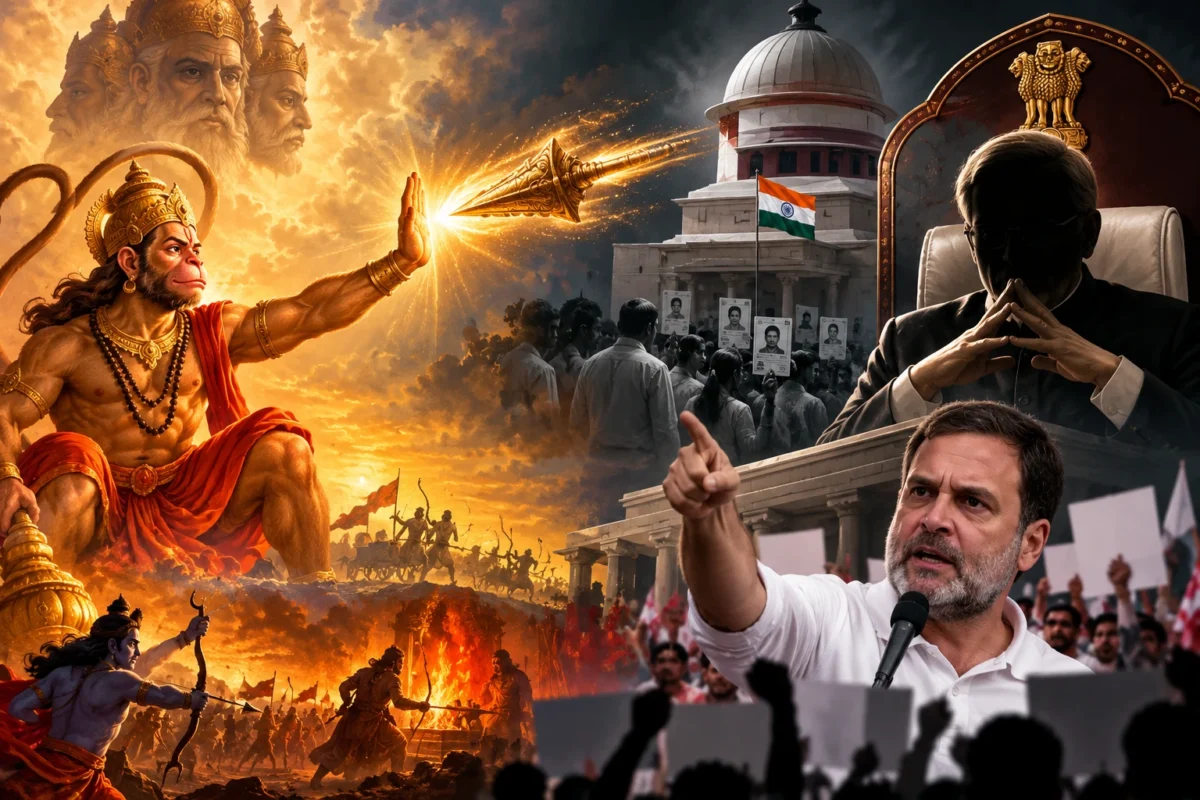
When dharna, picketing, media strategies and institutional remedies proved inadequate against this concentration of power, Gandhi argued that the opposition had to recover deeper resources. It turned to the primary sources that had originally armed the independence movement: truth and non-violence, practised through patient public presence and the language of love rather than reciprocal anger. The Bharat Jodo Yatra is offered as the practical embodiment of this shift. He asserted that the recovery has already succeeded: the defeat of the present regime is “a done deal,” visible on the streets and in the reported anxiety of those in power. The victors, he promised, will not humiliate the defeated.
Analytical close
The speech therefore situates the Indian experience inside the longer democracy–inequality struggle. Post-war democracies once used political power to compress inequality. In the post-2008 period, rising inequality has sought, with varying success, to capture or neutralise the democratic instruments that once constrained it. Comparative evidence shows that legal design matters enormously: open channels translated global liquidity into political distortion; closed channels limited the damage. Gandhi’s contribution is to diagnose India’s open-channel extreme, to name the resulting political style as fascist, and to propose a return to ethical first principles as the only remaining durable counter. Whether truth, non-violence and love can reverse the structural concentrations the speech identifies remains the practical test. The comparative and historical record at least explains why the diagnosis carries force.