The recent Reporters’ Collective investigation into ECI internal records from the 2024 elections in Maharashtra, Haryana, and Jammu & Kashmir has brought attention to mismatches between Form 17A (Register of Voters) figures and Form 17C / EVM-counted votes in 51 seats. In 19 of those seats, the internal records showed “0” or “nil” for voters who entered polling booths.Reporters-collective
Form 17A is the serial register in which polling staff record the name, EPIC number, and signature (or thumb impression) of each elector who is allowed to vote. Form 17C is the Account of Votes Recorded, prepared by the presiding officer at the close of poll; it captures the total votes recorded on the EVM control unit (and related details). Under the rules, these should broadly tally, with only limited, documented exceptions (for example, a voter who enters but declines to press the button under Rule 49-O, or cases under Rule 49-M). Returning officers are expected to scrutinise the forms the next day for signs of possible malpractice. Large or unexplained gaps, or blank/nil entries where numbers should appear, point to serious lapses in record-keeping, oversight, or duty. Whether the cause is clerical error, incomplete data entry into the aggregated constituency-level returns the Collective examined, or something more deliberate, the statutory paper trail that is supposed to protect the integrity of the count was compromised or left unverifiable in these cases. The ECI has pushed back, describing parts of the report as misleading and arguing that some figures appear to have confused total electors with votes polled; it stresses that Form 17C remains the operative statutory account shared with polling agents and that no post-poll complaints of Form 17C mismatches were received in the cited seats. The underlying documents and the absence of public booth-level 17C data still leave the discrepancies requiring transparent explanation.Dailypioneer
Two types of mismatch matter logically.
If the 17A figure is higher than the votes ultimately recorded on the EVM/17C, one theoretical explanation is that some electors entered, were registered in 17A, but did not cast a vote (by choice or mistake). In a functioning booth this should be immediately obvious: the ballot unit does not beep, the VVPAT does not print a slip, and the control unit remains in the “enabled” state until the next voter is processed. Presiding officers and polling agents present would notice both the refusal and the machine state. Enabling the machine for the next voter while the previous command is still active is not the normal sequence. Agents would also recognise the individual who declined. Large-scale occurrence of this without contemporaneous record or challenge strains ordinary procedure.
The reverse mismatch—17C / EVM count higher than the number of electors recorded as having entered the booth on 17A—is a logical impossibility under normal conditions. More votes cannot be recorded than the number of people who were identified, inked, entered in the register, and permitted to vote. That gap implies either votes were recorded without corresponding 17A entries (bogus voting during the poll) or the count later diverged from the sealed record. Form 17A is not a loose sheet; it is a hard-bound statutory register that travels with the other sealed documents into the strong room. It is not easily “misplaced.” Its absence or a nil entry therefore cannot be dismissed as routine paperwork loss.
These observations do not by themselves prove organised fraud in any specific seat. They do establish that the primary statutory cross-check failed or was not properly completed and audited in dozens of constituencies. The ECI’s own framework treats material mismatches as potential red flags requiring scrutiny; the collective’s review of the aggregated returning-officer returns indicates that scrutiny either did not occur or did not produce public explanation or corrective action such as re-polls.
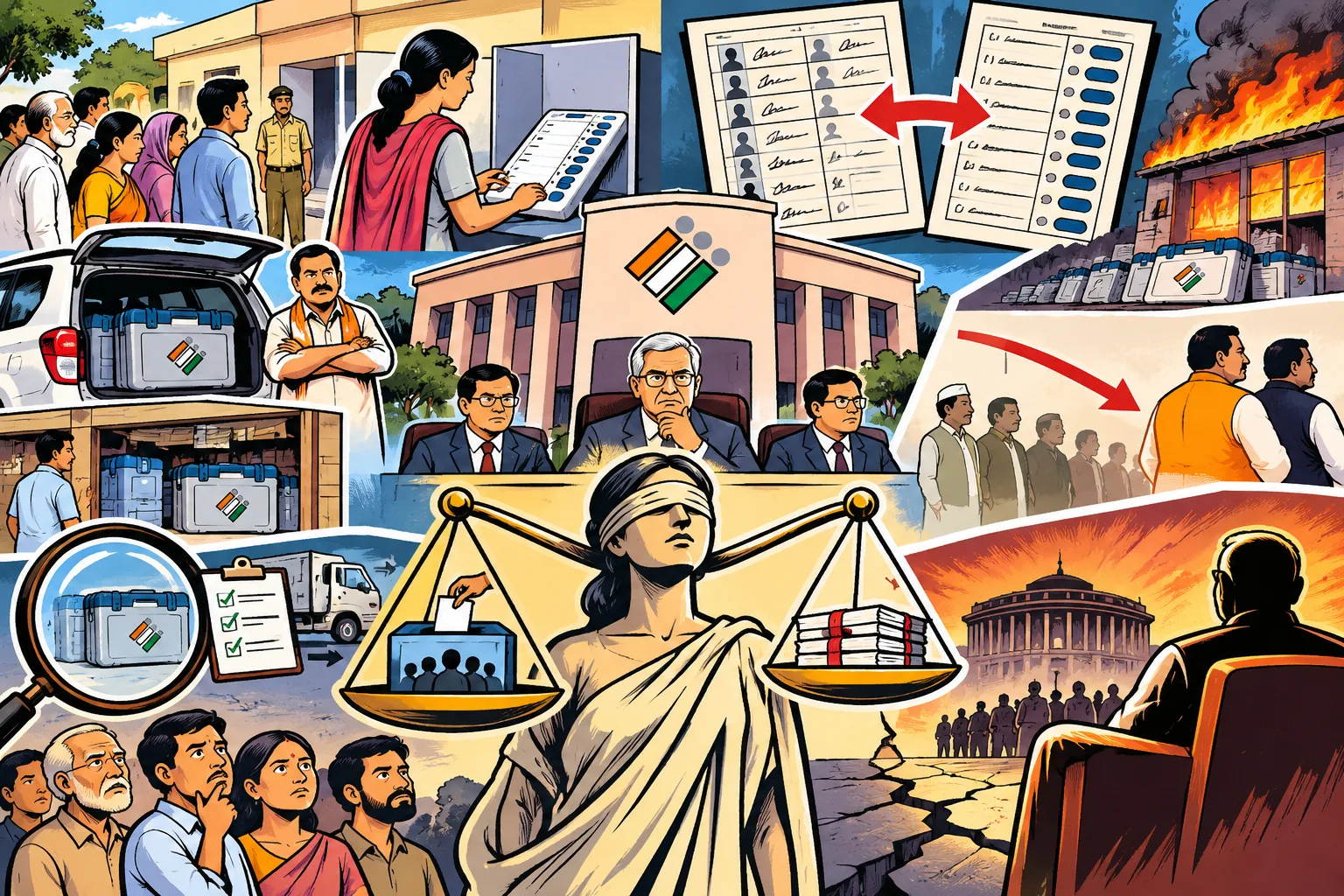
Electoral-integrity concerns have a longer history. Allegations of EVM manipulation gained political currency after the 2017 Uttar Pradesh assembly elections. The subsequent introduction of VVPAT added a paper trail but also technical complexity to the debate. Attention later shifted toward electoral-roll integrity, now institutionalised through the Special Intensive Revision process. Parallel to both strands is a more physical question that the current record gaps make harder to dismiss: the security and continuity of the sealed machines themselves between the close of poll and counting. An assembly constituency typically has hundreds of polling stations and therefore hundreds of Form 17C accounts. Counting agents are few; they observe from a distance, often across barriers. Reports of machines found with unauthorised persons, large numbers reported missing or damaged, and occasional fire incidents at storage locations have appeared after polling days in various elections. The possibility that a sealed unit could be substituted with another unit carrying a different set of votes is therefore not merely speculative; it is a risk that the physical and documentary chain of custody is meant to close. Weak or missing 17A/17C reconciliation weakens that chain.
A concrete illustration of how district-level logistics can create opacity appears in the 2023 Chhattisgarh assembly election in Balodabazar. The seat straddles areas linked to both Raipur and Balodabazar districts. EVMs are distributed through District Election Officers rather than solely through the Returning Officer. In that contest the Congress performance reportedly tracked the district pattern—weak in the Raipur-side booths (consistent with the broader Raipur district trend) and stronger in the Balodabazar-side booths (consistent with other seats in that district). Whether the outcome reflected genuine local preference or differential handling of machines and records from two separate district offices cannot be settled from aggregate results alone. The dual-district character simply makes independent verification of the full chain more difficult and therefore more necessary.
None of the above requires assigning partisan motive to every discrepancy. Clerical failure on the scale suggested by nil entries or multi-lakh gaps is itself a serious institutional failure. If the gaps are not clerical, the logical possibilities include suppression, inflation, or post-poll alteration of the recorded votes. In either case the remedy is the same: full public release of the underlying booth-level Form 17A and 17C data (or at least independent audit of the sealed originals), clear explanation of every material mismatch, and strengthening of the physical custody protocols that keep sealed EVMs and the accompanying statutory registers continuous from poll close to counting. Without that, the statutory safeguards that are supposed to make electronic voting trustworthy remain open to reasonable doubt.
The vote is the only inductive process in a constitutional democracy. It is the sole large-scale exercise of conscientious choice — the moment at which the system must correspond to something external to its own categories: the actual, dispersed will of the citizen body. Everything else — statutes, rules of procedure, the formal independence of the Election Commission, the elaborate architecture of Forms 17A and 17C — is deductive. These structures derive their meaning and authority from the primary act of choice. They possess coherence; the vote alone possesses correspondence.
When the institution charged with protecting that correspondence begins to prioritise its own procedural self-consistency over verifiable fidelity to the vote, it inverts the ethical order. That inversion is the definition of dysfunction. And institutional dysfunction does not remain local. It creates a vacuum. Into that vacuum power expands. Tyranny is the name we give to the resulting order — an ethical absurdity in which the forms of legitimacy continue while the only act that can confer legitimacy is rendered opaque or secondary.
This is the proper frame in which to read the findings of The Reporters’ Collective.
The record of mismatch
In the 2024 elections in Maharashtra, Haryana and Jammu & Kashmir, the Collective examined internal returning-officer reports covering 530 constituencies. In 51 seats the aggregated figures for voters who entered the booths (Form 17A) and votes counted on the EVMs (Form 17C) did not match. In 19 of those seats the internal records showed “0” or “nil” against the number of electors who walked in. In others the gaps ran into lakhs — Badkhal in Haryana, Mumbai North in Maharashtra, Kaithal, Srinagar among them. In several cases officials appear to have entered the total number of registered electors as the number of votes polled, producing an apparent 100 per cent turnout that the Commission’s own declared figures contradict.
These are not minor clerical variances. Form 17A is the bound statutory register of every identified elector permitted to vote. Form 17C is the statutory account of votes recorded. Under the rules the two must broadly reconcile. Material, unexplained divergence is meant to trigger scrutiny. When the aggregated internal records themselves contain nil entries or multi-lakh gaps, the primary cross-check that was supposed to guarantee correspondence between the physical act of voting and the recorded result has failed.
The Commission’s response has been to defend coherence: Form 17C is the operative statutory document; copies were given to polling agents; no formal post-poll complaints of mismatch were received in the cited seats; some of the large figures appear to confuse electors with votes polled. Each of these statements may be formally correct. None of them restores correspondence. They assert the integrity of the closed system of procedure. They do not demonstrate that the inductive act — the vote — was accurately captured and remains publicly verifiable.
The wider pattern of opacity
The same prioritisation of coherence over correspondence appears in the longer record of physical custody. EVMs have repeatedly been found in unauthorised vehicles (including, in one documented case, a sitting MLA’s car). Reserve machines have turned up in shops and private premises. Historical RTI discrepancies of nearly twenty lakh machines between manufacturers’ supply figures and the Commission’s acknowledged receipts have never been fully reconciled to public satisfaction. In June 2026 a fire in a Kolkata government building destroyed three to four thousand EVMs used in the recent West Bengal elections; the unusual pattern of the fire’s spread prompted an SIT and public questions about sabotage. Each episode is another instance in which the chain that is supposed to keep the physical record continuous with the inductive act becomes difficult to verify.
Parallel to these technical failures is a political consolidation: the electoral space occupied by independents and many smaller parties has steadily contracted. The residual vote has tended to flow toward the larger formations. Whether this is purely the result of strategic voting or is amplified by reduced confidence in the neutrality of the counting process cannot be settled from aggregate data alone. What is clear is that as the field narrows, the integrity of the remaining contest becomes more, not less, consequential.
The ethical inversion
An election commission is a referee. Its authority is not self-generated; it is conferred by the continued willingness of the principal contestants to accept its rulings as binding. When one major side concludes that the referee’s processes no longer reliably correspond to the actual vote, the institution has already failed the fundamental test. Continuing to answer scrutiny with technical self-defence does not repair the failure; it deepens it. It signals that the institution now regards its own procedural coherence as more important than the public’s ability to verify the inductive truth on which the entire system rests.
That is the ethical absurdity. Ethics requires conscientious choice. The vote is the only such exercise at scale. Every institution that derives from it must remain subordinate to it. When the guardian of the vote begins to treat the vote as secondary to its own rules, the derivative claims primacy over the source. The system continues to function in form while its ethical substance is hollowed out.
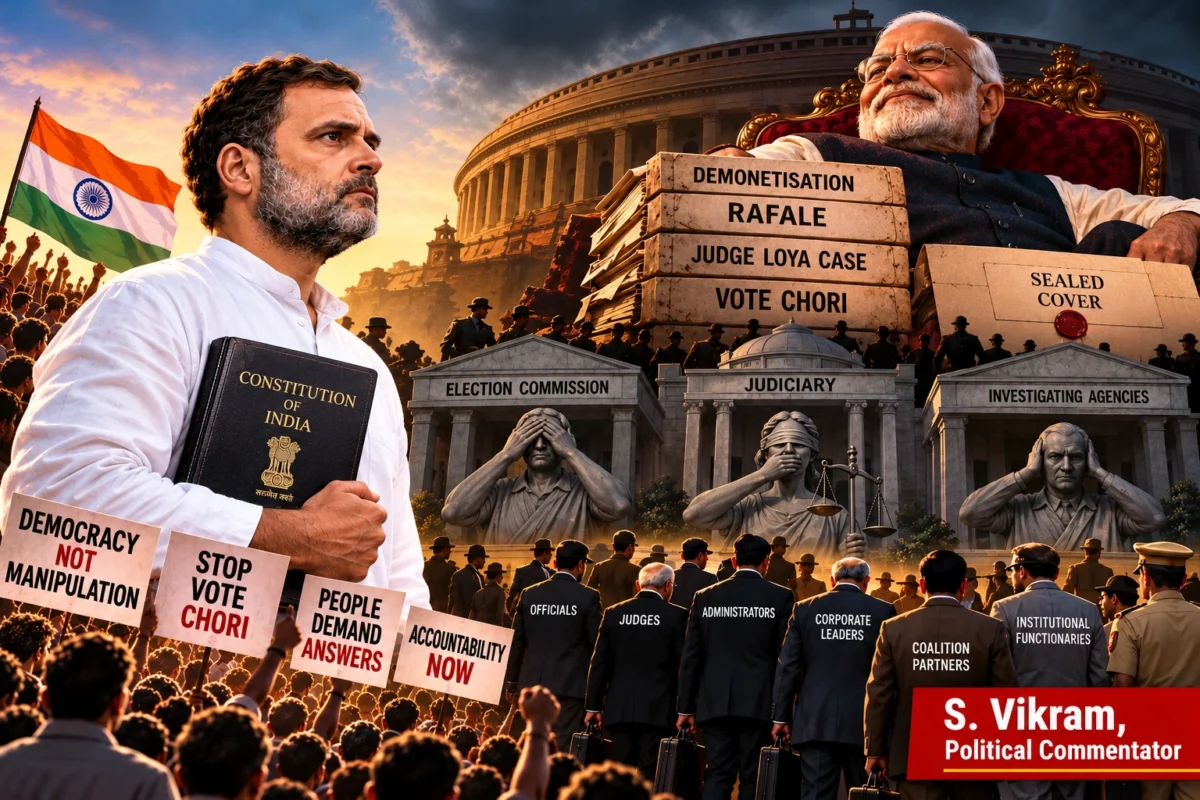
Dysfunction of this kind does not stay contained. It opens a vacuum. Into that vacuum the executive expands. What begins as institutional opacity ends as concentrated power no longer effectively constrained by an independent, trusted process of popular choice. Tyranny is simply the name of that endpoint — the worst form of anarchy because it wears the mask of order while destroying the only act that can make order legitimate.
The remedy is therefore not another layer of internal protocol. It is the restoration of correspondence: full public release or independent audit of the booth-level Form 17A and 17C records where material mismatches exist, continuous and verifiable chain-of-custody documentation, and a demonstrated willingness to treat every significant gap as a problem to be explained rather than a challenge to be dismissed. Only then can the inductive act regain the primacy that ethics and democracy both require.
Until that happens, the discrepancies documented by The Reporters’ Collective are not technical curiosities. They are symptoms of an institution that has begun to prefer coherence to correspondence — and of a system that is, to that extent, already living inside the ethical absurdity.