Somewhere in the space between a Red Fort speech and a Parliament House meeting room, the argument this essay wants to make was already made for it — twice, by two different men, neither of whom intended to make it.
The first was Narendra Modi, on the RSS’s centenary, calling it “the biggest NGO of the world.” The second was Kiren Rijiju, walking down a corridor to Rahul Gandhi’s office to seek support for a bill that, on its stated purpose, has nothing to do with either of them. Between those two moments sits the real subject of the Foreign Contribution (Regulation) Amendment Bill, 2026: not foreign money, not national security, not even religion in the end, but the question of who in India is still permitted to organise people outside the party system — and who gets to decide.
Three genealogies, one grave
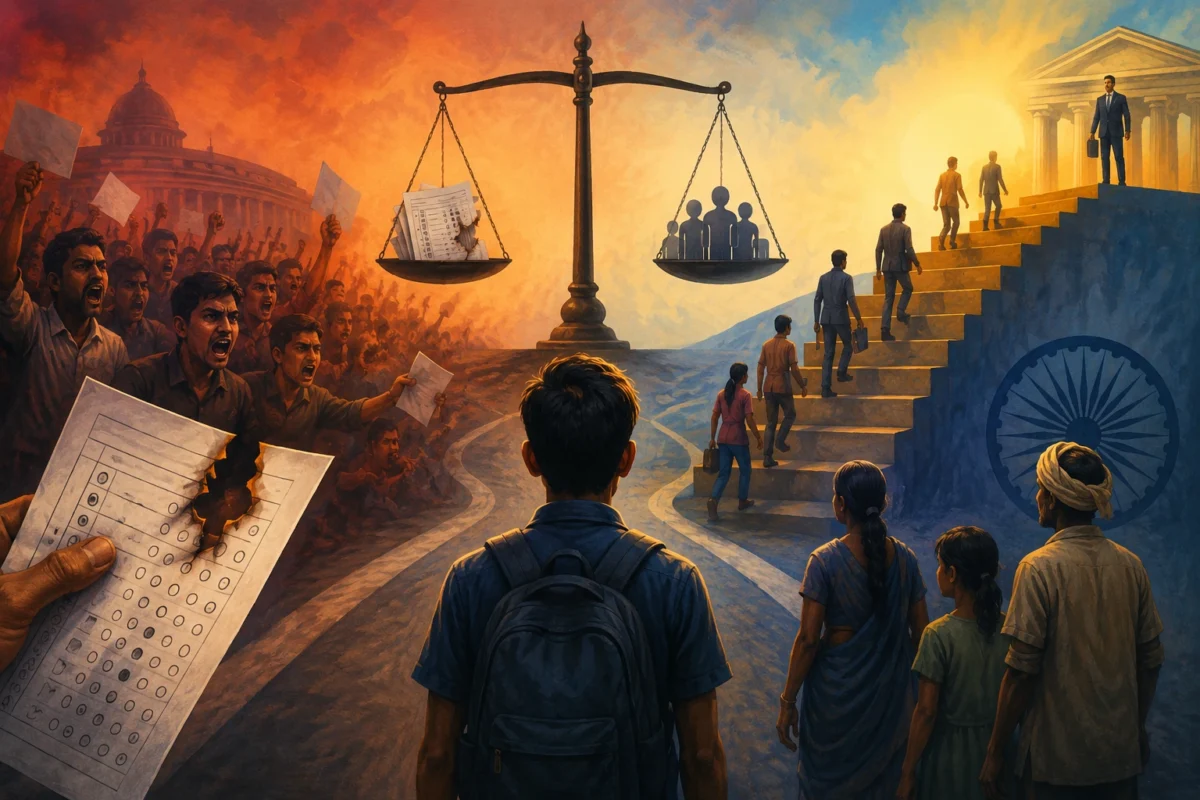
India’s civil society did not arrive as a single tradition. It arrived as three, largely unrelated to each other in origin, ideology, or intent.
The first is the oldest: Christian missionary patronage, dating to the Raj, which built hospitals, schools, and colleges in the gaps a colonial administration was too indifferent or too cash-strapped to fill. This was charity in the old sense — vertical, denominational, embedded in a theology of service — but it left behind a physical and institutional inheritance that still educates and heals millions of Indians who have never set foot in a church.
The second is the Gandhian wave: the constructive programme that came out of non-cooperation, the nationalist schools and colleges that sprang up as a rival to colonial education, Wardha’s long afterlife as a laboratory of voluntarist innovation. Its governing philosophy was that power and resources properly belong to the people, not the state — a claim that has quietly outlived Gandhi himself and shaped everything from the Bhoodan movement to the NGO sector’s self-image seventy years later. It is worth remembering that the RSS is the exact contemporary of this wave, born in 1925 into the same ferment, but constituted as its ideological opposite — cadre-based, hierarchical, and explicitly sceptical of the Congress-led national movement it grew up alongside.
The third is the youngest and the most foreign, in every sense: the development-industrial complex that arrived with the World Bank, the IMF, and foundations like Ford and Rockefeller, carrying a theory of modernisation and a neoliberal order that wanted implementation without the friction of domestic politics. In a capital-starved country, this money was not large by the standards of its source, but it was enormous by the standards of its destination — a village bonanza. NGOs mushroomed. The state itself eventually discovered that paying an NGO to run an awareness campaign was cheaper than maintaining a permanent bureaucracy to do the same job, and by the first decade of this century the Indian government had become the sector’s single largest funder, a relationship the UPA formalised and deepened through the National Advisory Council.
Three genealogies — missionary, Gandhian, technocratic — sharing almost nothing except the accident of needing a foreign remittance to survive. And it is exactly that accident, not any coherence of purpose or ideology, that the state eventually chose to regulate as though it were one thing.
The hinge: when help became threat
The moment this sector discovered its own collective weight was 2011: the aggregate credibility of decades of village-level presence, suddenly readable as a single force. The Narmada Bachao Andolan had already shown what organised opposition to a development project could look like; the formation of the National Alliance of People’s Movements gave it a coordinating shell. Anna Hazare’s anti-corruption mobilisation then drew on the accumulated public trust of that entire civil-society ecosystem and turned it, briefly, into something that could occupy Ramlila Maidan and shake a government. The same year, in the aftermath of Fukushima, a comparable civil-society mobilisation against the Kudankulam nuclear plant stalled a state infrastructure project outright.
That double demonstration — that this diffuse, foreign-funded, credibility-rich sector could move both political and industrial outcomes — produced the Intelligence Bureau’s 2012-13 report on NGOs “stalling development,” which named Kudankulam, POSCO, coal-block opposition and GM-crop resistance as costing the country two to three percentage points of GDP growth. It is difficult to overstate how much ideological work that report did. It gave the Indian state, for the first time, a coherent theory of civil society not as a delivery partner or a moral witness but as an obstacle to be neutralised — and it collapsed three genealogies that had nothing in common into a single administrative category: foreign-funded.
Everything that follows reads differently once you see the IB report as the hinge rather than the 2020 amendment or the 2026 bill. Ford Foundation’s FCRA clearance was revoked in 2015 over its funding to Teesta Setalvad’s organisations. Greenpeace India lost its registration the same year. The 2020 amendment banned sub-granting to smaller partners — quietly severing the funding chain that used to let Adivasi and Dalit grassroots groups access foreign money without needing their own FCRA licence — while adding a mandatory SBI Delhi account and an administrative-expense cap. None of this was aimed at any single genealogy. The Wardha lineage and the Ford Foundation lineage, opposed to each other in almost every respect, ended up regulated by the identical instrument, targeted alike.
The fourth chokepoint
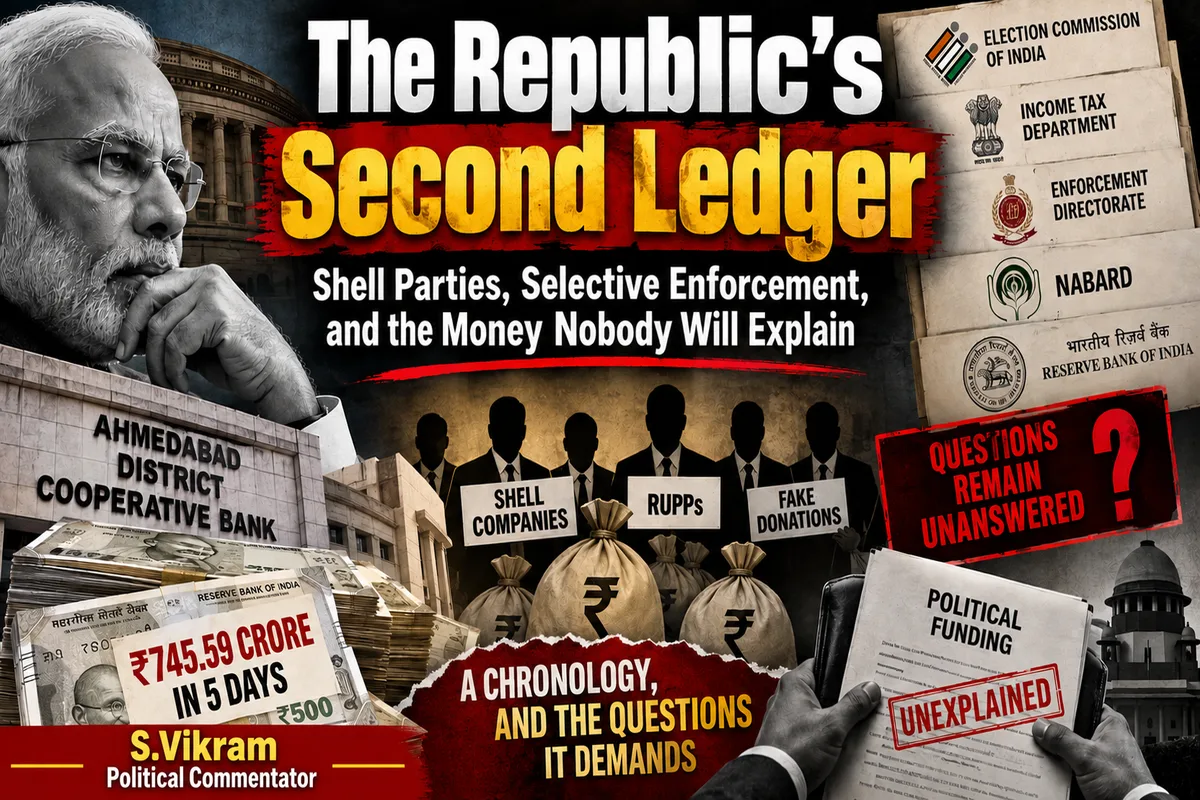
What makes the 2026 bill worth reading as a capstone rather than an isolated reform is what else happened in the decade around it. Demonetisation, in 2016, hit the cash-dependent machinery of political opposition and informal-sector mobilisation in a single stroke. Electoral bonds, introduced the following year and struck down by the Supreme Court only in 2024, let the ruling party capture the overwhelming share of disclosed corporate political funding while keeping the donor list opaque for the six years the anonymity actually mattered. Enforcement Directorate and Income Tax raids on opposition party accounts, timed with metronomic reliability around election season, did the rest of the work at the level of retail political competition.
FCRA is the missing fourth leg of that architecture — the one channel the domestic funding chokehold could never reach, because it ran through NGOs rather than parties, and because it was also the specific channel that had funded the one form of mobilisation — NAPM, Anna, Kudankulam — that had shown it could move people at scale without needing a party structure at all.
Each of these four instruments, taken alone, survives its official justification: a war on black money, a transparency reform for political funding, anti-corruption enforcement, a national-security clampdown on foreign interference. Stacked together and read against who they have actually disabled versus who they have left untouched, they resolve into something more legible: the sequential disarmament of every mode of organised opposition to the ruling order — electoral, financial, and grassroots — carried out under four different banners that never need to admit to each other’s existence.
The asymmetry that speaks for itself
This is where the RSS’s own organisational form matters, and where Modi’s own words do more argumentative work than anything a critic could construct. The Sangh’s affiliates run overwhelmingly on domestic, diffuse, small-donation and cadre-labour models — never exposed to any of the four chokepoints above, because none of them depend on the instruments those chokepoints target. Cash economy shocks, opaque bond instruments, agency raids, and FCRA scrutiny each individually survive a neutral-sounding justification. But a toolkit built to look procedurally neutral, applied to organisations with structurally different funding models, produces a result that is not neutral in the least.
And then the Prime Minister, from the ramparts of the Red Fort, on the Sangh’s own centenary, closed the argumentative loop himself: “In a way, the RSS is the biggest NGO of the world.” The Congress response at the time went straight to the point — where is the RSS’s own registration certificate, its own bank accounts, its own disclosure? The organisation being praised in the vocabulary of voluntary service has never once submitted to the disclosure architecture now being tightened, provision by provision, around everyone else operating in that same category. It is not necessary to argue that the state privileges one organisational form and treats every other as suspect. The Prime Minister said the equivalence out loud, from the highest platform in the country, at the precise moment his government was finishing the machinery to expel everyone else from the category he was claiming for the Sangh. The RSS gets the honorific without the burden. Everyone else gets the burden without the immunity.
The judiciary’s blessing
None of this narrowing has been an executive project alone, and it is worth being precise about that, because it changes what kind of claim can be made about it. On 8 April 2022, a three-judge bench led by Justice A.M. Khanwilkar delivered its judgment in Noel Harper v. Union of India, upholding the constitutionality of the 2020 FCRA amendment in almost its entirety — the ban on sub-granting to smaller partners, the mandatory SBI Delhi branch account, the reduction of the administrative-expense ceiling. The one partial concession was procedural rather than substantive: the Court read down the mandatory-Aadhaar requirement to permit a passport as an alternative form of identification, leaving every structural restriction intact.
The reasoning matters more than the outcome. The Court held that there is no absolute fundamental right to receive foreign contributions, and that “foreign contribution can have material impact in the matter of socio-economic structure and polity of the country,” concluding that its inflow “ought to be at the minimum level, if not completely eschewed.” That is not a narrow holding about SBI account logistics. It is the judiciary adopting, in its own voice, the same conceptual premise as the 2012-13 Intelligence Bureau report — that foreign-funded civil society is presumptively a matter of national concern to be minimised rather than a legitimate mode of associational life to be protected — and elevating that premise into constitutional doctrine. Critics of the judgment, including constitutional scholars who tracked the case closely, have argued that the 132-page opinion largely reproduces the Union government’s own submissions rather than subjecting them to independent scrutiny on freedom-of-association, equality, and proportionality grounds — a judgment, in one formulation, that comforted the comfortable and afflicted the afflicted.
What this means for the 2026 bill is that its drafters are not writing on a blank constitutional slate, nor gambling on an untested doctrine. The Designated Authority provision, the retrospective asset-vesting scheme, the discriminatory pattern of cancellations and non-renewals — all of it can now be argued, with real judicial cover, as a permissible extension of a principle the Supreme Court has already endorsed: that Parliament may regulate foreign contribution as strictly as it wishes, because no one has a right to receive it in the first place. The narrowing of India’s civic space over the last decade has therefore acquired something the demonetisation shock and the electoral bonds scheme never had — not merely executive force, backed by a compliant parliamentary majority, but constitutional legitimacy, certified by the country’s highest court. That is a harder thing to reverse than a bill. A future government hostile to this architecture can repeal a statute with a parliamentary majority; unwinding Noel Harper requires either a differently persuaded bench or a constitutional amendment, both far heavier lifts. The chokehold, in other words, is not just legislated. It has been adjudicated.
What the 2026 bill actually does, and what it has already conceded
Stripped of rhetoric, the Foreign Contribution (Regulation) Amendment Bill, 2026, introduced in the Lok Sabha on 25 March, creates a Designated Authority empowered to take provisional charge of an organisation’s foreign-sourced funds and the assets built with them the moment its FCRA registration is cancelled, surrendered, or lapses without renewal. If registration is later restored, the assets return. If it is not restored within a prescribed window, the transfer becomes permanent.
The most severe version of this — retrospective application, meaning assets accumulated legally over decades could be swept up under a rule that did not exist when they were built — appears to have been walked back. Mizoram’s Chief Minister confirmed after meeting the Home Minister that the bill will not apply retrospectively. That is a real concession, and probably the correct one to register as a concession rather than dismiss, since it removes the single most catastrophic scenario: centuries-old missionary schools, hospitals, and colleges being swept into state control over funding decisions made under an entirely different legal regime. What appears to remain intact is the Designated Authority mechanism itself, applied prospectively — which still leaves the state holding a permanent, standing option to convert licence cancellation into asset seizure for any organisation going forward, missionary or otherwise, the moment this bill passes.
It is also worth registering, in fairness, that the bill’s defenders are not simply inventing a problem. When an FCRA registration lapses today, the assets built with that money genuinely do fall into a legal vacuum — no clear custodian, no clear disposition. The government’s account of what the bill fixes is not fictional. The dispute is not over whether a gap exists. It is over who benefits from closing it, and under what standard of even-handed enforcement — a standard that a decade of discriminatory cancellations, expirations, and Sangh-affiliated exemptions gives Indian civil society every reason to distrust in advance.
The Rijiju theatre
Parliamentary Affairs Minister Kiren Rijiju’s outreach to Rahul Gandhi in the first week of August — two meetings and two phone calls in ten days, alongside comparable outreach to Akhilesh Yadav and other opposition leaders — reads, on its face, like ordinary legislative management of a paralysed Monsoon Session in which five bills had already been passed without discussion. That reading is not wrong. But it does not need to be wrong for the second reading to also be true.
Whatever Congress decides, the government now has both outcomes covered. If Congress declines to support the bill — the likely outcome, since Gandhi has conditioned any support on an all-party meeting Rijiju has not agreed to convene — the government gets to attribute the impasse to Congress obstruction rather than to the bill’s own design, useful simultaneously to a domestic Hindutva constituency (“we tried to build consensus, they blocked it”) and to a Trump administration audience (“even the Christian-sympathetic opposition was consulted before we acted”). If some form of partial or abstaining support does eventually emerge, the retrospective climbdown becomes the alibi: we listened, we softened it, even the opposition came around. The outreach does not need to succeed to do its work. Its mere visibility, regardless of Rahul Gandhi’s actual answer, already produces the message the government needs on both fronts at once.
The American miscalculation
The confidence behind all of this rests on a specific, well-tested bet: that Washington’s religious-freedom apparatus is loud but toothless. It is not an unreasonable bet. USCIRF has recommended India for Country of Particular Concern designation for seven consecutive years, and the State Department has never once acted on it — under Trump’s first term, under Biden, and so far under Trump’s second. Modi himself was denied a US visa for a decade after 2002 and is now received as an honoured guest regardless. New Delhi’s standard response to each fresh USCIRF report — that it is “biased,” “motivated,” an “organisation of particular concern” in its own right — has worked, without cost, for the better part of a decade.
But this year’s version of the pressure is not the same shape as the ones the bet was calibrated against, and two things about it deserve more weight than Delhi appears to be giving them.
First, the USCIRF ask has sharpened considerably — for the first time naming the RSS directly and recommending targeted sanctions, including possible asset freezes and US entry bans on its members, alongside a call to halt arms sales altogether. That is a different order of provocation than an abstract CPC label nobody enforces; it names the organisation Modi just called the world’s largest NGO as a target for the kind of sanctions regime usually reserved for hostile foreign entities.
Second, and more consequentially, the actual centre of gravity on this issue inside the administration is not where Delhi’s institutional memory expects it to be. There is, at the moment, no filled Ambassador-at-Large for International Religious Freedom at the State Department — the position has sat vacant for the entirety of this term, prompting religious-freedom advocates themselves to describe US international religious-freedom policy as “a ship with no captain.” The domestic-facing White House Faith Office, led by Paula White-Cain, has no documented India-specific engagement; its mandate is federal grantmaking and anti-Christian-bias enforcement inside American agencies, not foreign persecution claims. In the vacuum that vacancy leaves, the loudest and most consequential American voices on this question are not institutional at all. They are a single-term Congressman, Riley Moore, calling the bill “a clear attack against Christians” and invoking St Thomas the Apostle’s arrival on the Malabar Coast — and, more significantly, the Vice President himself.
JD Vance is not a bystander on this axis. Months before the FCRA bill became a live controversy, he said publicly that he hoped his Hindu wife would eventually become Christian, and has separately declared America “a Christian nation” and religious liberty itself “a Christian concept” — a civilisational framing that is, structurally, the mirror image of the Hindu-nation argument the Sangh makes about India. Vance is not approaching this bill as a detached liberal objecting to majoritarian excess from the outside. He is a committed Christian nationalist watching a rival nationalism act on a religious minority he has already shown he thinks about in explicitly doctrinal, personal terms. That is a fundamentally different, and far less predictable, kind of pressure than a Congressman’s tweet or an unenforced CPC recommendation — and Vance’s proximity to power runs to 2028 and beyond, considerably longer than any single news cycle Delhi is currently managing around.
The commons, closing
Read end to end, the arc is not a series of unconnected controversies — a currency reform here, a funding-law amendment there, an intemperate Independence Day speech, a diplomatic spat with a junior Congressman. It is one project, executed in four instruments and over more than a decade, to ensure that the only large-scale, resourced, credible way to organise Indians outside the ruling party’s own structures is the ruling party’s own structures. Three genealogies of Indian civil society — the missionary, the Gandhian, the developmental — spent a century building an idea that Indians could hold real power and resources independent of the state. The FCRA Amendment Bill, 2026, whatever its final retrospective or prospective shape, is the instrument that closes the last door on that idea, dressed, as its predecessors were, in the entirely genuine language of transparency and national security. Whether an American Vice President’s personal theology turns out to be the one obstacle Delhi did not fully price in is, at this point, the only part of the story still being written.