Pezeshkian’s Ceasefire Gambit, the Mediators He Chose, and the Countries He Did Not
On March 11, 2026, as the war launched by the United States and Israel against Iran entered its thirteenth day and the Strait of Hormuz remained closed to commercial shipping for the ninth consecutive day, Iranian President Masoud Pezeshkian posted a single statement on X. He had spoken, he said, to the leaders of Russia and Pakistan. He reaffirmed Iran’s commitment to peace. The only way to end the war — “ignited by the Zionist regime and the US” — was through three conditions: the recognition of Iran’s legitimate rights, the payment of reparations, and firm international guarantees against future aggression.
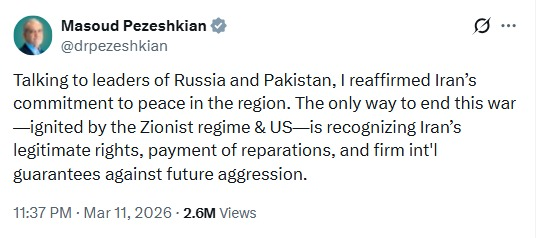
The statement was, on the surface, a ceasefire proposal. Read with greater attention, it is a piece of diplomatic craftsmanship of the first order — a document as significant for what it omits as for what it states, and as revealing in its choice of interlocutors as in its articulation of terms. Two names appear in the post. Two others — the ones one might most naturally have expected — do not. That absence is, in its own way, the most important thing the statement says.
The Art of the Possible: What Was Not Said
Pezeshkian’s three conditions represent a studied act of restraint. Iran entered this war — or more precisely, had this war thrust upon it — carrying a full deck of maximalist demands accumulated over decades: the recognition of Palestinian statehood, Israeli withdrawal from occupied territories including the Golan Heights and southern Lebanon, the lifting of sanctions that have strangled its economy since 1979, the acknowledgement of its nuclear programme as a legitimate civilian enterprise. Any one of these could have been placed on the table. None of them were.
Instead, Pezeshkian offered three formulations carefully calibrated to be broad without being empty. The first — recognition of Iran’s “legitimate rights” — is a phrase of deliberate elasticity. To the Carnegie Endowment for International Peace analysts who parsed it, it encompasses Iran’s claim to a peaceful nuclear programme and its regional influence through allied networks in Lebanon, Iraq, Syria, and Yemen. To an Iranian domestic audience, it is a comprehensive endorsement of the resistance narrative. To an international audience seeking a diplomatic opening, it is vague enough to permit negotiation. Every party can locate its own position within it without being explicitly invited to do so. This is not evasion. It is the grammar of serious diplomacy.
The second condition — reparations for the damage caused by US and Israeli strikes, which by Iran’s count have killed over 1,200 people and struck thousands of sites — is in some ways the boldest of the three. It frames the conflict as one of legal accountability rather than ideological confrontation. It invites the international community to calculate the cost of the damage and assign moral responsibility. It positions Iran not as a revolutionary state making demands on the existing order but as a victim seeking redress within that order — appealing to the universal language of liability and justice that resonates particularly in the Global South, which has its own long memory of unrecompensed damage inflicted by external powers.
The third condition — firm international guarantees against future aggression — is the most strategically sophisticated. Iran’s core fear, confirmed by Bloomberg citing unnamed Iranian officials, is not the current war but the next one. The main concern of the regime is a resumption of Israeli operations once a ceasefire holds. Tehran has now experienced two acts of external aggression during active nuclear negotiations — in June 2025 and again in February 2026. It is not willing to negotiate its way into a third. The demand for multilateral enforcement mechanisms, potentially through the UN Security Council, is a bid for integration into the international security architecture rather than permanent outlier status. It is, as the statement’s logic implies, the position of a state that wishes to be fully accommodated in the international community — not one seeking to dismantle it.
What gives the whole construction its diplomatic elegance is precisely what Pezeshkian chose to leave out. No demand for the “right of return.” No call for Israeli withdrawal from the Golan Heights or Lebanese territory. No explicit demand for sanctions relief, though it may be implicit in the first condition. No ultimatum on the nuclear programme by name. By stripping away the maximalist positions that have historically made Iranian proposals impossible for Western interlocutors to engage with, Pezeshkian has created a document that — for the first time since the war began — can be discussed.
The Mediators: Russia as Guarantor, Pakistan as Backchannel
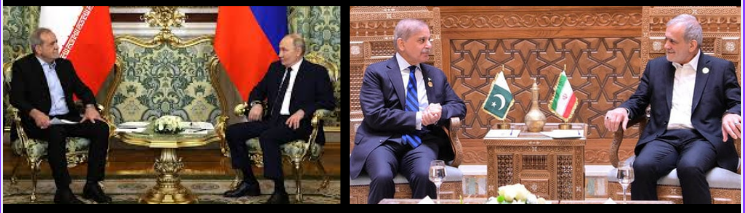
The choice of Russia and Pakistan as named interlocutors is not accidental and not symmetric. Each serves a distinct and carefully considered function in the diplomatic architecture Pezeshkian is assembling.
Russia is the regional guarantor. It is Iran’s Caspian neighbour, a country whose sphere of influence runs from the Black Sea through Syria, where it maintains active military bases, to the Persian Gulf’s periphery. Russia has working relationships with Israel — it has historically maintained channels with Netanyahu — and, through Turkey, with the broader NATO architecture. It has raised ceasefire options in calls with both Trump and Pezeshkian since the war began, and raised the issue explicitly in a Putin-Trump phone call on March 11, the same day Pezeshkian posted his statement. Russia’s interest is layered: it wants enough de-escalation to maintain its own regional influence, and it has already profited materially from the Hormuz closure, with Brent crude surging past $100 per barrel and Russian oil exports filling the gap left by disrupted Gulf supplies. It can talk to all sides. It has reasons to want a managed outcome rather than a decisive one. As a potential security guarantor for a ceasefire agreement, it is the most credible available candidate.
Pakistan is the more counterintuitive choice and arguably the more important one. The Pakistani military has cultivated an ostentatiously close relationship with Donald Trump and his inner circle. Prime Minister Shehbaz Sharif described Trump as a “man of peace” after the India-Pakistan ceasefire of May 2025. Army Chief Asim Munir visited the White House. Pakistan nominated Trump for the Nobel Peace Prize — a gesture that subsequently became a domestic political liability as Pakistani protests erupted over the US-Israel strikes on Iran. Despite this domestic discomfort, Pakistan’s utility as a backchannel to Washington is precisely what makes it valuable to Tehran. By naming Pakistan as an interlocutor, Pezeshkian is acknowledging what any realistic assessment of the situation demands: that no lasting ceasefire is possible without American involvement, and that the formal channels between Tehran and Washington are, for the moment, non-functional. Pakistan is the bridge across that gap. Islamabad has already been active: Foreign Minister Ishaq Dar told Iran directly that Pakistan has a defence agreement with Saudi Arabia, and helped facilitate assurances that Saudi territory would not be used as a launchpad for strikes — a diplomatic intervention that appears to have shaped Iranian targeting restraint toward Riyadh and Muscat.
The Diplomat reported that Pakistan had attempted mediation before the war began, and that its good-faith initiatives were brushed aside by Washington — leaving Islamabad with both the credibility of having tried and the frustration of having been ignored. That combination — access to both sides, genuine grievance against neither, and a demonstrated willingness to absorb diplomatic risk — makes Pakistan an unusually well-positioned interlocutor for precisely this moment.
The Conspicuous Absences: China and India
Two names do not appear in Pezeshkian’s post. Their absence is the most diplomatically eloquent part of the statement.
China’s exclusion is explicable on strategic grounds and reflects a calculation about what would make the proposal viable rather than what would make it structurally comprehensive. China is deeply invested in Iran — it purchases roughly ninety percent of Iran’s oil exports, giving it the leverage to compel Tehran to manage the Hormuz blockade selectively, which it has exercised, with Chinese-linked vessels enjoying effective safe passage while others are denied it. China has dispatched a special envoy to the region and Foreign Minister Wang Yi has called counterparts from seven countries. But including Beijing in a ceasefire proposal would have instantly transformed it, in American and Israeli eyes, from a humanitarian initiative into a geopolitical manoeuvre by the anti-Western bloc. It would have poisoned the possibility of US engagement before it began. Pezeshkian’s exclusion of China from the named mediators is not a signal of estrangement. It is a signal of seriousness — an acknowledgement that making the proposal workable for Washington requires keeping Beijing in the background even while it remains structurally essential to the Hormuz equation.
India’s absence is of a different and more painful character. It is not a strategic calculation by Pezeshkian. It is an assessment of India’s current diplomatic weight in this theatre — and the assessment is damning.
India had, until recently, cultivated exactly the kind of multi-aligned posture that would have made it a natural mediator in this conflict. It had strong ties with Iran through the Chabahar port project and as an energy customer. It maintained cordial relations with Israel and had deepened defence and technology partnerships with Tel Aviv. It had historically positioned itself as a voice of restraint in regional conflicts. Prime Minister Modi visited Israel on February 25-26, 2026, just two days before Operation Epic Fury began on February 28. That timing — a public embrace of Netanyahu on the eve of war — was not coincidental in Iranian eyes.
When the strikes came, India’s response was a study in miscalculated silence. The government failed to issue a prompt condolence for the death of Supreme Leader Khamenei. Foreign Secretary Vikram Misri visited the Iranian Embassy to sign the condolence book on March 5 — a week after the killing, and only after the diplomatic cost of the delay had become apparent. A senior BJP leader made a similar visit. Coming as late as they did, The Diplomat observed, these gestures looked less like confident diplomatic signals and more like damage control.
The consequences have been immediate and material. India imports roughly half its crude oil through the Strait of Hormuz. Over ten million Indian citizens work in Gulf states. India’s fertiliser tenders in March went unawarded because cargo ships refused to transit the strait. On March 11 — the same day Pezeshkian posted his ceasefire conditions — External Affairs Minister Jaishankar had to place a phone call to Iranian Foreign Minister Araghchi to negotiate a specific transit waiver for Indian vessels. The Free Press Journal reported the outcome with sharp precision: India had secured a “diplomatic permission” to use a waterway it had long championed as part of the international commons. As one analysis put it, the country that habitually invokes its right to free navigation in international waters was now requesting a pass from the country blockading them. China, by contrast, had effectively become the de facto custodian of Hormuz passage, its vessels accorded Tier One status by the IRGC in recognition of Beijing’s financial centrality to the Iranian war effort.
Iran’s official response to India’s pro-Israel tilt was unambiguous. An Iranian official was quoted as saying India had made a “foolish miscalculation” by aligning with Netanyahu. At the Raisina Dialogue in New Delhi, Iran’s Deputy Foreign Minister Saeed Khatibzadeh did not come to reassure but to warn — accusing Washington of deception in the Geneva negotiations that preceded the war and framing the conflict in existential terms before an Indian audience. The message was delivered on Indian soil, at India’s own premier security forum, and India had no meaningful response to give. The country that spent years building a reputation as the voice of the Global South — as the indispensable balancing power between the Western and non-Western worlds — found itself unable to secure Hormuz transit for its own tankers and absent from the diplomatic architecture being assembled around the conflict it had failed to prevent or even clearly condemn.
The Rocky Road: Trump, the IRGC, and the Limits of the Proposal
The elegance of Pezeshkian’s diplomatic construction should not obscure the obstacles it faces. The most immediate is Trump himself. Within hours of Pezeshkian’s conciliatory message to Gulf neighbours earlier in the week — in which the Iranian president apologised for strikes and ordered the armed forces to stop targeting regional countries except where attacks originated from their territory — Trump posted on Truth Social that Iran had “surrendered” and threatened it would be hit “very hard” the same day. He has demanded unconditional surrender as the only acceptable outcome. Steve Witkoff, Trump’s envoy, when asked how the war would end, replied: “I don’t know.”
There is also a structural tension within Iran itself that Pezeshkian’s statement cannot fully resolve. Al Jazeera’s analyst Resul Serdar noted that the IRGC is now in full operational control, and that the President — constitutionally the second figure in the Islamic Republic, not the first — has limited influence over strategic military decisions. IRGC chief Ahmad Vahidi is described as one of the most radical commanders in the organisation’s history. When Pezeshkian ordered the armed forces to stop targeting neighbouring countries, the IRGC issued its own statement re-framing the order in ways that preserved its operational freedom. The ceasefire conditions Pezeshkian has articulated may represent the political leadership’s genuine position. Whether they represent the IRGC’s position is a different and unresolved question.
Foreign Minister Araghchi added a further complication earlier in the week, stating that Iran was not seeking a ceasefire and saw no reason to negotiate. He subsequently wrote that a “unique deal” had been lost after the intervention of what he called an “‘America Last’ cabal” — suggesting internal divisions within both the Iranian and American decision-making structures about whether any negotiated outcome is currently possible.
Judo Diplomacy and Its Meaning
Despite these obstacles, Pezeshkian’s March 11 statement marks a genuine inflection point. It is Tehran’s first shift from outright rejection of ceasefire talks to conditional engagement since the war began. It is the first formal ceasefire framework Iran has offered, replacing the fiery posture of the war’s opening days with a document that can be discussed, modified, and potentially built upon. It transforms the narrative from Iran as a state absorbing punishment to Iran as a state making claims within the framework of international law — claims about accountability, redress, and security that have broad resonance well beyond the immediate parties to the conflict.
The choice of Pakistan as a named interlocutor — a nuclear-armed Sunni state with a working relationship with Trump, a border with Iran, and the memory of having tried to prevent this war — is the move of a state thinking clearly about what kind of diplomatic architecture can actually produce results. The choice of Russia as the other named interlocutor reflects an accurate reading of who has the regional leverage, the multi-directional access, and the interest in a managed rather than maximalist outcome. The exclusion of China, whatever its costs to bilateral optics, reflects a sophisticated calculation about what the US needs to see in order to engage.
What does not appear in Pezeshkian’s post is, in the end, what the statement is most eloquently about. The absence of maximalist demands clears the space for negotiation. The absence of India marks where a major power stood when the moment came — and found, to its cost, that the years of building relationships had been squandered in a season of misalignment. The absence of China from the named mediators, paradoxical given Beijing’s actual structural power in the crisis, reflects Tehran’s understanding that a workable proposal must be framed for its most reluctant audience.
Three conditions. Two mediators. Two absences. In the geometry of that arrangement, the current state of the world’s diplomatic order is legible with unusual clarity.