The defining political question in India today may not be whether liberalism can defeat nationalism, or whether the opposition can dislodge the regime. It may be whether the political order can survive a contest in which the destruction of the opponent’s credibility becomes more important than the preservation of the conditions under which political opponents can coexist.
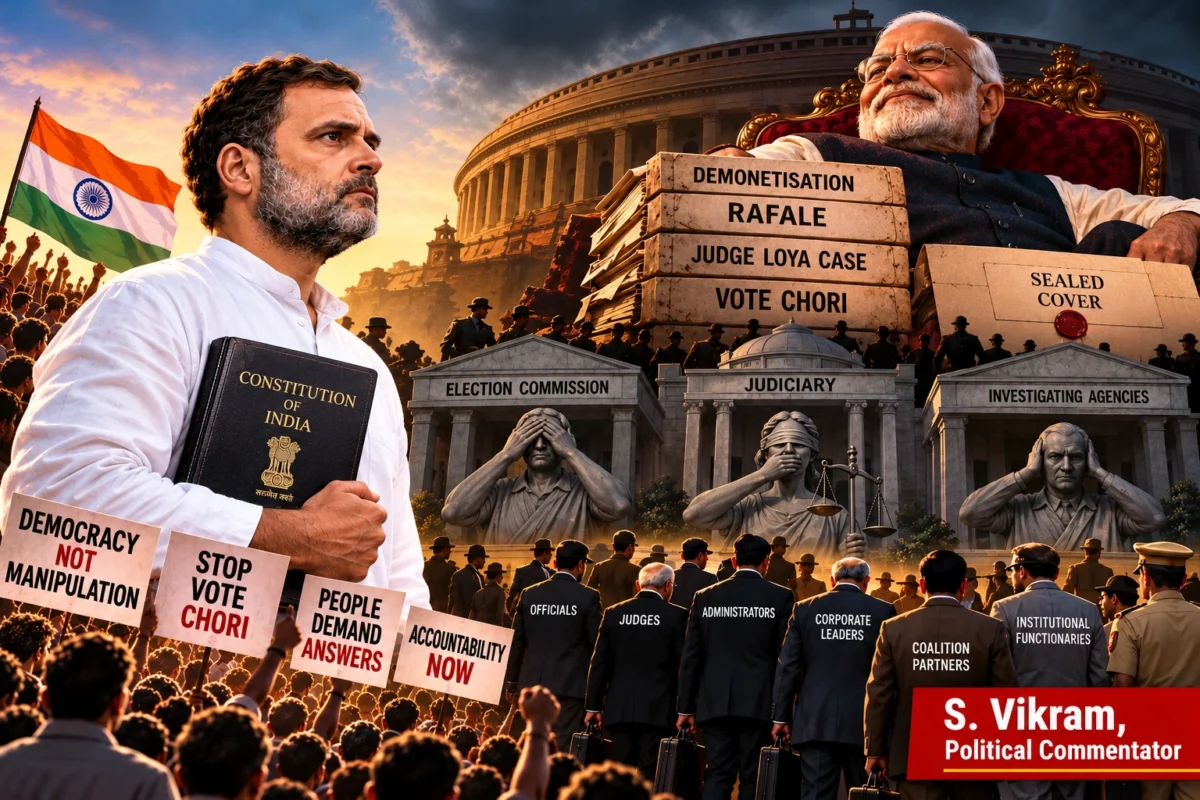
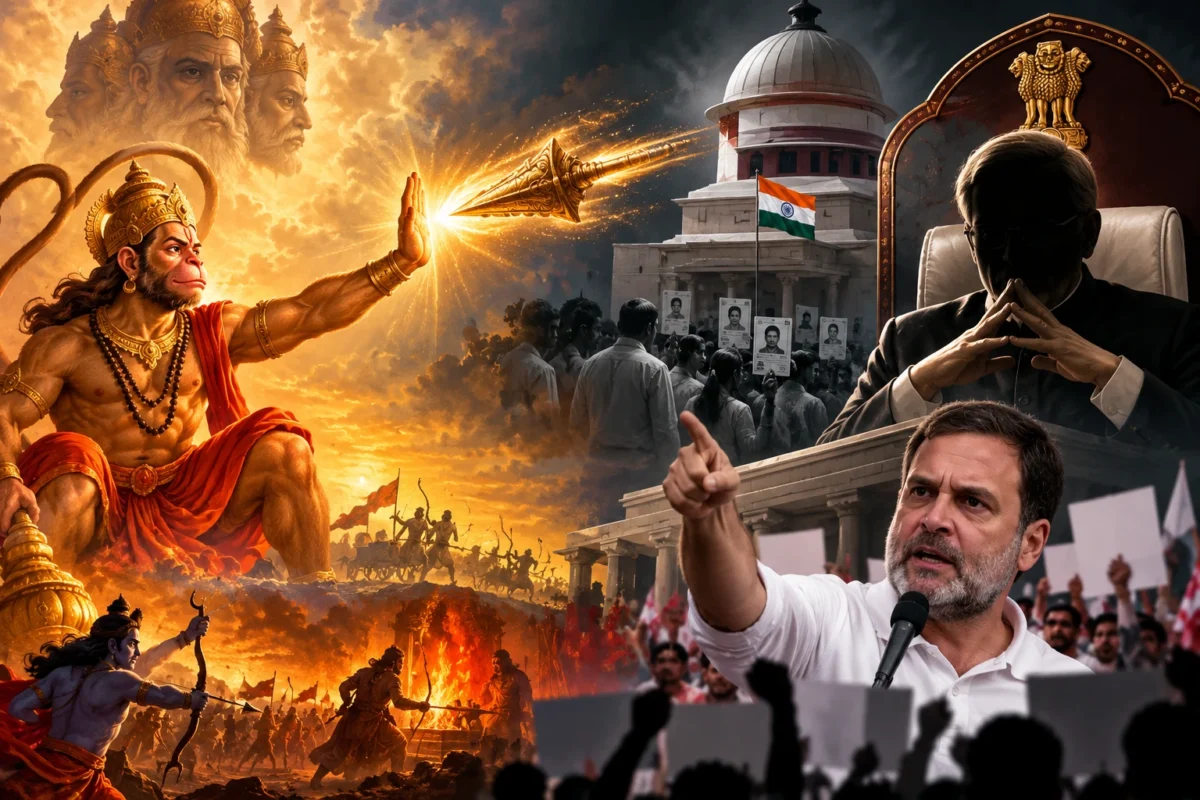
The renewed Gen Z agitation has brought this question into sharp focus. Protests over electoral-roll revisions and the conduct of the Election Commission have generated allegations of disenfranchisement and political manipulation, which the Election Commission and the ruling party dispute. The scale of the unrest and the force of the state response have made electoral accountability a question of wider democratic legitimacy.
It is against this background that the controversy surrounding Sharjeel Imam acquires its political significance. The argument here is not that his statements should be excused, or that the political ideas they express are beyond criticism. It is that the renewed controversy may be serving a purpose larger than the scrutiny of those statements: to redirect the political contest from the accountability of the regime to the ideological credentials of its opponents.
The distinction matters. A controversy may be genuine in its subject and politically instrumental in its use. The words may be real; the political urgency attached to them may nevertheless be selective. The question is not simply what Imam said, but why his statements become the test by which the liberalism, patriotism and political legitimacy of others are judged.
The hypothesis of deliberate political orchestration requires evidence. But the political function of the controversy can be examined even before its precise origins are established.
I. When the opponent becomes the instrument
Political brinkmanship ordinarily involves taking a contest to the edge in the hope that the other side will retreat first. Absolute brinkmanship goes further. It places the common ground itself at risk, making the opponent’s surrender more valuable than the preservation of the rules through which both sides might continue to compete.
The regime’s implicit challenge to the opposition is stark: you accuse us of dismantling the Constitution; let us see whether you are prepared to defend it when doing so becomes politically costly. Will you defend the rights of a person whose political ideas you reject? Will you acknowledge the illiberal possibilities within minority politics? Will you risk being identified with a figure whose statements can be presented as hostile to the nation? Or will you prove your patriotism by accepting the dominant definition of nationalism?
The challenge is effective because it contains a genuine problem. Imam’s political ideas must be examined on their merits. A liberal defence of constitutional rights cannot require silence about religious exclusivism, hostility to secular democracy or the subordination of individual liberty to collective religious identity. Yet criticism of these ideas cannot automatically be converted into a case for withdrawing constitutional protection.
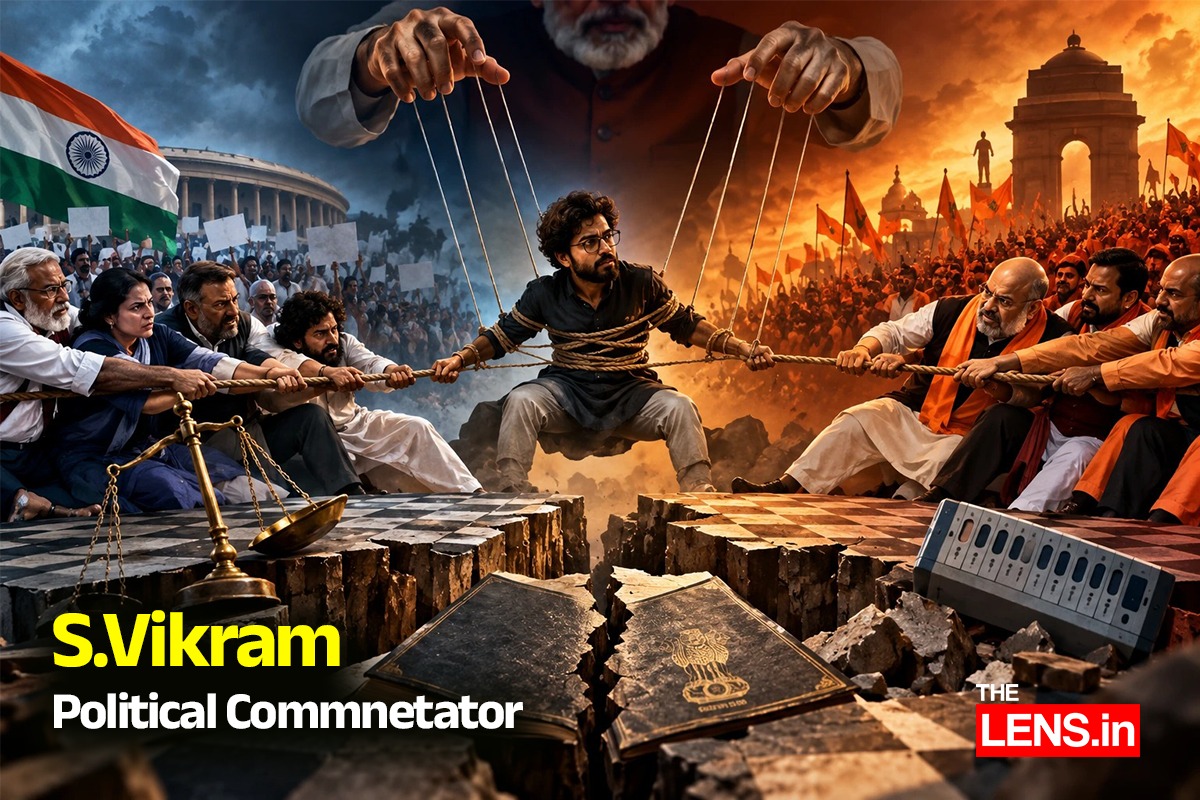
The political manoeuvre, as I understand it, lies in collapsing these distinctions. Imam becomes a pawn in a larger contest in which the opposition is compelled to demonstrate its nationalism before it can credibly oppose the regime.
The opposition is thus caught between two failures. If it defends constitutional rights, it risks being accused of defending Imam’s ideology. If it disowns him to escape that accusation, it risks accepting the premise that constitutional rights are conditional on the political acceptability of those who exercise them.
The regime does not need the opposition to endorse Imam. It needs the opposition to fight on ground where its constitutional commitments can be turned into political liabilities.
II. The prisoner’s dilemma and the destruction of shared interests
The deeper issue concerns the nature of political society itself.
Civilisation depends on the recognition of shared interests among people who disagree about fundamental questions. They need not share a religion, a historical memory, a conception of the good life or even a common understanding of the nation. They must, however, recognise that some interests cannot be secured by one side’s permanent domination of the other.
The prisoner’s dilemma provides a useful analogy. When each participant fears that the other will exploit cooperation, both may choose defensive strategies that leave them worse off. Political trust erodes, concessions become dangerous and the collectively beneficial outcome becomes harder to achieve.
But when brinkmanship is deliberately used to exploit an opponent’s restraint, the problem becomes more serious. Cooperation ceases to be merely difficult; it becomes a potential source of vulnerability. The actor who respects the rules may be disadvantaged precisely because the other actor does not feel equally constrained by them.
This is the logic of absolute brinkmanship. Constitutional restraint is represented as weakness. Compromise becomes capitulation. The willingness to preserve common institutions is treated as an opportunity to force further concessions.
The short-term gains can be considerable. A government may divide the opposition, consolidate its supporters and displace an inconvenient question of institutional accountability with a more emotionally charged dispute over national identity. Yet the long-term costs may be greater. The opposition loses confidence in the possibility of fair political competition. Citizens begin to regard institutions as instruments of factional power. Political actors become increasingly unwilling to accept defeat or extend legitimacy to their opponents.
The regime may win the immediate contest while weakening the common order on which its own future legitimacy depends.
This is why the problem cannot be described simply as polarisation. Polarisation is a condition of political life; absolute brinkmanship makes the erosion of common ground a means of political advantage.
And where there is malice—where the opponent’s commitment to restraint is knowingly exploited—an appeal to shared interests alone is inadequate. The answer must include the capacity to resist, impose political costs and defend institutional limits. Otherwise, the party that continues to cooperate unconditionally may help destroy the very order it hopes to preserve.
The difficulty is to resist without reproducing the same logic. Liberalism must be capable of defending itself without abandoning the principles that distinguish it from the politics it opposes.
III. The opposition cannot escape its own history
Yet the opposition has no easy escape. This is where the argument must turn inward.
The present crisis cannot be explained entirely by the conduct of the regime. The opposition also inherits the failures, silences and unresolved contradictions of the political settlement that preceded 2014. Its predicament is not simply that it is being forced to defend liberalism under unfavourable conditions. It is that it must defend liberalism while confronting questions it often preferred to postpone.
The chickens have come home to roost.
The Indian constitutional settlement was an extraordinary attempt to reconcile political democracy with social inequality, religious diversity and the competing claims of national identity. It established a framework of equal citizenship without resolving every conflict between community, individual and state. It offered constitutional protections without eliminating the social power that could make those protections difficult to exercise.
The Nehruvian project sought to hold India together through a composite national identity. It rejected the idea that the nation must be defined exclusively by religious belonging. Yet its vision could also become prescriptive: citizens were expected to recognise themselves in a synthesis of historical and cultural inheritances formulated by political leaders and intellectual elites.
The problem was not that composite nationalism was inherently mistaken. It was that the project could sometimes treat the question of Indian identity as if the correct synthesis had already been found, leaving insufficient room for those who rejected its terms.
Nor did the constitutional order resolve the contradictions between caste hierarchy and political equality, or between the rights of individuals and the authority claimed by religious communities. These tensions remained embedded in the political settlement.
A liberalism that now responds to the regime merely by invoking the Constitution as an accomplished achievement will be inadequate to the moment. It must acknowledge that the constitutional promise has always exceeded the social and political conditions in which it has operated.
It must also recognise that the opposition cannot defeat majoritarian nationalism simply by recovering an idealised past. The past contains resources for democratic renewal, but it also contains compromises, exclusions and unanswered questions.
The task is to defend the constitutional principles that remain indispensable while acknowledging the inadequacies of the political project through which they were historically expressed.
IV. 2014 as the watershed
The significance of 2014 lies not merely in the electoral victory of the BJP. It marks a watershed in the political struggle over the definition of India.
The post-independence settlement had never eliminated competing conceptions of the nation. Religious nationalism, caste-based political claims, regional identities and rival historical memories persisted beneath the official language of secularism and composite citizenship. But the dominant constitutional framework sought to prevent any one of these from becoming the exclusive criterion of national belonging.
After 2014, the balance of political legitimacy shifted decisively. A majoritarian account of national identity increasingly acquired the authority to determine which political claims were legitimate and which were suspect. Disagreement over history could be recast as hostility to the nation; criticism of the government could be presented as evidence of disloyalty; and the defence of minority rights could be subjected to a test of patriotic credentials.
This transformation did not emerge from nowhere. It drew on historical memories, social antagonisms and failures of political representation that earlier governments had not resolved. But 2014 altered the balance of power through which these conflicts were expressed.
The present controversy over Imam, viewed in this light, becomes more than an episode in the long-running argument over secularism and religious identity. It illustrates the predicament of an opposition whose constitutional principles are now judged against a conception of nationalism that has acquired greater political authority than before.
The opposition is invited to prove that it is nationalist enough to oppose the nationalists. The more it accepts this test, the more it concedes the terms of the contest.
But rejecting that test requires more than declarations of constitutional fidelity. It requires the opposition to explain why the Constitution must protect people whose ideas it rejects, why the state must not become the instrument of a particular religious identity, and why the legitimacy of political disagreement cannot depend on the approval of the majority.
It also requires a willingness to confront the illiberal elements within minority politics without allowing those elements to become a justification for majoritarian domination.
The opposition’s predicament is therefore both imposed and inherited. The regime can exploit unresolved contradictions, but it did not create all of them.
V. Partition and the questions that refuse to disappear
The unresolved questions of Indian nationalism cannot be understood without revisiting Partition.
Jinnah’s Fourteen Points of 1929, the two-nation theory, the Cabinet Mission Plan of 1946 and the constitutional anxieties of B.R. Ambedkar belong to a history in which the relationship between majority rule and minority security was never settled beyond dispute.
These histories must be treated carefully. Jinnah’s demands for constitutional safeguards and his eventual pursuit of Pakistan cannot be reduced to one unchanging political intention. The Cabinet Mission Plan attempted to preserve Indian unity through a weak centre and provincial groupings, and its failure involved complex conflicts over power, representation and the future structure of the state.
Ambedkar’s concerns about the political position of the Depressed Classes were also distinct from Jinnah’s claims for Muslim political representation. The Poona Pact of 1932, reached after Gandhi’s fast against separate electorates for the Depressed Classes, replaced the proposed separate electorates with reserved seats within joint electorates. Ambedkar’s subsequent criticisms show that the settlement did not eliminate his concerns about independent political representation.
Nevertheless, there is a family resemblance between the underlying anxieties: what happens when a group fears that its political future will depend on the goodwill of a more powerful majority?
The answers pursued by Jinnah and Ambedkar differed profoundly. Their concerns cannot be treated as interchangeable, still less as proof that Partition was inevitable. But the question they raise remains central to constitutional democracy: how can those who fear domination participate as equal citizens without being required to depend on the benevolence of those who dominate?
The constitutional answer must lie in enforceable rights, political representation, institutional safeguards and the continuing possibility of challenging the exercise of power. It cannot rest on the assumption that the majority will always be enlightened or tolerant.
Nor can history settle the question simply by providing one definitive narrative of national origins.
History can expose falsehoods, challenge myths and reveal the consequences of political choices. But historical evidence is not, by itself, an argument for belief. People inhabit history through collective memories, inherited injuries and stories about who they are. Such memories can be selective or imagined; their political force nevertheless persists.
One cannot simply hurl historical facts at people and expect their beliefs to disappear.
The challenge is not to compel everyone to accept a single historical memory. It is to prevent conflicting memories from becoming the basis of unequal citizenship.
VI. The limits of the Nehruvian answer
This brings us to a difficulty that liberals must confront honestly.
Nehru sought to understand India as a palimpsest of historical inheritances, a civilisation shaped by successive encounters rather than by one exclusive religious identity. This vision offered a powerful alternative to majoritarian nationalism. It understood India as a political and historical community whose unity could not be reduced to cultural uniformity.
Yet even this account could become a demand that people understand themselves as composite identities. The very idea of synthesis can impose a preferred way of belonging. A person may not experience their identity as composite, or may refuse to accept the terms through which a political elite describes the nation.
Constitutional pluralism must therefore go beyond prescribing the correct national identity, whether majoritarian or composite.
It must allow people to define themselves through singular, overlapping, changing or conflicting identities without making any one of these the condition of their citizenship. It must also protect the right to challenge inherited identities, including religious and cultural authorities within one’s own community.
The Constitution should not require agreement about the meaning of India. It should guarantee the conditions under which disagreement about India remains compatible with equal citizenship.
This is a more demanding conception of constitutionalism than either majoritarian nationalism or an idealised version of Nehruvian consensus. It asks citizens to share a political order without requiring them to share a single account of their collective past.
It also asks liberals to defend rights consistently, including when doing so brings them into conflict with their own political sympathies.
VII. The question that will not go away
The controversy surrounding Sharjeel Imam may eventually recede. The immediate political actors will change. New controversies will displace old ones. But the underlying question will remain: can India sustain a common political life without making a prescribed understanding of national identity the price of belonging?
If the controversy is being used to force the opposition to choose between liberalism and established nationalism, the temptation will be to escape through tactical silence, selective condemnation or an increasingly defensive patriotism. Such responses may offer short-term relief, but they will not resolve the dilemma.
The opposition must be able to criticise Imam’s ideas without surrendering his constitutional rights. It must be able to challenge majoritarian nationalism without treating every minority political claim as liberal. It must defend the Constitution without pretending that the history of Indian constitutionalism is free of contradictions.
Above all, it must recover the idea that the preservation of a common political order is a shared interest, not a concession one faction makes to another.
This is where the charge of absolute brinkmanship becomes most serious. If political advantage is pursued by making constitutional restraint costly, by exploiting the opponent’s commitments and by turning national belonging into a test of ideological conformity, the damage is not confined to the opposition. It reaches the foundations of political coexistence.
A nation is a longer-lived entity than the government of the day or the political generation that inherits it. Individuals may tire of difficult questions. Parties may prefer to postpone them. Intellectuals may seek refuge in reassuring narratives. But a question avoided is not a question answered. It returns, often under less favourable circumstances and in more destructive forms.
The crisis of Indian liberalism, therefore, is not simply that the regime is attacking the Constitution. It is that the defence of the Constitution now requires a confrontation with the unresolved questions of the national project itself.
The opposition cannot escape this reckoning. Nor can it meet it by proving that it is more nationalist than the nationalists. It must explain why the nation should remain a political community in which no single religious, cultural or historical identity possesses an exclusive claim to legitimacy.
That is the choice obscured by the controversy over Imam. The choice is not between Imam and India, or between minority rights and national loyalty. It is between a politics that treats the opponent’s defeat as more important than the preservation of common institutions and a constitutionalism that recognises the shared interest in keeping political disagreement survivable.
The chickens have come home to roost because the questions that the constitutional settlement could not resolve—and that subsequent political generations often preferred not to confront—have returned as instruments of political power.
2014 was the watershed because it changed the terms on which those questions could be asked and answered. What follows will depend on whether liberalism can confront its own silences without surrendering its principles, and whether the opposition can resist brinkmanship without reproducing it.
A civilisation does not survive because its people finally agree on their history. It survives because they continue to recognise one another as participants in a common life, even when they cannot agree on what that life means.
When that recognition is withdrawn, political victory may still be possible. What becomes uncertain is whether the political community itself can endure.